史鉴
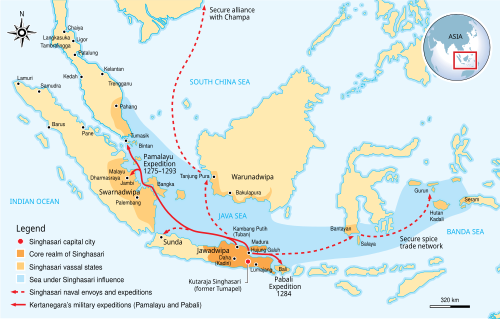
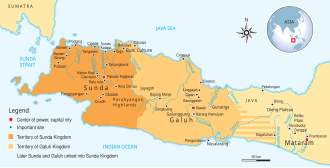
图:Gunawan Kartapranata · CC BY-SA 3.0 · 维基共享资源
- 存在时间
- 1222 年—1292 年
- 首都
- 玛琅
- 宗教
- 佛教、印度教、爪哇民间信仰
- 类型
- 王国、历史国家
- 简述
- 爪哇古国
信诃沙里(Singhasari)是于1222年及1292年间存在于东爪哇的一个王国,忽必烈遣使要求其归降,但被拒绝,最终被元朝海军所灭。
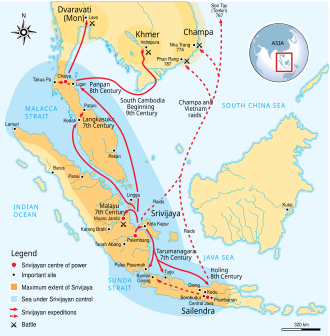
宋朝时,爪哇岛上有三个国家:西部的塔鲁纳国,中部的诃陵国,东部的东爪哇国。宋太宗淳化三年(992年),东爪哇国王穆罗茶(Dharmvamca)遣使朝贡宋朝。当时穆罗茶王已统一爪哇岛,势力扩展到巴厘岛、渤林邦、并和苏门答腊岛上的三佛齐国交战。但东爪哇-三佛齐战争结果,东爪哇国兵败,国王穆罗茶被杀。三佛齐势力扩展入爪哇岛。
十三世纪时信诃沙里国开始于爪哇岛上崛起。1290年,信诃沙里国王克塔纳伽拉将三佛齐逐出爪哇。信诃沙里国王克塔纳伽拉的女婿罗登·韦查耶创立强大的满者伯夷王朝,以满者伯夷城为首都(在今泗水西南)。随后信诃沙里国王克塔纳伽拉被叛将贾亚卡特望杀害。
1292年元至元二十九年,元世祖忽必烈派遣一千艘战舰组成的海军,从福建泉州渡海,登陆爪哇,联合信诃沙里王女婿克塔拉亚萨攻打信诃沙里国叛将贾亚卡特望,灭信诃沙里国。
满者伯夷国王罗登·韦查耶随后反戈,打退元军,统一爪哇。元史称满者伯夷为“麻偌巴歇”,是爪哇国的国都。
正文摘自中文维基百科「信诃沙里」(删去了参考文献、表格和图片),按 CC BY-SA 4.0 使用
英文维基百科的更多内容
中文维基百科这一条比较短,下面是英文维基百科同一条目的节选,原文为英文,未翻译。
Singhasari (Javanese: ꦏꦫꦠꦺꦴꦤ꧀ꦱꦶꦔ꧀ꦲꦱꦫꦶ, romanized: Karaton Singhasari or Karaton Singosari, Indonesian: Kerajaan Singasari), also known as Tumapel, was a Javanese Hindu-Buddhist kingdom located in east Java between 1222 and 1292. The kingdom succeeded the Kingdom of Kediri as the dominant kingdom in eastern Java. The kingdom's name is cognate to the Singosari district of Malang Regency, located several kilometres north of Malang City.
Etymology
Singhasari (alternate spelling: Singosari) was mentioned in several Javanese manuscripts, including Pararaton. According to tradition, the name was given by Ken Arok during the foundation of the new kingdom to replace its old name, Tumapel, located in a fertile highland valley which today corresponds to the area in and around Malang city. It derives from Sanskrit word singha which means "lion" and sari which in Old Javanese could mean either "essence" or "to sleep".……
Foundation
Singhasari was founded by Ken Arok (1182–1227/1247), whose story is a popular folktale in Central and East Java. Most of Ken Arok's life story and the early history of Singhasari were taken from the Pararaton account, which also incorporates some mythical aspects. Ken Arok was an orphan born of a mother named Ken Endok and an unknown father (some tales stated he was a son of the god Brahma) in the Kediri kingdom's territory.
Expansion
In the year 1275, King Kertanegara, the fifth ruler of Singhasari who had been reigning since 1268, launched a naval campaign northward towards the weak remains of the Srivijaya in response to continuous Ceylon pirate raids and Chola kingdom's invasion from India which conquered Srivijaya's Kedah in 1025. The strongest of these Malaya kingdoms was Jambi, which captured the Srivijaya capital in 1088, followed by the Dharmasraya Kingdom, and the Temasek Kingdom of Singapore.
Conflict with the Mongols
Singhasari, and its successor kingdom, Majapahit, were among the few kingdoms in Asia that were able to thwart an invasion by the Mongol horde by repelling a Mongol force in 1293. As the centre of the Malayan peninsula trade winds, the rising power, influence, and wealth of the Javanese Singhasari empire came to the attention of Kublai Khan of the Mongol Yuan dynasty based in China. Moreover, Singhasari had allied with Champa, another powerful state in the region.……
Fall of Singhasari
In 1292, Regent Jayakatwang, a vassal king from the Kingdom of Daha (also known as Kediri or Gelang-gelang), prepared his army to conquer Singhasari and kill its king if possible, assisted by Arya Viraraja, a regent from Sumenep on the island of Madura.
The Kediri (Gelang-gelang) army attacked Singhasari simultaneously from both north and south.……
The beginning of Majapahit empire
In early 1293, the Mongol naval forces arrived on the north coast of Java (near Tuban) and on the Brantas River mouth to flank what they thought was Singhasari. Raden Wijaya found the opportunity to use the unsuspecting Mongols to overthrow Jayakatwang.……
Rulers of Singhasari
- Ken Arok 1222–1227
- Anusapati 1227–1248
- Panji Tohjaya 1248
- Vishnuvardhana-Narasimhamurti 1248–1268
- Kertanegara 1268–1292
Contemporary inscriptions
Gondang inscription
The Gondang Inscription is an in-situ inscription dating back to the era of the Singhasari Kingdom which was more recently discovered in 2017 in the middle of rice fields within Rejoso Hamlet, Gondang Village, Gondang District, Mojokerto Regency, East Java. The inscription was founded by local residents and was written in the Old Javanese language bearing the date 1197 Saka or 1275 AD.
正文摘自英文维基百科(原文为英文,未翻译)「Singhasari」(节选,删去了参考文献、表格和图片),按 CC BY-SA 4.0 使用;在维基百科读全文 ›
同时期、同地区的政权