史鉴
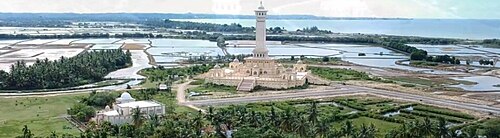
图:DISDIKBUD Aceh Utara · Public domain · 维基共享资源
- 存在时间
- 1267 年—1521 年
- 政体
- 君主制
- 宗教
- 伊斯兰教
- 货币
- 迪拉姆
- 后继
- 亚齐苏丹国
- 所属
- Muslim Southeast Asia
- 类型
- 岛屿国家、历史国家、群岛国家
- 简述
- former kingdom in northern Sumatra
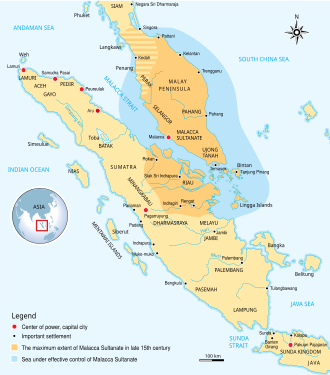
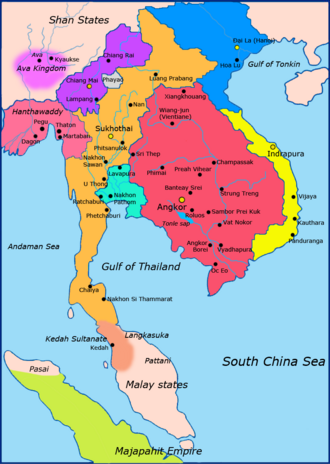
苏木都剌国是东南亚古国,故地在今印度尼西亚苏门答腊岛北部。“苏木都剌”为梵语Samudra的音译,意为“海洋”。苏木都剌国建国于13世纪后期。该国地处东西方交通要道,是当时阿拉伯、印度和中国进行贸易的重要地点。元至元十九年(1282年)遣使节到元朝与中国建立友好关系。1292年马可·波罗西行时曾经其地。伊本·白图泰在去中国的途中也曾在该地逗留。14世纪中期苏木都剌国臣服于麻喏巴歇国。15世纪初郑和下西洋曾三至其国。16世纪为亚齐苏丹国所灭。其名后来就用以称全岛。“苏木都剌”一名见于《元史·外国列传》,而《元史·武宗本纪》则译作“八昔”,《岭外代答》中称之为“波斯”(Pasai),《岛夷志略》中作“须文答腊”、“须文答剌”,《瀛涯胜览》中作“苏门答剌”,《明史·外国列传》中作“须文达那”。
正文摘自中文维基百科「苏木都剌国」(删去了参考文献、表格和图片),按 CC BY-SA 4.0 使用
英文维基百科的更多内容
中文维基百科这一条比较短,下面是英文维基百科同一条目的节选,原文为英文,未翻译。
The Samudera Pasai Sultanate (Malay: كسلطانن سامودرا ڤاساي), also known as Samudera or Pasai or Samudera Darussalam or Pacem, was a Muslim kingdom on the north coast of Sumatra from the 13th to the 16th centuries.
Little evidence has been left to allow for historical study of the kingdom. The kingdom was believed to have been founded by Merah Silu, who later converted to Islam and adopted the name Malik ul Salih, in the year 1267 CE. After the 1521 Portuguese invasion, the garrison evacuated Pasai in 1524 and the first Sultan of Aceh, Ali Mughayat Syah, annexed the territory.
Etymology
Based on the fourteenth century chronicle Hikayat Raja-raja Pasai, 'Samudera' can be inferred to have come from the word "Semudera" ([səmudəra]), which meant 'a very large ant'. The name was given by Merah Silu when he discovered an ant as large as a cat while hunting at a 'high ground'. Eventually, the place was cleared for the establishment of a new state and 'Semudera' was adopted as its name.
'Samudera' is also thought to be derived from the Sanskrit word Samudra, which means "ocean."
Literature also indicates the origin of the name 'Pasai' which came from Si-Pasai, the hunting dog of Sultan Malik al Salleh, who was Merah Silu after his conversion to Islam. The legend narrates that Malik, while hunting with the dog, encountered a deer which was not afraid of the dog's barking but instead barked back. He was bewildered by this and thought that this might be a good sign for the place to be established as a new state for his son, Malik Al Tahir. The dog died soon after the kingdom was founded, and Malik chose to bury him there, naming the kingdom Pasai after him.
In the 14th century, the Italian traveller Odoric of Pordenone used the name Sumoltra for Samudra, and subsequent European writers also used similar forms of the name to refer to the Sumatra island itself.
History
The earliest inscription found during this period is the tombstone of Ibnu Mahmud in Leubok Tuwe, Meurah Mulia, North Aceh. The tombstone dated from Dhul Hijjah 622 Hijri or 1226 CE. The inscription mentioned that Ibn Mahmud was a shahid.
Arab and Indian Muslims had traded in Indonesia and China for many centuries. A Muslim tombstone in eastern Java bears a date corresponding to 1082. But substantial evidence of Islam in Indonesia begins only in northern Sumatra at the end of the 13th century. Two small Muslim trading kingdoms existed by that time at Pasai and Peureulak or Perlak. A 1297 royal tomb at Samudra is inscribed entirely in Arabic. By the 15th century several harbour kingdoms developed, all ruled by local Muslim princes, from the north coast of Java and elsewhere to as far east as Ternate and Tidore in Maluku. Marco Polo spent five months here, he had Ferlec, Basma, and Samara (Samudera) mentioned in his travel story. Another famous traveller Ibn Battuta on his way to China stayed 15 days at Samudera.
The establishment of the first Muslim centres in Indonesia was probably a result of commercial circumstances. By the 13th century the collapse of Srivijayan power, drew foreign traders to harbours on the northern Sumatran shores of the Bay of Bengal, safe from the pirate lairs at the southern end of the Strait of Malacca.……
List of rulers
These are the list of rulers who ruled the Samudera Pasai Sultanate:
Historical heritage
The discovery of the tomb of Sultan Malik as-Saleh (696 H or 1267 AD), was referred to by historians as a sign that Islam had entered the Archipelago around the 13th century. Although there is an opinion that the possibility of Islam has come earlier than that. The story of the Pasai Kings is indeed full of myths and legends but the description of the story has helped in uncovering the dark side of history of the existence of this kingdom. The kingdom's past glory has inspired its people to re-use the name of the founder of this kingdom for the University of Malikussaleh in Lhokseumawe.
正文摘自英文维基百科(原文为英文,未翻译)「Samudera Pasai Sultanate」(节选,删去了参考文献、表格和图片),按 CC BY-SA 4.0 使用;在维基百科读全文 ›
人物
前后承接的政权
同时期、同地区的政权