史鉴
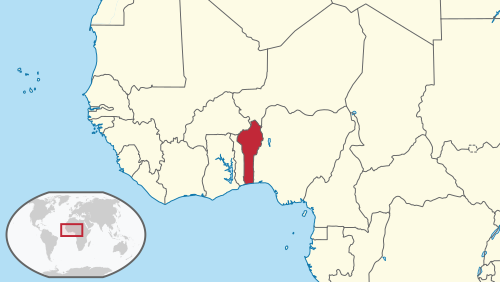
图:TUBS · CC BY-SA 3.0 · 维基共享资源
- 存在时间
- 1958 年 12 月 4 日—1975 年 11 月 30 日
- 首都
- 波多诺伏
- 政体
- 共和制
- 官方语言
- 法语
- 货币
- 非洲金融共同体法郎
- 前身
- 法属达荷美、法属达荷美
- 后继
- 贝宁人民共和国
- 类型
- 联系国、历史国家
- 所在大洲
- 非洲
- 简述
- 历史国家
达荷美共和国(法语:République du Dahomey)是在1958年12月11日法兰西共同体内成立的一个自治共和国。在获得自治权之前,它原属于法属达荷美。1960年8月1日达荷美共和国获得完全独立。1975年,该国以贝宁湾命名为贝宁(贝宁湾又以位于今尼日利亚贝宁城的贝宁帝国命名),因为“贝宁”对于该国所有族群而言都被视为政治中立,而“达荷美”则令人想起以丰族为主的达荷美王国。1972年10月,马蒂厄·克雷库领导的政变(该国历史上第五次政变)推翻了文官政府(由阿霍马德贝、阿皮蒂和马加组成的三人执政联盟领导)。克雷库随后宣布支持马克思列宁主义,并于1975年11月30日宣布达荷美共和国解散,建立贝宁人民共和国。
正文摘自中文维基百科「达荷美共和国」(删去了参考文献、表格和图片),按 CC BY-SA 4.0 使用
英文维基百科的更多内容
中文维基百科这一条比较短,下面是英文维基百科同一条目的节选,原文为英文,未翻译。
The Republic of Dahomey (French: République du Dahomey; pronounced [daɔmɛ]), simply known as Dahomey (Fon: Danhomè), was established on 4 December 1958, as a self-governing colony within the French Community. Prior to attaining autonomy, it had been French Dahomey, part of the French Union. On 1 August 1960, it attained full independence from France.
In 1975, the country was renamed Benin after the Bight of Benin (which was in turn named after the Kingdom of Benin which had its seat of power in Benin City, modern-day Nigeria), since "Benin" was deemed politically neutral for all ethnic groups in the state, whereas "Dahomey" recalled the Fon-dominated Kingdom of Dahomey.
History
The Republic of Dahomey became independent of France on 1 August 1960. In the words of the historian Martin Meredith, the young country "was encumbered with every imaginable difficulty: a small strip of territory jutting inland from the coast, it was crowded, insolvent and beset by tribal divisions, huge debts, unemployment, frequent strikes and an unending struggle for power between three rival political leaders". These rivals were Justin Ahomadégbé-Tomêtin, who held sway in the southern and central regions of the country, Sourou-Migan Apithy, who dominated the southeast, and Hubert Maga, whose power base was located in the north.
Upon independence, Maga became the first president of Dahomey. A political crisis in 1958, prior to independence, had led to Maga's Dahomeyan Democratic Movement joining a coalition government, with a subsequent crisis leading to Maga becoming the head of government in April 1959. This compromise, however, was unable to solve Dahomey's problems, and an uprising broke out in October 1963, culminating in a coup d'état, and the replacement of Maga as president with Apithy. This also failed to bring about stability, and Apithy was removed in another coup, in December 1965.
Following the 1965 coup, Colonel Christophe Soglo became president. A veteran of the French Army, he saw himself as a Dahomeyan Charles de Gaulle, banning all political activity with the stated aim of stabilising the country. Civilian rule was in fact restored in 1968, but the tumult of the preceding years meant that the army remained a key player in Dahomeyan politics, with civilian presidents beholden to their military backers. In October 1972, a coup (the fifth in the country's history) led by Mathieu Kérékou removed a civilian government (which had been headed by a triumvirate consisting of Ahomadégbé, Apithy and Maga). Kérékou would go on to proclaim his support for Marxism–Leninism, declaring the end of the Republic of Dahomey and the establishment of the People's Republic of Benin on 30 November 1975.
正文摘自英文维基百科(原文为英文,未翻译)「Republic of Dahomey」(节选,删去了参考文献、表格和图片),按 CC BY-SA 4.0 使用;在维基百科读全文 ›
相关事件
- 1963年政变1963 年 10 月 28 日 · 革命与起义 · 非洲
前后承接的政权

同时期、同地区的政权