史鉴
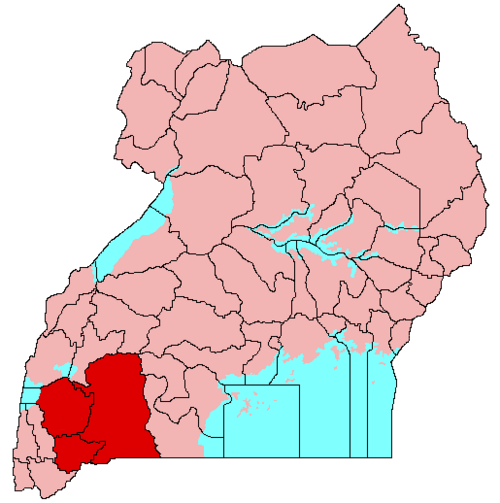
图:No machine-readable author provided. Kirk979 assumed (based on copyright claims) · CC BY-SA 3.0 · 维基共享资源
- 存在时间
- 15 世纪—1967 年 (Wikidata 的日期只记到世纪,非确切年份)
- 首都
- 姆巴拉拉
- 类型
- 历史国家
- 简述
- a traditional Bantu kingdom in Uganda and lasted from the 15th century until 1967, which was located in south-western Uganda, east of Lake Edward
Ankole (Nkore before the colonial era) was a traditional Bantu kingdom in Uganda and lasted from the 15th century until 1967. The kingdom was located in south-western Uganda, east of Lake Edward.
详细介绍
Geography
The kingdom of Ankole is located in the South-Western region of Uganda bordering Rwanda and the Democratic Republic of Congo. Ankole is home to some of the most favorable grazing lands in Africa:
The very fact that the Hima can live almost entirely on cattle bespeaks the richness of their homeland among so many arid or semi-arid areas of primitive pastoralism in the world. In those areas reliance on cattle as a single source of subsistence is impossible; people have to turn, in addition, to other sources of food. In contrast, Himaland, called Kaaro Karungi (the good land) by both its inhabitants and their neighbours, is known for the fertility of its soil, the abundance of its pastures, and its rainfall well spread out both seasonally and perennially.……
History
Under the Empire of Kitara
Before the collapse of the Empire of Kitara, Nkore was a small and remote area on the edges of the empire.
Founding
According to legend, the first (and semi-legendary) king of Nkore, Ruhinda Rwa Njunaki (was the son of Wamala), was born as the illegitimate and the last king of Bachwezi kingdom. His mother was known as Njunaki and was a servant in the king's palace. The Hinda clan later took adopted Hima identity for itself in order to gain more support from the Hima pastoralists. Shrines to Wamara and Ruhinda were associated with fertility. The initial core of the kingdom was in Isingiro, 20 km south of Mbarara.
Colonial and post-colonial periods
On 25 October 1901, the Kingdom of Nkore was incorporated into the British Protectorate of Uganda by the signing of the Ankole agreement.
The kingdom was formally abolished in 1967 by the government of President Milton Obote, and since then, the kingdom has not been restored officially.
Culture and society
Organization
Nkore society evolved into a system of ranked statuses, where even among the cattle-owning elite, patron-client ties were important in maintaining social order. Men gave cattle to the king (mugabe) to demonstrate their loyalty and to mark life-cycle changes or victories in cattle raiding. This loyalty was often tested by the king's demands for cattle or for military service. In return for homage and military service, a man received protection from the king, both from external enemies and from factional disputes with other cattle owners.
The Emitwe leaders (commanders of the basic military units) were the second most powerful group after the Mugabe in Ankole. They spent most of their time in court when not fighting. They had their encampments (amacumbi) near the palace but not in it. The Emitwe leaders were also the top regional administrators.……
Iru and Hima relations
Nkore society was composed of the Iru (pl. Bairu) and Hima (pl. Bahima).……
Military
The Iru were able to join the army and even lead army units (emitwe). Bairu warriors were considered far superior to the ordinary Iru farmers and also to the ordinary Hima (who were derisively called "tick eaters"). Bairu leaders of the emitwe were as equal as the Bahima who held the same office and were of greater standing than those Bairu or Bahima who did not. Poems and songs of praise were sung about the exploits of Iru warriors against the rival Kingdom of Rwanda.
Kananura, a member of the Hororo people, speaks of the military organization of Nkore: "A war expedition without the Bairu could not be contemplated or be successful. The Omukama used to call out all his male subjects to fight if there was a war to be fought."
An Iru named Katare (son of Kobengo) was one of the most famous warriors during the reign of Ntare IV, and his praises are still sung in Ankole today;……
List of Abagabe of Ankole
Names and dates up to 1967 taken from John Stewart's African States and Rulers.
Nkole people
Nkole people are a Bantu ethnic group native to Uganda. They primarily inhabit Ankole. They are closely related to other Bantu peoples of the region, namely the Nyoro, Kiga, Tooro and Hema peoples. Their population is 4,187,445 (9.8% of Uganda).People from Ankole region are referred to as “Banyankore”.
The Banyankore speak Orunyankore, a Great Lakes Bantu language. There were an estimated 12.3 million native speakers in 2014.
Counties of Nkole (Amashaza)
Nkore Kingdom was divided into ten counties. These counties are now divided into various political constituencies. But the original ten counties of Nkore include:
- Kashari
- Isingiro
- Rwampara
- Nyabushozi
- Ibanda
- Sheema
- Kajjara
- Bunyaruguru
- Igara Bushenyi
- Buhweju
Nkole calendar
The Nkore calendar was divided into 12 months. They were named according to weather conditions and activities done in that period. They include:
- Biruuru
- Kaatambuga
- Katumba
- Nyeikoma
- Kyabahezi
- Kahingo
- Nyeirurwe
- Kamena
- Kicuransi
- Kashwa
- Museenene
- Muzimbezi
正文摘自英文维基百科(原文为英文,未翻译)「Ankole」(节选,删去了参考文献、表格和图片),按 CC BY-SA 4.0 使用;在维基百科读全文 ›
同时期、同地区的政权