史鉴
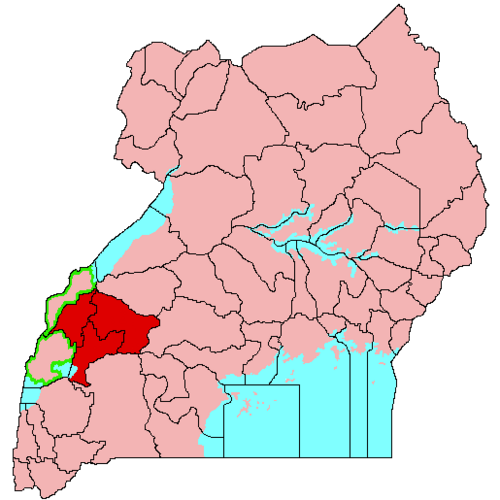
图:No machine-readable author provided. Kirk979 assumed (based on copyright claims) · CC BY-SA 3.0 · 维基共享资源
- 存在时间
- 1830 年—1967 年
- 政体
- 君主立宪制
- 官方语言
- Tooro
- 货币
- 乌干达先令
- 类型
- 王国、历史国家
- 所在大洲
- 非洲
- 简述
- Bantu kingdom in midwestern Uganda
土柔王国(土柔语:Obukama bwa Tooro,发音:[oβukáma βwa tóːɾo])是乌干达西部边境地区的班图自治王国。由布尼奥罗王国统治者尼阿穆图库拉基耶邦贝三世的长子奥利米一世于1830年反叛后建立的独立王国。1876年曾一度又被布尼奥罗王国吞并,1891年重新独立。1967年君主制度被乌干达政府废除,1993年重新恢复。
详细介绍
历史
十九世纪前的某个时候,土柔王国从布尼奥罗王国的一个分离部分演变而来。1830年,奥穆卡玛奥利米一世脱离并建立了自己的独立王国。1876 年,该王国并入布尼奥罗王国,但又于 1891 年重新获得独立。1967 年,乌干达政府废除了君主制,1993 年又恢复了君主制。
正文摘自中文维基百科「土柔王国」(删去了参考文献、表格和图片),按 CC BY-SA 4.0 使用
英文维基百科的更多内容
中文维基百科这一条比较短,下面是英文维基百科同一条目的节选,原文为英文,未翻译。
The Tooro Kingdom is one of the 17 recognised traditional kingdoms located within the borders of Uganda.
The people native to the kingdom are the Batooro, and their language is likewise called Rutooro. The Batooro and those of the neighbouring kingdom of Bunyoro, speak the Runyoro/Rutooro dialect of the Runyakitara language and share a similar background and cultural traits. The Batooro live on Uganda's western border, south of Lake Albert.
History
The Tooro Kingdom evolved out of a breakaway segment of Bunyoro sometime before the nineteenth century. It was founded in 1830 when Omukama Kaboyo Olimi I, the eldest son of Omukama of Bunyoro Nyamutukura Kyebambe III of Bunyoro, seceded and established his own independent kingdom. Absorbed into Bunyoro-Kitara in 1876, it reasserted its independence in 1891.
In 1967, with the ratification of the Third constitution of Uganda, Tooro's monarchy was abolished, alongside the monarchies of Bunyoro, Buganda, Ankole, and Busoga, but was reinstated in 1993.
Cultural influence
The Austrian painter Friedensreich Hundertwasser (1928–2000) spent some time there in the 1960s where he painted a number of works and named them after the kingdom.
The Batooro people have a strong culture but similar in stratification to Banyoro. They have a strong cultural naming system (PET NAME) known as Empaako. With the Empaako naming system, children are given one of twelve names shared across the communities in addition to their given and family names. Addressing someone by his or her Empaako is a positive affirmation of cultural ties. It can be used as a form of greeting or a declaration of affection, respect, honour or love.
Use of Empaako can defuse tension or anger and sends a strong message about social identity and unity, peace and reconciliation. The Empaako names are: Amooti, Abooki, Akiiki, Ateenyi, Adyeeri, Atwooki, Abwooli, Araali, Acaali, Bbala, and Okaali.
Abakama ba Tooro (Kings of Tooro)
- The following is a list of the Abakama of Tooro since 1800:
- Olimi I: 1822–1865
- Ruhaga of Tooro: 1865–1866
- Nyaika Kyebambe I: 1866–1871 and 1871–1872
- Rukidi I: 1871
- Olimi II: 1872–1875
- Rukidi II: 1875–1875
- Rububi Kyebambe II: 1875 and 1877–1879
- Kakende Nyamuyonjo: 1875–1876 and 1879–1880
- Katera: 1876–1877
- Interregnum, reverted to Bunyoro: 1880–1891
- Kyebambe III: 1891–1928
- Rukidi III: 1929–1965
- Olimi III: 1965–1967 and 1993–1995
in pretence: 1967–1993 (monarchy abolished)
Rukidi IV: 1995–2026
Nyabongo I, September 2026–present.
正文摘自英文维基百科(原文为英文,未翻译)「Tooro Kingdom」(节选,删去了参考文献、表格和图片),按 CC BY-SA 4.0 使用;在维基百科读全文 ›
同时期、同地区的政权