史鉴
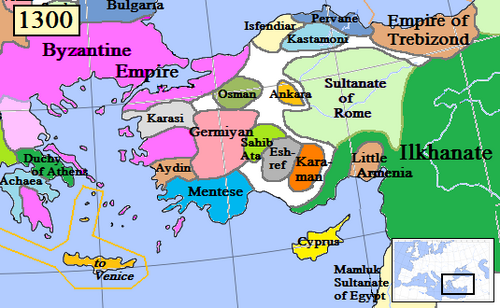
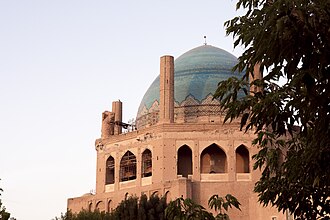
图:Gabagool · CC BY 3.0 · 维基共享资源
- 存在时间
- 1300 年—1429 年
- 首都
- 屈塔希亚
- 政府首脑
- Bey of Germiyan
- 类型
- 历史国家
- 简述
- former country
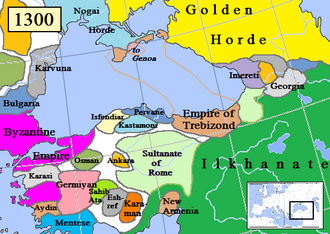
Germiyan, or the Germiyanids (Old Anatolian Turkish: كرميان; Turkish: Germiyanoğulları Beyliği or Germiyan Beyliği), were a dynasty that controlled parts of western Anatolia from c. 1300 to 1429. Germiyan first appeared in the 12th-century chronicles of Matthew of Edessa and The Georgian Chronicles when they fought against the County of Edessa and the Kingdom of Georgia. They reappeared in historical records of 1239 near Malatya, where they were tasked with suppressing the Babai revolt. The tribe relocated to western Anatolia with the encroaching Mongol invasion. During the reign of Yakub I (r. 1300–40), Germiyan gained sovereignty with the demise of the Sultanate of Rum and forged war with the neighboring Ottomans and the Byzantine Empire, which continued during his successor Mehmed's rule (r. 1340–1361).
Amidst political tension caused by the neighboring Karamanids, Suleiman (r. 1361–1387) married his daughter Devletşah Hatun to the Ottoman prince and future sultan, Bayezid I (r. 1389–1402). The process saw a major dowry payment that transferred much of the Germiyanid realm to Ottoman control, including the capital Kütahya. Yakub II (r. 1387–1390, 1402–1411) was initially on friendly terms with the Ottomans but eventually attempted to reclaim the former lands that were lost following his sister's wedding. He was jailed by his brother-in-law Bayezid I in 1390, and Germiyan wholly came under Ottoman control. Nine years later, Yakub escaped from prison and sought the protection of Timur (r. 1370–1405), who, after defeating Bayezid with the help of Yakub at the Battle of Ankara in 1402, restored Germiyan's former boundaries. In 1411, Kütahya fell to Mehmed II of Karaman (r. 1398–1399, 1402–1420), interrupting Yakub's reign a second time.……
详细介绍
History
Background
During the 11th century, much of West Asia was subject to Seljuk rule. A branch of the Seljuk dynasty formed the Sultanate of Rum, an Islamic state in Anatolia, which saw its height from the late 12th century to 1237. Germiyan likely came from Kerman or Fars province, and perhaps headed west with the Khwarazmshahs. After the death of Jalal al-Din Mangburni, they remained in the Malatya area.
Germiyan is first mentioned in the 1162 chronicle of the Armenian author Matthew of Edessa in regards to a battle near Azaz in 1119 under the Turkoman lord Ilghazi against the Crusader Joscelin I, Count of Edessa (r. 1118–31). Matthew locates the Germiyan north of the Artuqids near Malatya, indicating their location wasn't "immediately obvious" to his audience. Matthew mentioned Germiyan a second time when Ilghazi gathered Turkmen contingents from the lands of Rum and Germiyan to aid Ghazi, Emir of Ganja, who suffered a decisive defeat against the Kingdom of Georgia in 1122. Germiyan is later attested to in The Georgian Chronicles three times. The Turkmens of Germiyan thus reappeared in 1160 in a joint offensive with the Turkmens of Diyar Bakr against Georgia. In 1185, the Turkmens of Germiyan joined a composite army in Erzurum against Queen Tamar (r. 1184–1213).
The Germiyan first appeared in Islamic sources in 1239 under Kaykhusraw II's rule of the Sultanate of Rum. Muzaffar al-Din, Yakub I's paternal grandfather, was tasked with subduing Baba Ishak's rebellion in the area around Malatya.……
Origins
Thirteenth-century Iranian historian Ibn Bibi referred to Germiyan in his Selçukname as Atrak-e Kharazmiyan wa Germiyan (lit. 'Turks of Kharazm and Germiyan') and Turkan-e Germiyan (lit. 'Turks of Germiyan').……
Culture
Architecture
Yakub's architectural legacy included the Yakub Chelebi Külliye (building complex) in Kütahya. It was built in 1411–12 and is composed of an imaret, masjid, türbe (tomb), madrasa (school), and library. After five months of operation, the Karamanid occupation forced the imaret to close for two and a half years. In 1414, when the region was regained by the Ottoman Sultan Mehmed I on behalf of Yakub, the building returned to use, and inscriptions (vakfiye), 2 by 3.70 meters in size, were added to the building, detailing its history. The inscriptions indicate that the imaret was owned by Mehmed I. It was later destroyed and the building was restored in accordance with its original form by its waqf (endowment) trustee Ishak Fakih bin Halil in 1440–41. In 1803, the Ottoman governor of Anatolia, Gurju Osman Pasha, commissioned its reparation and merged the imaret and the masjid. The tomb includes the sarcophagi of Yakub II and his wife Pasha Kerime Hatun, which are ornamented with encaustic tiles. The building was restored again in 1999 and reopened as the Encaustic Tile Museum.
Literature
Suleiman Shah was described as a generous ruler, and many literary works were produced under him. Suleiman had Shaykh-oghlu Mustafa, who was the nishanji and defterdar (treasurer) at his court, translate several Persian works to Turkish, including Ḳābūs-name (kept by the Egyptian National Library and Archives) and Marzbān-nāme. Shaykh-oghlu also authored a prose, Kanz al-kubarāʾ, and a verse romance, Khurshīdnāme, dedicated to Suleiman Shah. Manuscripts of these works are kept in Istanbul, London, and Paris.……
正文摘自英文维基百科(原文为英文,未翻译)「Germiyanids」(节选,删去了参考文献、表格和图片),按 CC BY-SA 4.0 使用;在维基百科读全文 ›
相关事件
- 安卡拉之战1402 年 7 月 20 日 · 战役 · 西亚
同时期、同地区的政权