 史鉴
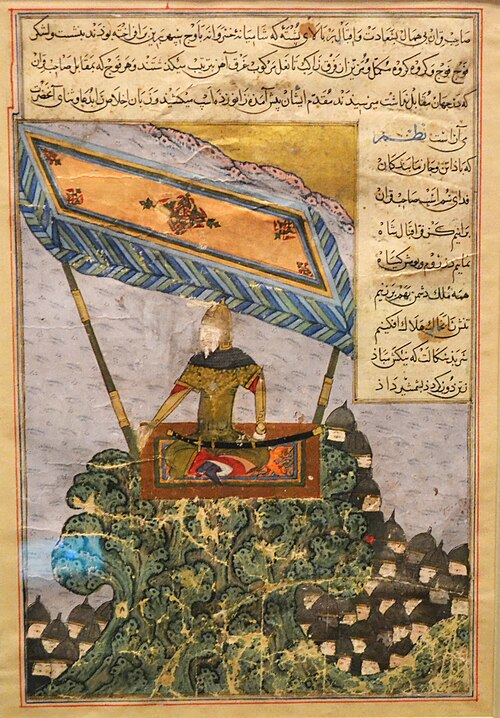
图:1436 painting · Public domain · 维基共享资源
- 时间
- 1402 年 7 月 20 日 (日期为儒略历)
- 地点
- Çubuk Ovası
- 国家 / 地区
- 土耳其
- 参与方
- 奥斯曼帝国、帖木尔帝国、白羊王朝、安纳托利亚侯国、格尔米扬、卡斯特里奥蒂亲王国、塞尔维亚公国 (中世纪)、布兰科维奇地区、Jonima family、Mihrabanids、黑鞑靼、Zaharia family
- 属于
- Timurid invasion of the Ottoman Empire
- 类型
- 战役
- 简述
- battle near Ankara on 20 July 1402, between the Timurid Empire and the Ottoman Sultanate
安卡拉之战指1402年奥斯曼帝国和帖木儿帝国之间发生于今土耳其安卡拉附近的会战。
1402年春,帖木儿率大军15万人左右发动对奥斯曼帝国的战争,数月之间即兵临安卡拉城下。奥斯曼苏丹“雷霆”巴耶济德一世率军7万人左右利用安卡拉以东的森林设防,以降低帖木儿骑兵的机动优势。帖木儿遂于7月20日率军由南面迂回攻城,迫使巴耶济德回军救援。双方不久相会于平原之上,帖木儿遂发挥骑兵优势集中兵力攻击巴耶济德军左翼。
激战半日后,巴耶济德军中的鞑靼军队和安纳托利亚联军先后倒向帖木儿,巴耶济德本军随即崩溃,其本人被俘。帖木儿获胜后并没有继续对奥斯曼帝国的进攻,因为正获得探子来的情报而迅速回师撒马尔罕,筹备征服中国,他不久却死在征讨的路上。另一方面这次失败使奥斯曼帝国大伤元气,进入了王位空悬的十年内战,延缓了东罗马帝国的灭亡近半个世纪,同时也解除了帖木儿入侵中国时的后顾之忧。
正文摘自中文维基百科「安卡拉之战」(删去了参考文献、表格和图片),按 CC BY-SA 4.0 使用
英文维基百科的更多内容
中文维基百科这一条比较短,下面是英文维基百科同一条目的节选,原文为英文,未翻译。
The Battle of Ankara or Angora (Ottoman Turkish: آنقره محاربهسی, romanized: Anḳara Muḥârebesi) was fought on 28 July 1402, at the Çubuk plain near Ankara, between the forces of Timur and the Ottoman sultan Bayezid I. The battle was a major victory for Timur, leading to the Ottoman Interregnum.
Background
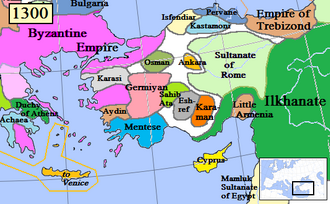
Timur, a Turco-Mongol from Transoxiana (now Uzbekistan), had built an empire in Central Asia over the years, and became the most powerful ruler in Central Asia since Genghis Khan. He sought to rebuild the once great Mongol Empire. In the 1380s and 1390s, he invaded and conquered parts of Persia (including Azerbaijan and Upper Mesopotamia), ravaged southern Russia and Ukraine (1395–96), and sacked Delhi (1398). Although there had been tensions between the Ottomans and Mongols, nothing would warrant a war, until Bayezid demanded tribute from an emir loyal to Timur, which Timur understood to be a personal affront and a reason for war. In 1400–01 Timur took Sivas from the Ottomans, parts of Syria from the Mamluks, and next directed his forces towards Anatolia.
Troops
The sizes of the two armies are reliably estimated at 140,000 on Timur's side, mostly cavalry, along with 32 war elephants, and no more than 85,000 under Sultan Bayezid I. Historical sources exaggerated the number of troops to unrealistic proportions according to modern historians: Ahmad ibn Arabshah claimed 800,000 Timurid troops, while a German witness claimed 1.6 million, for instance.
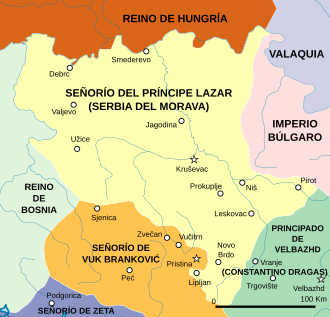
The Ottoman force included contingents under Bayezid's sons, Ghazis, Janissaries, Anatolian Muslim vassals, and various European (Balkan Christian) vassals. Among Serbian vassals participating were Stefan Lazarević, Vuk Lazarević, Đurađ Branković and his brother Grgur Branković, and among Albanian were Koja Zaharia, Dhimitër Jonima, Gjon Kastrioti, and probably Tanush Dukagjini.……
Battle positioning
Bayezid reluctantly withdrew his forces from the blockade of Constantinople and marched them through the midsummer heat. When they arrived, they were tired and thirsty, but were allowed no time to rest or recuperate. Bayezid was advised by his generals to take up defensive positions and, when Timur's forces pushed back the Ottomans, to withdraw into the mountains and force Timur to break ranks and attempt to hunt the Ottomans in their own terrain during the midsummer heat. Bayezid instead chose to take an offensive stance and marched eastward. Advancing Ottoman scouts found no traces of the Timurids, who secretly marched southwest, rested, and were situated to the rear of the Ottomans.……
Battle
The battle began with a large-scale attack from the Ottomans, countered by swarms of arrows from the Timurid horse archers. Several thousand were killed and many surrendered to Timur. Stefan Lazarević and his knights successfully fought off the Timurid assaults and cut through the Mongol ranks three times. Each time Stefan advised Bayezid to break out with him, Bayezid declined to do so. But the Serbians managed to save one of Bayezid's sons and the treasury from the Mongols and made their way to Constantinople. The Serbian troops wore heavy black plate armour which was very effective against the Timurid arrows. Timur admired the Serbian troops who according to him "fight like lions".……
Aftermath
After the battle, Timur moved through western Anatolia to the Aegean coast, where he besieged and took the city of Smyrna, a stronghold of the Christian Knights Hospitalers.
The battle was catastrophic for the Ottoman state, fracturing what remained and bringing almost total collapse of the empire. This resulted in a civil war among Bayezid's sons. The Ottoman civil war continued for another 11 years (1413) following the Battle of Ankara.
The battle is also significant in Ottoman history as being the only time a Sultan was captured in person.
正文摘自英文维基百科(原文为英文,未翻译)「Battle of Ankara」(节选,删去了参考文献、表格和图片),按 CC BY-SA 4.0 使用;在维基百科读全文 ›
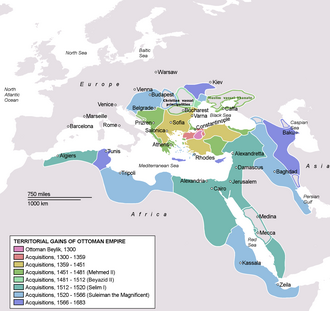
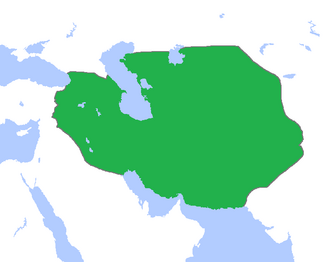
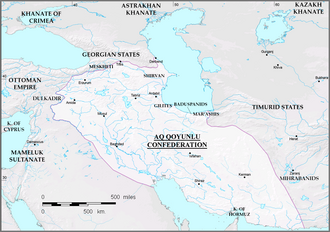
相关政权
同时期、同地区的大事
- 奥斯曼属保加利亚1396 年—1878 年 · 时代与时期 · 西亚
同时期的同类事件(战役)
- 格伦瓦德之战1410 年 7 月 15 日 · 战役 · 欧洲
- 阿金库尔战役1415 年 10 月 25 日 · 战役 · 欧洲
- 科索沃战役1389 年 6 月 28 日 · 战役 · 欧洲
- 库里科沃战役1380 年 9 月 8 日 · 战役 · 欧洲
- 尼科波利斯战役1396 年 9 月 25 日 · 战役 · 欧洲
- 奥尔良之围1428 年 10 月 21 日—1429 年 5 月 17 日 · 战役 · 欧洲
- 阿尔茹巴罗塔战役1385 年 8 月 14 日 · 战役 · 欧洲
- 帕提战役1429 年 6 月 18 日 · 战役 · 欧洲
- 君士坦丁堡之围1422 年 6 月—1422 年 8 月 · 战役 · 西亚
- 沃尔斯克拉河战役1399 年 8 月 12 日 · 战役 · 欧洲
- 塞萨洛尼基之围1422 年 6 月—1430 年 3 月 29 日 · 战役 · 欧洲
- 昆都尔察河谷大战1391 年 6 月 18 日 · 战役 · 欧洲