史鉴
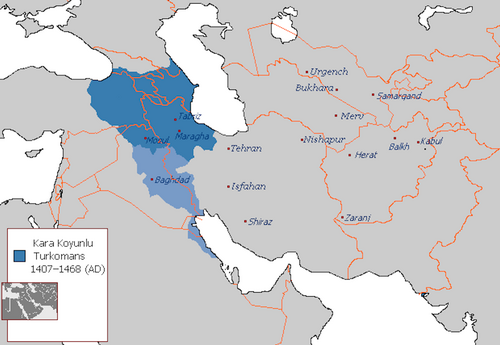
图:Arab League at English Wikipedia · Public domain · 维基共享资源
- 存在时间
- 1375 年—1468 年
- 首都
- 大不里士、摩苏尔、埃尔吉斯
- 政体
- 绝对君主制、absolutism
- 官方语言
- 波斯语
- 宗教
- 什叶派
- 货币
- Tenge
- 类型
- 历史国家
- 简述
- 14世纪土库曼人建立的王朝
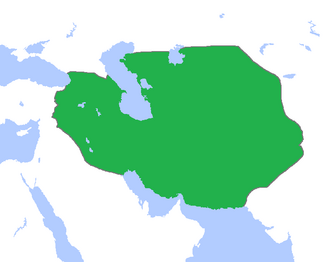
黑羊王朝是土库曼部族建立的王朝,存在于1374年—1468年,统治现在的阿塞拜疆、伊朗西北部与伊拉克东北地区。王朝早期为札剌亦儿王朝的藩属,曾被帖木儿帝国击败,最后被白羊王朝消灭。
详细介绍
历史
一些学者将黑羊王朝的乌古斯方言与阿塞拜疆语联系起来。黑羊王朝的东乌古斯方言今天被称为阿塞拜疆语。
1375年,黑羊王朝于波斯地区东部的赫拉特建都,成为当时统治巴格达与大不里士二大城市的札剌亦儿王朝之藩属。
卡拉·优素福1在位时,土库曼族造反,攻下了大不里士,结束了其对札剌亦儿王朝的藩属地位。
1400年,黑羊王朝被来自渴石的帖木儿打败,卡拉·优素福逃到埃及。
1406年,卡拉·优素福又重新占领大不里士。1410年,黑羊王朝占领巴格达。1420年,卡拉·优素福去世。
黑羊王朝领袖贾汗·沙与帖木儿帝国的沙哈鲁签订和平协议,但不久后则契约。
1447年,杰汗·沙赫占领了今属伊拉克的部分地区及阿拉伯半岛东部沿海地区。时帖木儿帝国则控制了伊朗西部。
1466年杰汗·沙赫试图夺取白羊王朝所控制的迪亚巴克尔,最终战败被杀。
1468年黑羊王朝由同为土库曼族政权的白羊王朝所灭。
《明史·西域传》作讨来思。当即大不里士(Tabriz)古名Tauris之对音。明宣宗宣德六年(1431年)曾遣使入贡于明朝,是时建都于此的正是黑羊王朝。《明史·外国传》将黑羊王朝占领的巴格达作黑葛达。黑葛达在宣德年间也遣使入贡。《明史》黑葛达记载:“国小民贫,尚佛畏刑。多牛羊,以铁铸钱”。
正文摘自中文维基百科「黑羊王朝」(删去了参考文献、表格和图片),按 CC BY-SA 4.0 使用
英文维基百科的更多内容
中文维基百科这一条比较短,下面是英文维基百科同一条目的节选,原文为英文,未翻译。
The Qara Qoyunlu or Kara Koyunlu (Azerbaijani: Qaraqoyunlular, قاراقویونلولار; Persian: قره قویونلو), also known as the Black Sheep Turkomans, were a Turkoman, culturally Persianate, Muslim dynasty that ruled over the territory comprising present-day Azerbaijan, Armenia, northwestern Iran, eastern Turkey, and northeastern Iraq from about 1374 to 1468.
History
Etymology
The name Qara Qoyunlu literally means "[those with] black sheep". They were likely so named because of the black sheep that was painted on their flags. It has been suggested that this name refers to old totemic symbols, but according to Rashid al-Din Hamadani, the Turks were forbidden to eat the flesh of their totem-animals, and so this is unlikely given the importance of mutton in the diet of pastoral nomads. Another hypothesis is that the name refers to the predominant color of their flocks.
Origins
The ruling family descended from the Yıwa tribe of the Oghuz Turks, specifically the Baharlu, who by the fourteenth century possessed territories north of Lake Van and Mosul in Upper Mesopotamia.……
Rise
During the 14th century, the Qara Qoyunlu had several encounters with the powerful Jalayirid Sultanate, which was based in Baghdad and Tabriz.……
Religion
During the Qara Qoyunlu period, Shia Islam was being spread, notably through the activities of Shaykh Junayd of the Safavid order in Azerbaijan and Anatolia and the Musha'sha' in Khuzistan. Vladimir Minorsky writes that the Qara Qoyunlu adopted Shia Islam as a unifying ideology for their loose tribal confederation, and that "in trying to unify their adepts on a shīʿa platform, they can be regarded as the forerunners of the Safavids." Their rivals, the Aq Qoyunlu, probably rejected heterodox religious influences out of their enmity towards the Qara Qoyunlu. According to R.……
Governance
The Qara Qoyunlu state organization was based mainly on of its predecessors, Jalayirids, and the Ilkhanids. Qara Qoyunlu rulers used the title sultan since the enthronement of Pirbudag by Qara Yusuf. Sometimes the title bahadur appeared on the coinage. They also used the titles khan, khagan and padishah.
Keeping with a Persianate culture, the Qara Qoyunlu used the Persian language for diplomacy, poetry, and as a court language. Diplomatic letters to the Timurids and Ottomans were written in Persian, while the correspondence with the Mamluk sultans were in Arabic. Official internal documents (farmān, suyūrghāl) were also written in Persian. Jahan Shah was titled Padishah-i Iran and King of Kings of Iran during his reign.
Culture
Under Timur, the cultural entity of Iran was renewed by Persian literature, art and culture being patronized throughout the Timurid Empire. Consequently, Qara Qoyunlu art was notably influenced by the Timurids. Jahan Shah wrote his poetry in Azerbaijani and Persian, while the Kitab-i Diyarbakriyya, a history of the Qara Qoyunlu and Aq Qoyunlu, was written by Abu Bakr Tehrani in Persian. The rule of the Qara Qoyunlu and other Turkoman dynasties speeded up the process—well underway by that time—by which Azerbaijan and parts of Fars became ethnically and linguistically Turkic.
Architecture
Jahan Shah is known for several architectural contributions through western Iran. The Northern Iwan of Darb-e Imam in Isfahan is attributed to him.……
Qara Qoyunlus in India
Sultan Quli Khawas Khan Hamdani (r.1518-1543), the founder of the Qutb Shahi dynasty of the Sultanate of Golconda in southern India, belonged to the Qara Qoyunlu and was a fourth-generation direct descendant of Qara Iskander (r.1421-1436). In the 16th century, he migrated from Iran to Delhi with his uncle, Allah-Quli, some of his relatives and friends. Later he migrated south, to the Deccan and served the Bahmani sultan, Mahmood Shah Bahmani II, who was of Afghan Origin. He established and declared the independence of the Sultanate of Golconda after the disintegration of the Bahmani Sultanate into the five Deccan sultanates.
正文摘自英文维基百科(原文为英文,未翻译)「Qara Qoyunlu」(节选,删去了参考文献、表格和图片),按 CC BY-SA 4.0 使用;在维基百科读全文 ›
相关事件
- Battle of Qara-Derrah Pass1395 年 · 战役 · 西亚
- Battle of Nakhchivan1406 年 10 月 14 日 · 战役 · 西亚
- Turkoman invasions of Georgia1407 年—1502 年 · 战役 · 欧洲
- Battle of Sardrud1408 年 4 月 21 日 · 战役 · 西亚
- Battle of Chalagan1412 年 12 月 · 战役 · 西亚
- Battle of Chapakchur1467 年 · 战役 · 西亚
人物
同时期、同地区的政权