史鉴
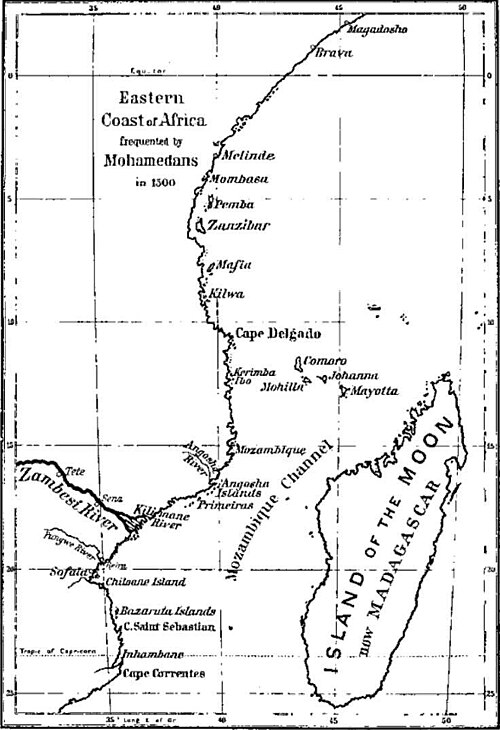
图:George McCall Theal · Public domain · 维基共享资源
- 存在时间
- 957 年—1513 年
- 首都
- 基尔瓦基斯瓦尼
- 类型
- 历史国家、苏丹国
- 简述
- 集中在基尔瓦的中世纪苏丹国
基尔瓦苏丹国(阿拉伯语:سلطنة كلوة)是一个非洲国家,以基尔瓦(现代坦桑尼亚林迪地区基尔瓦区附近的一个岛屿)为中心,其权力在其鼎盛时期延伸到斯瓦希里海岸的整个长度。根据传说,它是由设拉子的波斯王子阿里·伊本·哈桑·设拉子于10世纪创立的。他的家族统治苏丹国直到1277年,被阿拉伯家族阿布·莫哈布取代,直到1505年被葡萄牙入侵推翻。到1513年,苏丹国已经分裂成较小的国家,其中许多成为阿曼苏丹国的保护国。
正文摘自中文维基百科「基尔瓦苏丹国」(删去了参考文献、表格和图片),按 CC BY-SA 4.0 使用
英文维基百科的更多内容
中文维基百科这一条比较短,下面是英文维基百科同一条目的节选,原文为英文,未翻译。
The Kilwa Sultanate was a sultanate, centered at Kilwa (an island off modern-day, Kilwa District in Lindi Region of Tanzania), whose authority, at its height, stretched over the entire length of the Swahili Coast. According to the legend, it was founded in the 10th century by Ali ibn al-Hassan Shirazi, a Persian prince of Shiraz.
History
The history of the Kilwa Sultanate begins around 960–1000 AD. According to legend, Ali ibn al-Hassan Shirazi was one of seven sons of a ruler of Shiraz, Persia, his mother an Abyssinian slave. Upon his father's death, Ali was driven out of his inheritance by his brothers. Setting sail out of Hormuz, Ali ibn al-Hassan, his household and a small group of followers first made their way to Mogadishu, the main commercial city of the East African coast. However, Ali failed to get along with the city's Somali elite and he was soon driven out of that city as well.
Society and economy
Despite its origin as a Persian colony, extensive inter-marriage and conversion of local Bantu inhabitants and later Arab immigration turned the Kilwa Sultanate into a veritable melting pot, ethnically indifferentiable from the mainland. Recent ancient DNA studies have confirmed that Asian ancestry in the medieval period originally came from Iran, and that Asian and African ancestors began mixing at least 1,000 years ago.
The mixture of Perso-Arab and Bantu cultures is credited for creating a distinctive East African culture and language known today as Swahili (literally, 'coast-dwellers').……
Decline and fall
In its later years, the Sultans of Kilwa began falling into the hands of their ambitious ministers (viziers and emirs), who played the roles of kingmakers, and de facto rulers, and occasionally tried to foist themselves (or one of their family members) on the throne, in competition with the royal dynasty. The most successful was probably Emir Muhammad Kiwabi, who ruled Kilwa for nearly two decades through several sultans, including himself at one point.
Throughout his long 'reign', Emir Muhammad fought an on-again and off-again battle with his nephew, Hassan ibn Suleiman (son of an earlier vizier).……
Portuguese era
Source:
Portuguese scout Pêro da Covilhã, disguised as an Arab merchant, had travelled the length of the Kilwa Sultanate in 1489–1490, and visited the ports of Malindi, Kilwa and Sofala, and delivered his scouting report back to Lisbon, describing the condition of the Kilwa Sultanate in quite some detail. The first Portuguese ships, under Vasco da Gama, on their way to India, reached the sultanate in 1497. Da Gama made contact with the Kilwa vassals of Mozambique, Mombassa, and Malindi, seeking to secure their cooperation as staging posts for the Portuguese India Armadas.
Rulers
The chronology of rulers of the Kilwa Sultanate is reported in a chronicle translated into Portuguese in the 16th century, and recorded by the chronicler João de Barros. There is another surviving chronicle (Zanzibar chronicle) by an unknown author, written in the early 16th century, and compiled in 1862 by (or for) sheikh Moheddin (Majid?) of Zanzibar. The Barros and Zanzibar chronicle are not always in concordance with each other. The following follows Barros in its outlines, but fills in details from the Zanzibar chronicle. Alternative spellings and nicknames, mainly given in Barros's chronicle, are in italics.……
Shirazi era
(957 CE) Ali ibn al-Hassan Shirazi (Ighawumij) – founder of Kilwa
Possible link to Australia
In 1944, nine coins were found on Marchinbar Island, the largest island in the Wessel Islands of the Northern Territory of Australia. While four coins were identified as Dutch duits dating from 1690 to the 1780s, five with Arabic inscriptions were identified as being from the Kilwa Sultanate. The coins are now held by the Powerhouse Museum, Sydney, Australia. In 2018, another coin, also thought to be from Kilwa, was found on a beach on Elcho Island, another of the Wessel Islands.
正文摘自英文维基百科(原文为英文,未翻译)「Kilwa Sultanate」(节选,删去了参考文献、表格和图片),按 CC BY-SA 4.0 使用;在维基百科读全文 ›
同时期、同地区的政权