史鉴

图:MAREK SZAREJKO from CLONMEL, IRELAND - POLAND · CC BY-SA 2.0 · 维基共享资源
- 存在时间
- 703 年—1705 年 7 月 15 日
- 类型
- 维拉亚特、历史国家
- 所在大洲
- 非洲
- 简述
- 北非的历史地名
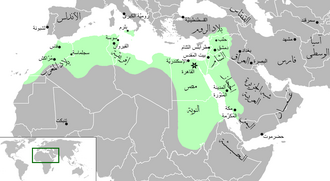
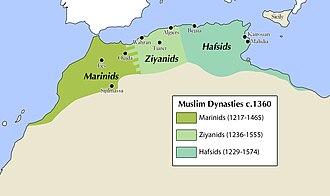
易弗里基叶(阿拉伯语:إفريقية Ifrīqya),或称近马格里布(阿拉伯语:المغرب الأدنى),中世纪北非地区名,源自罗马阿非利加行省,包括突尼斯、阿尔及利亚东部和的黎波里塔尼亚地区。
一般认为易弗里基叶的南界在称为杰里德的半干旱盐沼地区,其北界和西界比较模糊,可远达西西里岛和贝贾亚。易弗里基叶的首府先是迦太基,再是凯鲁万、马赫迪耶,最后是突尼斯。
多个穆斯林王朝以此为核心地带。阿格拉布王朝曾在827年入侵南意大利,建立西西里埃米尔国和巴里埃米尔国,后来被诺曼人征服。
正文摘自中文维基百科「易弗里基叶」(删去了参考文献、表格和图片),按 CC BY-SA 4.0 使用
英文维基百科的更多内容
中文维基百科这一条比较短,下面是英文维基百科同一条目的节选,原文为英文,未翻译。
Ifriqiya (Arabic: إفريقية, romanized: Ifrīqiya, lit. 'Africa') was a medieval historical region comprising today's Tunisia, Constantinois (roughly eastern Algeria), and Tripolitania (roughly western Libya), particularly the region between the sea and the edges of the Sahara. It included all of what had previously been the Byzantine province of Africa Proconsularis and extended beyond it, but did not include the Mauretanias.
Ifriqiya is bordered to the west by the Central Maghreb, with which the borders are fluid depending on the chroniclers and the era. For most of its early history, the capital of Ifriqiya was Qayrawan (Kairouan), but in some periods it moved to Mahdiya (Mahdia) and later it remained at Tunis.
Etymology
The name Ifriqiya was an Arabic derivation from Latin Africa. Some historical Arabic sources attributed the name to more legendary etymologies, such as being derived from a king of Yemen named Ifriqis or Ifriqish, who purportedly conquered the Maghreb in ancient times, or to a son of Abraham named Ifriq.
Definition
The boundaries of what was known as Ifriqiya were not precise and changed between authors or historical periods. The Mediterranean Sea and the border areas of the Sahara were normally the northern and southern boundaries, respectively. The eastern boundary was typically between Tripolitania (western Libya) and Cyrenaica (eastern Libya), as the latter was attached administratively to Egypt in the early Islamic period. The western boundary was more variable, due mainly to the changing political borders over time.……
History
The province of Ifriqiya was created in 703 CE when the Umayyads seized North Africa from the Byzantine Empire. Although Islam existed throughout the province, there was still considerable religious tension and conflict between the invading Arabs and the native Berbers. The beliefs and perceptions of people also shifted from area to area. This contrast was at its greatest between coastal cities and villages. Muslim ownership of Ifriqiya changed hands numerous times in its history with the collapse of the Umayyads paving the way for the Aghlabids, who acted as agents of the Abbasids in Baghdad.
They were then overthrown by the Fatimids in 909, when they lost their capital of Raqqada and the Fatimids went on to control all of Ifriqiya in 969, when they took control of Egypt. The Fatimids slowly lost control over Ifriqiya as their regents, the Zirids, became more and more autonomous until the mid-11th century when they fully separated.
List of rulers
Conquest phase
Cyrenaica and Tripolitana conquered in 643 by Amr ibn al-As, organised as new province with regional capital at Barqa; first governors uncertain.
Mu'awiya ibn Hudayj, c.665–666 — ruled from Barqa
Uqba ibn Nafi, 666–674 — conquered south Tunisia (Byzacena), founded Kairouan (670)
Abu al-Muhajir Dinar, 674–681
Uqba ibn Nafi, (restored), 681–683 — led cavalcade to Morocco, ostensibly brought the entire Maghreb under submission.
Uqba killed. Arabs expelled from Byzacena, which was then occupied by Awraba Berber chieftain Kusaila, 683–686.
Zuhayr ibn Qays, 683–689 — initially only Barqa, retook Byzacena in 686.
Zuhayr killed. Berbers under Kahina retake Byzacena in 689. No clear Arab governor, 689–92
Hassan ibn al-Nu'man al-Ghassani, 692–703 — initially only Barqa. Captured Carthage in 695 (lost again), then again in 698 (final). Permanent conquest of Ifriqiya, organised as a new province, separately from Egypt, directly under the Umayyad Caliph, with capital at Kairouan.
Umayyad Governors of Ifriqiya
Musa ibn Nusair al-Lakhmi, 703–715
正文摘自英文维基百科(原文为英文,未翻译)「Ifriqiya」(节选,删去了参考文献、表格和图片),按 CC BY-SA 4.0 使用;在维基百科读全文 ›
相关事件
- 征服突尼斯1535 年 6 月 16 日—1535 年 7 月 21 日 · 战役 · 欧洲
- Capture of Tunis1569 年 · 战役 · 欧洲
- Conquest of Tunis1573 年 · 战役 · 欧洲
人物
同时期、同地区的政权