史鉴
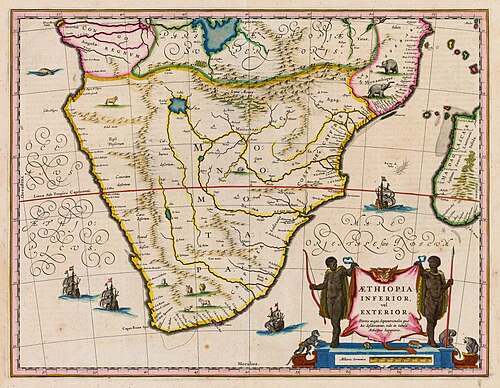
图:Willem Blaeu · Public domain · 维基共享资源
- 存在时间
- 1430 年—1760 年
- 前身
- 津巴布韦王国
- 后继
- 葡属东非、洛兹维帝国、Kingdom of Barue
- 类型
- 历史国家
- 简述
- kingdom in southern Africa between 1430 and 1760
姆韦尼·马塔帕王国(绍纳语:Mwene we Mutapa,葡萄牙语:Monomotapa),又称穆塔帕帝国(英语:Mutapa Empire),是津巴布韦历史上的一个王国,该国领土一度西起卡拉哈里沙漠,东至莫桑比克印度洋,北起赞比西河,南至林波波河。该国首都一度位于大津巴布韦。该国建立于15世纪初叶。17世纪30年代,该国一度被葡萄牙控制。1917年,姆韦尼·马塔帕的酋长被葡萄牙人杀害,王朝彻底覆灭。
正文摘自中文维基百科「姆韦尼·马塔帕王国」(删去了参考文献、表格和图片),按 CC BY-SA 4.0 使用
英文维基百科的更多内容
中文维基百科这一条比较短,下面是英文维基百科同一条目的节选,原文为英文,未翻译。
The Mutapa Empire – also referred to as Mwenemutapa or Munhumutapa (Shona: Mwene we Mutapa, Portuguese: Monomotapa) – was a Shona empire in the north of the Zimbabwean Plateau.
The Portuguese term Monomotapa is a transliteration of the Shona royal title Mwenemutapa derived from a combination of two words, Mwene meaning "Lord" and Mutapa meaning "conquered land". Over time the monarch's royal title was applied to the kingdom as a whole, and used to denote the kingdom's territory on maps from the period.
Geography
The Mutapa Empire was situated on the northern part of the Zimbabwean Plateau, which borders the Zambezi and Limpopo rivers and valleys to the north and south respectively, the Indian Ocean in the east, and the Kalahari Desert to the west. Several rivers traverse the Plateau, including the Save, Pungwe, and Runde. The Plateau largely consists of savanna-woodland with musasa and munondo trees on higher ground, and mufuti and munondo on lower ground. The Plateau is inhabited by elephants, lions, leopards, and deer, among others.
History
Origins and early history
Shona oral tradition attributes Great Zimbabwe's demise to a salt shortage, which may be a figurative way of speaking of land depletion for agriculturalists or of the depletion of critical resources for the community. Shona tradition says that some Karanga from Great Zimbabwe migrated slowly to the northern Zimbabwean Plateau. Accordingly, an elephant hunter in Shangwe named Mutota gained prominence, and took interest in trade along the Zambezi, while also finding salt in Dande. In the early-15th century Angoche traders had opened a new route along the Zambezi via the Tonga and Tavara to reach the goldfields close to Khami (capital of the Kingdom of Butua).……
Government
Kingship and central government
The state was headed by a mambo (king/emperor) with the title Mwenemutapa. A royal court was called zimbabwe ("large house of stone"), and was enclosed by stone walls and located at the capital. Some later rulers built their courts out of mud and wood, enclosed by wood fences. A new Mwenemutapa could relocate the capital, though that was only usually done if strategically necessary. Capitals were initially located in the Dande-Musengezi area, and moved to the region of Chidima (modern-day Mozambique) in the 18th century. Wives of the Mwenemutapa (vakaranga;……
Economy
The economy of the Mutapa state was based in agriculture and pastoralism. The royal cattle herds were likely very numerous (increased through reproduction and tribute), and some were kept as far as 150 km (93 mi) away from the capital. Cattle also served as a store of wealth, and possibly sometimes as baggage animals. They were loaned to people in a system called kuronzera, wherein the recipient could sell the cattle's product and keep the profit, though they were not allowed to dispose of the cattle. In practice, this constituted a system of vassalage and served to distribute wealth and food among the population. The Mwenemutapa also gifted cattle as a show of favour.……
Society and culture
Shona socio-political organisation consisted of increasing units of size, namely the nuclear family (imba), the village (musha), the ward (dunhu), and the chiefdom/province (nyika). The imba (which included a husband, his wife/wives, and their children) lived in a compound (mana) which had adjacent fields to grow crops. The largest of these belonged to the father, as the family head, and was worked on by everyone, though the wife/wives and older children also owned gardens. The father attended the village council (dare), and did hunting, cattle-keeping, and strenuous labour, while the wife/wives did housework, cooking (including brewing beer), and agricultural work.……
正文摘自英文维基百科(原文为英文,未翻译)「Mutapa Empire」(节选,删去了参考文献、表格和图片),按 CC BY-SA 4.0 使用;在维基百科读全文 ›
前后承接的政权
同时期、同地区的政权