史鉴
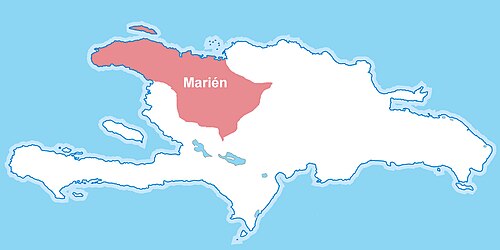
图:República Dominicana · Public domain · 维基共享资源
- 存在时间
- 1811 年 3 月 28 日—1820 年 10 月 8 日
- 首都
- 海地角
- 政体
- 君主立宪制
- 官方语言
- 法语、海地克里奥尔语
- 后继
- 海地共和国
- 类型
- 历史国家
- 所在大洲
- 美洲
- 简述
- 美洲国家
海地王国是原来的海地国总统亨利·克里斯托夫于1811年3月28日宣布他为“亨利一世”国王后,建立的一个君主制政权。这是继让-雅克·德萨林的海地帝国后,第二度试图建立的君主政权。但由于在德萨林遇刺后,海地就分裂成由亨利所统治的北部,及亚历山大·佩蒂翁所控制的南部,故此政权从未有效统治整个海地,范围仅限于海地北部。
正文摘自中文维基百科「海地王国」(删去了参考文献、表格和图片),按 CC BY-SA 4.0 使用
英文维基百科的更多内容
中文维基百科这一条比较短,下面是英文维基百科同一条目的节选,原文为英文,未翻译。
The Kingdom of Haiti, or Kingdom of Hayti (French: Royaume d'Haïti; Haitian Creole: Wayòm an Ayiti), was the state established by Henri Christophe on 28 March 1811 when he proclaimed himself King Henri I after having previously ruled as president of the State of Haiti, in the northern part of the country. This was Haiti's second attempt at monarchical rule, as Jean-Jacques Dessalines had previously ruled over the First Empire of Haiti as Emperor Jacques I from 1804 until his assassination in 1806.
During his reign, Henri built six castles, eight palaces (including the Sans-Souci Palace), the Royal Chapel of Milot, and the Citadelle Laferrière, built to protect the Kingdom from possible French invasions. He created a noble class and appointed four princes, eight dukes, 22 counts, 37 barons, and 14 chevaliers.
After suffering a stroke and with support for his rule waning, Henri I committed suicide on 8 October 1820. He was buried at the Citadelle Henry. His 16-year-old son and heir, Jacques-Victor Henri, Prince Royal of Haiti, was murdered 10 days later at the Sans-Souci Palace by rebels.
Following the assassination of Emperor Jacques I, the country was split. Parallel with the government of Christophe in the north, Alexandre Pétion, a free person of color, ruled over the south of the country as President of the Republic of Haiti until his death in 1818. He was succeeded by Jean-Pierre Boyer, who reunited the two parts of the nation after the deaths of Henri I and his son in 1820.
History
Background
From 1791 to 1804, the Haitian Revolution against the French colonists raged. After the failure of the French expedition of 1803, General Jean-Jacques Dessalines proclaimed Haiti's independence.
On 8 October 1804, Dessalines was crowned emperor in Cap-Haïtien under the name of Jacques I.
Following independence, political divisions emerged within Haiti's leadership. On 17 October 1806, Emperor Jean-Jacques Dessalines was assassinated at Pont-Rouge, near Port-au-Prince, in a conspiracy involving several senior officers, including forces aligned with General Alexandre Pétion.
After Dessalines's death, the empire was abolished and members of the imperial family went into exile. Pétion established a republic in southern Haiti and became its president. Meanwhile, General Henri Christophe assumed control of the northern region, where he founded the State of Haiti, a separate political entity.
Christophe initially ruled as president and later as president for life. Seeking to strengthen the legitimacy of his government, he reorganized the state along monarchical lines after consolidating military control of the northern territory in conflicts with the southern republic led by Pétion.……
Conflict with the Republic of the South
Following the division of Haiti in 1807, political tensions developed between the northern state governed by Henri Christophe and the southern republic led by Alexandre Pétion.……
Government
Difficult beginnings
Although political and military tensions with the southern republic continued, the frontier between the two states remained largely stable throughout Christophe's reign.
During the early years of the kingdom, Christophe faced internal opposition, including a revolt in 1812 that challenged aspects of his rule.
Christophe sought to consolidate authority through administrative and legal reforms intended to strengthen the state and promote economic productivity. His government introduced a constitutional framework and legal code, while also expanding public works and establishing schools intended to develop an educated administrative elite.
Christophe's administration emphasized centralized authority, a structured nobility, and the maintenance of agricultural production through a regulated labour system. These policies contributed to a period of relative political stability in northern Haiti, although tensions persisted both internally and in relations with the southern republic.
Organization of power
Under the constitutional framework established in 1811, executive authority in the Kingdom of Haiti was concentrated in the person of the king, who exercised primary control over legislation, administration, and the military.
Nobility system
With an edict dated 5 April 1811, King Henry proclaimed a noble class whose titles, shields, and mottos were intended to be transmitted hereditarily.……
正文摘自英文维基百科(原文为英文,未翻译)「Kingdom of Haiti」(节选,删去了参考文献、表格和图片),按 CC BY-SA 4.0 使用;在维基百科读全文 ›
相关事件
- 1820 Haitian Revolution1820 年 9 月—1820 年 10 月 26 日 · 革命与起义 · 拉丁美洲
前后承接的政权
同时期、同地区的政权