史鉴
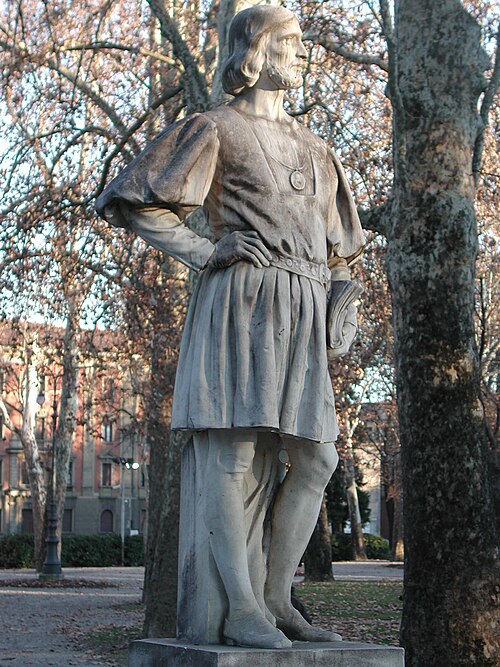
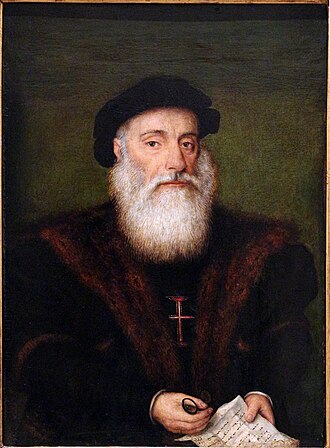
图:佚名 · CC BY-SA 3.0 · 维基共享资源
- 生卒
- 1474 年 9 月 8 日—1533 年 7 月 6 日 (日期为儒略历)
- 出生地
- 雷焦艾米利亚
- 去世地
- 费拉拉
- 身份
- 作家、诗人、剧作家
- 子女
- Virginio Ariosto
- 代表作
- 疯狂奥兰多
- 受影响于
- 维吉尔、马泰奥·马里亚·博亚尔多
- 原文名
- Ludovico Ariosto
- 宗教
- 天主教会
- 就读
- 费拉拉大学
- 任职机构
- 费拉拉大学
- 领域
- 诗歌、讽刺、演出法
- 流派 / 运动
- 文艺复兴全盛期
- 简述
- Italian poet (1474–1533)
阿里奥斯托(Ludovico Ariosto,1474年9月8日—1533年6月6日)意大利文艺复兴时诗人,代表作《疯狂的罗兰》。
详细介绍
生平
阿里奥斯托是雷焦艾米利亚一个富裕的贵族家庭的长子。尽管受到良好的人文主义教育,但阿里奥斯托一直未能掌握希腊文。因承担教育弟妹们的义务使他无法如愿全身心地投入学业和诗歌。他自1504年起追随伊波利托枢机(Ippolito d'Este),作为这位公子的使节,曾两次出使儒略二世的教廷。伊波利托后前往匈牙利,阿里奥斯托称病未从,转而事奉枢机的兄弟,费拉拉公爵阿尔方索一世。后者将他委任到偏远而贼寇横行的 Garfagnana 地方。在任期间阿里奥斯托治理成功,三年而退,回到费拉拉与情妇和儿子同享天伦。
著作
阿里奥斯托有模仿罗马诗人贺拉斯笔法写成七首《讽刺诗》(1517-1525)。他写作五部喜剧,根据拉丁古典文学但灵感来自当代生活,以俗语模仿拉丁喜剧。其代表作《疯狂的罗兰》是意大利文艺复兴时期重要的文学作品。《疯狂的罗兰》是博亚尔多《热恋的罗兰》(Orlando Innamorato)的续篇,第一版于1516年出版,40歌。其后又不断修改,1532年定稿时共46歌。故事以查理曼与撒拉森人之间的战争为背景,讲述罗兰迷恋上公主安洁莉卡的剧情。
正文摘自中文维基百科「阿里奥斯托」(删去了参考文献、表格和图片),按 CC BY-SA 4.0 使用
英文维基百科的更多内容
中文维基百科这一条比较短,下面是英文维基百科同一条目的节选,原文为英文,未翻译。
Ludovico Ariosto (UK: , US: ; Italian: [ludoˈviːko aˈrjɔsto, - ariˈɔsto]; 8 September 1474 – 6 July 1533) was an Italian poet. He is best known as the author of the romance epic Orlando Furioso (1516-1532). The poem, a continuation of Matteo Maria Boiardo's Orlando Innamorato, describes the adventures of Charlemagne, Orlando, and the Franks as they battle against the Saracens with diversions into many sideplots. The poem is transformed into a satire of the chivalric tradition. Ariosto composed the poem in the ottava rima rhyme scheme and introduced narrative commentary throughout the work.
Ariosto also coined the term "humanism" (in Italian, umanesimo) for choosing to focus upon the strengths and potential of humanity, rather than only upon its role as subordinate to God. This led to Renaissance humanism.
Birth and early life
Ariosto was born in Reggio nell'Emilia, where his father Niccolò Ariosto was commander of the citadel. He was the oldest of 10 children and was seen as the successor to the patriarchal position of his family. From his earliest years, Ludovico was very interested in poetry, but he was obliged by his father to study law.
After five years of law, Ariosto was allowed to read classics under Gregorio da Spoleto. Ariosto's studies of Greek and Latin literature were cut short by Spoleto's move to France to tutor Francesco Sforza. Shortly after this, Ariosto's father died.
Education and patronage
After the death of his father, Ludovico Ariosto was compelled to forgo his literary occupations and take care of his family, whose affairs were in disarray. Despite his family obligations, Ariosto managed to write some comedies in prose as well as lyrical pieces. Some of these attracted the notice of Cardinal Ippolito d'Este, who took the young poet under his patronage and appointed him one of the gentlemen of his household. Este compensated Ariosto poorly for his efforts;……
New patronage and diplomatic career
The cardinal's brother, Alfonso, duke of Ferrara, now took Ariosto under his patronage. By then, Ariosto had already distinguished himself as a diplomat, chiefly on the occasion of two visits to Rome as ambassador to Pope Julius II. The fatigue of one of these journeys brought on an illness from which he never recovered, and on his second mission he was nearly killed by order of the Pope, who happened at the time to be in conflict with Alfonso.
On account of the war, his salary of 84 crowns a year was suspended, and it was withdrawn altogether after the peace. Because of this, Ariosto asked the duke either to provide for him, or to allow him to seek employment elsewhere. He was appointed to the province of Garfagnana, then without a governor, situated on the Apennines, an appointment he held for three years.……
Poetic style
Throughout Ariosto's writing are narratorial comments dubbed by Daniel Javitch as "Cantus Interruptus". Javitch's term refers to Ariosto's narrative technique to break off one plot line in the middle of a canto, only to pick it up again in another, often much later, canto. Javitch argues that while many critics have assumed Ariosto does this so as to build narrative tension and keep the reader turning pages, the poet in reality defuses narrative tension because so much time separates the interruption and the resumption. By the time the reader gets to the continuation of the story, he or she has often forgotten or ceased to care about the plot and is usually wrapped up in another plot. Ariosto does this, Javitch argues, to undermine "man's foolish but persistent desire for continuity and completion". Ariosto uses it throughout his works.
正文摘自英文维基百科(原文为英文,未翻译)「Ludovico Ariosto」(节选,删去了参考文献、表格和图片),按 CC BY-SA 4.0 使用;在维基百科读全文 ›
受其影响的人物

同时代、同地区的人物



同时代、同身份的人物(文学)