史鉴

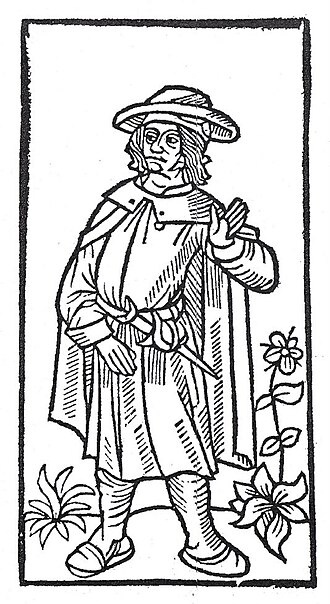
图:佚名 · Public domain · 维基共享资源
- 生卒
- 1441 年—1494 年 12 月 19 日 (日期为儒略历)
- 出生地
- 斯坎迪亚诺
- 去世地
- 雷焦艾米利亚
- 身份
- 作家、诗人
- 配偶
- Taddea Gonzaga
- 子女
- Camillo Boiardo
- 代表作
- 热恋的罗兰、La historia imperiale
- 简述
- Italian writer
马泰奥·马里亚·博亚尔多(英语:Matteo Maria Boiardo,1441年—1494年),文艺复兴时期欧洲作家。他效力于费拉拉宫廷,他创作有喜剧,十四行诗以及一部未完成的传奇小说《恋爱中的奥兰多》(1495年出版)。
正文摘自中文维基百科「马泰奥·马里亚·博亚尔多」(删去了参考文献、表格和图片),按 CC BY-SA 4.0 使用
英文维基百科的更多内容
中文维基百科这一条比较短,下面是英文维基百科同一条目的节选,原文为英文,未翻译。
Matteo Maria Boiardo (US: boy-AR-doh, boh-YAR-doh, Italian: [matˈtɛːo maˈriːa boˈjardo]; 1440 – 19/20 December 1494) was an Italian Renaissance poet, best known for his epic poem Orlando innamorato.
Early life
Boiardo was born in 1440, at or near, Scandiano (today's province of Reggio Emilia); the son of Giovanni di Feltrino and Lucia Strozzi. His mother Lucia was the sister of the humanist poet Tito Vespasiano Strozzi, his father Giovanni the son of Feltrino Boiardo, whom Niccolò III d'Este, Marquis of Ferrara, had made Count of Scandiano, with seignorial power over Arceto, Casalgrande, Gesso, and Torricella. Boiardo was an ideal example of a gifted and accomplished courtier, possessing both a gallant heart and deep humanistic learning.
In 1441 the family moved to Ferrara, where Matteo Maria grew up until his father died in 1451. At an early age he entered the University of Ferrara, where he acquired a good knowledge of Greek and Latin, and even of the Oriental languages. He was in due time admitted doctor in philosophy and in law.
Career
Up to the year of his marriage to Taddea Gonzaga, the daughter of the Count of Novellara (1472), he had received many marks of favour from Borso d'Este, Duke of Ferrara, having been sent to meet Frederick III (1469), and afterwards visiting Pope Paul II (1471) in the train of Borso. In 1473 he joined the retinue which escorted Eleonora of Aragon, the daughter of Ferdinand I, to meet her spouse, Ercole, at Ferrara.
In 1476 Boiardo returned to Ferrara to become Duke Ercole's companion; here he witnessed the unfolding of Niccolò d'Este's conspiracy against Ercole, his cousin, whose victory Boiardo promptly celebrated in his Latin Epigrammata. In 1478 Boiardo married Taddea dei Gonzaga of Novellara, by whom he had six children.
Writings
In his youth Boiardo had been a successful imitator of Petrarch's love poems. For Ercole d'Este he produced his first humanist works in Latin, the Carmina de laudibus Estensium and the Pastoralia, both dating from 1463–4; he also undertook a number of free translations into the vernacular, from Cornelius Nepos, Xenophon, Apuleius, Herodotus, and the chronicler Riccobaldo of Ferrara.
While in Reggio in 1469 Boiardo met Antonia Caprara, who inspired his canzoniere, his first original work in the vernacular, now regarded as one of the highest poetic achievements of the 15th century. Entitled Amorum libri tres and comprising 180 sonnets, canzoni, and madrigals, it recounts in Petrarchan mode the three phases of the poet's love, from initial joy to subsequent disillusionment and final mourning.……
Legacy
Boiardo's Orlando Innamorato enjoyed great popularity amongst his contemporaries, its unfinished state prompting a number of sequels by, amongst others, Nicolò degli Agostini, Raffaele Valcieco, and above all Ludovico Ariosto in his Orlando Furioso. But Pietro Bembo's reformation of the language in 1525, the rediscovery of Aristotle's Poetics in the 1530s, and the incipient Counter-Reformation in the 1540s all caused it to fall from favour amongst critics and writers, including Torquato Tasso, who found it lacking on linguistic, theoretical, and moral grounds.……
Translations
The first translation of Boiardo into English was Robert Tofte's Orlando Inamorato: The Three First Bookes (1598), in reality the first three cantos of book 1 in Domenichi's version. The Italian text was known to Spenser and Milton, but it was not until the 19th century that other partial translations were attempted, by Richard Wharton (1804), William Stewart Rose (1823), and Leigh Hunt (1846).
正文摘自英文维基百科(原文为英文,未翻译)「Matteo Maria Boiardo」(节选,删去了参考文献、表格和图片),按 CC BY-SA 4.0 使用;在维基百科读全文 ›
受其影响的人物
同时代、同地区的人物