史鉴
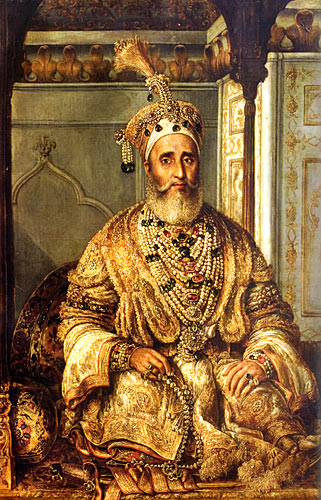
图:Ágoston Schoefft · Public domain · 维基共享资源
- 生卒
- 1775 年 10 月 24 日—1862 年 11 月 7 日
- 出生地
- 德里
- 去世地
- 仰光
- 国籍 / 所属
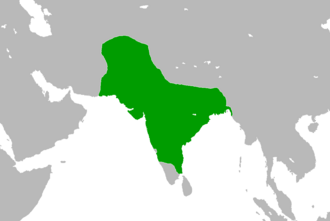
- 莫卧儿帝国
- 身份
- 君主、作家、诗人
- 职位
- Mughal emperor
- 父亲
- 阿克巴·沙二世
- 母亲
- Lal Bai Timurid Qudsia Begum Sahiba, Kallu Bai
- 配偶
- Zeenat Mahal、Taj Mahal Begum
- 子女
- 米尔扎·贾万·巴克特、Mirza Dara Bakht、Mirza Farkhunda Shah、Mirza Khizr Sultan
- 原文名
- ابو ظفر سِراجُ الْدین محمد بُہادر شاہ ظفر
- 家族
- 莫卧儿王朝、帖木儿王朝
- 宗教
- 逊尼派
- 简述
- 18th and last Mughal Emperor from 1837 to 1857
穆罕默德·巴哈杜尔沙阿·扎法尔(1775年10月24日—1862年11月7日,Bahadur Shah II、Abu Zafar Sirajuddin Muhammad Bahadur Shah Zafar、Bahadur Shah Zafar,或译作“巴哈杜尔沙二世”、“巴哈杜尔沙·扎法尔”),统治印度次大陆的莫卧儿帝国末代皇帝,亦为乌尔都语诗人。
巴哈杜尔·沙阿为莫卧儿皇帝阿克巴尔·沙阿二世与其印度妻子所生,在阿巴克·沙阿去世以后于1838年9月28日正式登基继承皇位。1857年爆发印度民族起义后,巴哈杜尔·沙阿翌年即被英国东印度公司当局殖软禁于第二次英缅战争后刚被英国占领的缅甸仰光大金寺内,最终于1862年郁郁而终。
正文摘自中文维基百科「巴哈杜尔·沙阿二世」(删去了参考文献、表格和图片),按 CC BY-SA 4.0 使用
英文维基百科的更多内容
中文维基百科这一条比较短,下面是英文维基百科同一条目的节选,原文为英文,未翻译。
Bahadur Shah II (Abu Zafar Siraj-ud-din Muhammad; 24 October 1775 – 7 November 1862), also known by his poetic title Bahadur Shah Zafar (Persian: بهادر شاه ظفر; Zafar lit. 'Victory'), was the twentieth and last Mughal emperor and an Urdu poet. He was a titular emperor with his authority limited to the Walled City of Delhi, but was declared the Emperor of India by the forces opposing East India Company forces in parts of the Indian subcontinent during the Indian Rebellion of 1857. Zafar was exiled to Rangoon in British-controlled Burma in December 1857 by the East India Company after rebel defeat in the war, putting an end to the nearly 500-year long Timurid dynasty started by Timur.
His spouse was Zeenat Mahal. He was the second son and the successor to his father, Akbar II, who died in 1837.
Bahadur Shah Zafar's father, Akbar II, had been imprisoned by the British and he was not his father's preferred choice as his successor. One of Akbar Shah's queens pressured him to declare her son, Mirza Jahangir, as his successor. However, the East India Company exiled Jahangir after he attacked Archibald Seton, their resident in the Red Fort, paving the way for Bahadur Shah to assume the throne.
Reign
Bahadur Shah Zafar ruled over a Mughal Empire that had by the early 19th century been reduced to only the city of Delhi and the surrounding territory as far as Palam.……
1857 Rebellion
As the Indian Rebellion of 1857 spread, Sepoy regiments reached the Mughal Court at Delhi.
On 12 May 1857, Zafar held his first formal audience in several years.……
Trial
The trial was a consequence of the Sepoy Mutiny and lasted for 21 days, had 19 hearings, 21 witnesses and over a hundred documents in Persian and Urdu, with their English translations, were produced in the court. At first the trial was suggested to be held at Calcutta, the place where Directors of East India company used to their sittings in connection with their commercial pursuits.……
Death
In 1862, at the age of 87, he fell ill. In October, his condition deteriorated. He was "spoon-fed on broth" but he found that difficult too by 3 November. On 6 November, the British Commissioner in Rangoon, Captain H. Nelson Davies, wrote that Zafar "is evidently sinking from pure desuetude and paralysis in the region of his throat".……
Family and descendants
Bahadur Shah Zafar had four wives and numerous concubines. His wives were:
- Begum Ashraf Mahal
- Begum Akhtar Mahal
- Begum Zeenat Mahal
- Begum Taj Mahal
- He had twenty-two sons including:
Mirza Dara Bakht Miran Shah (1790–1841)
- Mirza Muhammed Shahrukh Bahadur
- Mirza Kayumar Bahadur
Mirza Fath-ul-Mulk Bahadur (alias Mirza Fakhru) (1816–1856)
Mirza Muhammad Quwaish Bahadur
Mirza Mughal (1817–1857)
Religious beliefs
Bahadur Shah Zafar was a devout Sufi. He was regarded as a Sufi Pir and used to accept murids or pupils. The newspaper Delhi Urdu Akhbaar described him as "one of the leading saints of the age, approved of by the divine court." Before his accession, he lived like "a poor scholar and dervish", differing from his three royal brothers, Mirza Jahangir, Salim and Babur.……
Epitaph
He was a prolific Urdu poet and calligrapher. He wrote the following Ghazal as his own epitaph. In his book, The Last Mughal, William Dalrymple states that, according to Lahore scholar Imran Khan, the beginning of the verse, umr-e-darāz māṅg ke ("I asked for a long life") was not written by Zafar, and does not appear in any of the works published during Zafar's lifetime.……
Legacy
Zafar is seen as the hero of Indian rebellion of 1857. In 1943, the Indian National Army paid tribute to his tomb in Rangoon. In 1975, Indian government released a postal stamp in his honour.
In popular culture
Zafar was portrayed in the play 1857: Ek Safarnama set during the Indian Rebellion of 1857 by Javed Siddiqui.……
TV serials and films
A television show, Bahadur Shah Zafar, aired on Doordarshan in 1986.……
正文摘自英文维基百科(原文为英文,未翻译)「Bahadur Shah Zafar」(节选,删去了参考文献、表格和图片),按 CC BY-SA 4.0 使用;在维基百科读全文 ›
亲属
所属政权
同时代、同地区的人物

同时代、同身份的人物(帝王与政治)