史鉴
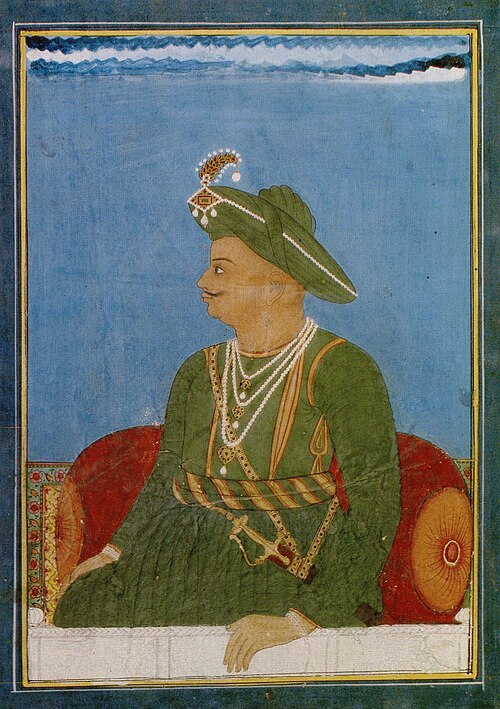
图:Anonymous artist from Mysore, India. · Public domain · 维基共享资源
- 生卒
- 1751 年 11 月 20 日—1799 年 5 月 4 日
- 出生地
- 代文赫利
- 去世地
- 什里伦格伯德讷
- 国籍 / 所属
- 迈索尔土邦
- 身份
- 作家、政治人物、统治者、freedom fighter
- 职位
- 君主、sultan of Mysore
- 父亲
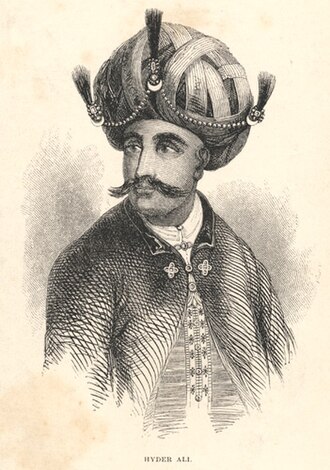
- 海达尔·阿里
- 子女
- Ghulam Muhammad Sultan Sahib、Shezada Hyder Ali、Abdul Khaliq Sultan、Fateh Hyder、Muiz-ud-din、Yasin Sahib、Subhan Sahib、Shukr-ullah、Ghulam Ahmad
- 参与
- 英迈战争
- 宗教
- 伊斯兰教
- 军衔
- 将军
- 简述
- 南印度迈索尔苏丹王
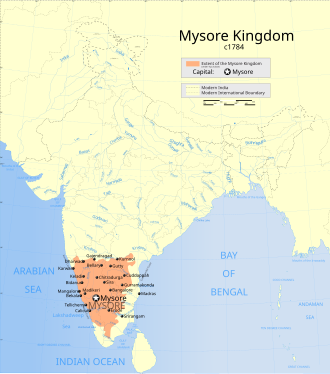
蒂普苏丹(乌尔都语:ٹیپو سلطان;波斯语:تیپو سلطان;印地语:टीपू सुल्तान;英语:Tipu Sultan,1750年11月20日—1799年5月4日),一译提普苏丹,本名Sultan Fateh Ali Sahab Tipu,南印度迈索尔王国首席大臣暨苏丹海达尔·阿里之子。其父阿里去世后成为迈索尔首席大臣暨苏丹(1782年至1799年)。摩诃罗阇瓦迪亚王朝的王权被架空。蒂普因以诗作而闻名,为虔诚的穆斯林,对其他宗教很宽容,比如让法国人建起了迈索尔第一座教堂。在第二次英国-迈索尔战争中,他协助父亲阿里打败了英国的入侵,并与英签订芒格洛尔条约;但第三次和第四次英国-迈索尔战争,与英国、特拉凡哥尔联军交战以失败告终,1799年5月4日,在斯赫里朗格阿帕特塔纳保卫战中阵亡。
1799年,经过英国-迈索尔战争之后,迈索尔被英国征服成为其辖下土邦,王权回归瓦迪亚王室,改由英国指派总督控制朝政。
正文摘自中文维基百科「蒂普苏丹」(删去了参考文献、表格和图片),按 CC BY-SA 4.0 使用
英文维基百科的更多内容
中文维基百科这一条比较短,下面是英文维基百科同一条目的节选,原文为英文,未翻译。
Tipu Sultan (Urdu: [ʈiːpuː sʊlt̪aːn], Kannada: [ʈipːu sult̪aːn], Sultan Fateh Ali Sahab Tipu; 1 December 1751 – 4 May 1799), commonly referred to as Sher-e-Mysore (Tiger of Mysore), was the Sultan of Mysore from 1782 until his death in 1799. He was a pioneer of rocket artillery. He expanded the iron-cased Mysorean rockets and commissioned the military manual Fathul Mujahidin. The economy of Mysore reached a zenith during his reign. He deployed rockets against advances of British forces and their allies during the Anglo-Mysore Wars, including the Battle of Pollilur and Siege of Srirangapatna.
Tipu Sultan and his father Hyder Ali used their French-trained army in alliance with the French in their struggle with the British, and in Mysore's struggles with other surrounding powers: against the Marathas, Sira, and rulers of Malabar, Kodagu, Bednore, Carnatic, and Travancore. Tipu became the ruler of Mysore upon his father's death from cancer in 1782 during the Second Anglo-Mysore War. He negotiated with the British in 1784 with the Treaty of Mangalore which ended the war in status quo ante bellum.
Tipu's conflicts with his neighbours included the Maratha–Mysore War, which ended with the signing of the Treaty of Gajendragad.
Tipu remained an enemy of the British East India Company. He initiated an attack on British-allied Travancore in 1789. In the Third Anglo-Mysore War, he was forced into the Treaty of Seringapatam, losing a number of previously conquered territories, including Malabar and Mangalore. In the Fourth Anglo-Mysore War, a combined force of British East India Company troops supported by the Marathas and the Nizam of Hyderabad defeated Tipu. He was killed on 4 May 1799 while defending his stronghold of Seringapatam.
Early years
Childhood
Tipu Sultan was born into a Muslim family in Devanahalli, in present-day Bangalore Rural district, about 33 km (21 mi) north of Bangalore on 1 December 1751. He was named "Tipu Sultan" after the saint Tipu Mastan Aulia of Arcot.……
Language
Tipu Sultan's mother tongue was Urdu.……
Early military service
Early Conflicts
Tipu Sultan was instructed in military tactics by French officers in the employment of his father. At age 15, he accompanied his father against the British in the First Anglo-Mysore War in 1766. He commanded a corps of cavalry in the invasion of Carnatic in 1767 at age 16.……
Second Anglo-Mysore War
In 1779, the British captured the French-controlled port of Mahé which Tipu had placed under his protection, providing some troops for its defence.……
Ruler of Mysore
On 29 December 1782, Tipu Sultan crowned himself Badshah or Emperor of Mysore with the title Nawab Tipu Sultan Bahadur at age 32, and struck coinage.
Conflicts with Maratha Confederacy
The Maratha Empire under its new Peshwa Madhavrao I regained most of Indian subcontinent, twice defeating Tipu's father in 1764 and then in 1767.……
Invasion of Malabar (1766–1790)
In 1766 when he was 15 years old Tipu accompanied his father on an invasion of Malabar.……
Death
Horatio Nelson defeated François-Paul Brueys D'Aigalliers at the Battle of the Nile in Egypt in 1798. Three armies marched into Mysore in 1799—one from Bombay and two British, one of which included Arthur Wellesley. They besieged the capital Srirangapatna in the Fourth Mysore War.……
Administration
Tipu introduced a new calendar, new coinage, and seven new government departments, during his reign, and made military innovations in the use of rocketry.
Mysorean rockets
Dr APJ Abdul Kalam, the former President of India, in his Tipu Sultan Shaheed Memorial Lecture in Bangalore (30 November 1991), called Tipu Sultan the innovator of the world's first war rocket.……
The coinage system
The coinage of Tipu Sultan is one of the most complex and fascinating series struck in India during the 18th century.……
Assessment and legacy
India
The original copy of the Constitution of India bears a painting of Tipu Sultan. School and college textbooks in India officially recognize him as a "freedom-fighter" along with many other rulers of the 18th century who fought European powers.
Family
Tipu had several wives. His first wife was Sultan Begum Sahib also known as Padishah Begum. She was the daughter of Imam Sahib Bakhshi Naita from Arcot, and sister of Ghulam Husain Khan, known as the Pondicherry Nawab, a descendant of Chanda Sahib. They married in 1774.……
正文摘自英文维基百科(原文为英文,未翻译)「Tipu Sultan」(节选,删去了参考文献、表格和图片),按 CC BY-SA 4.0 使用;在维基百科读全文 ›
亲属
所属政权
同时代、同地区的人物

同时代、同身份的人物(帝王与政治)