 史鉴
事件 › 条约与会议
消除对妇女一切形式歧视公约任择议定书
Optional Protocol to the Convention on the Elimination of All Forms of Discrimination against Women
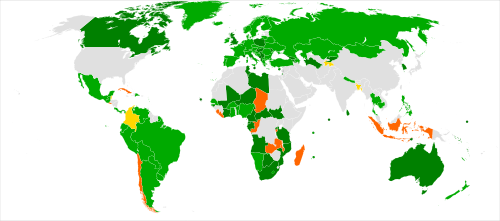
图:Mimid · CC BY-SA 4.0 · 维基共享资源
- 时间
- 1999 年 10 月 6 日
- 地点
- 纽约
- 国家 / 地区
- 美国
- 属于
- United Nations General Assembly Resolution 54/4
- 类型
- 条约
- 简述
- 1999 United Nations treaty
《〈消除对妇女一切形式歧视公约〉任择议定书》(英语:Optional Protocol to the Convention on the Elimination of All Forms of Discrimination against Women,OP-CEDAW)是一项国际条约,为《消除对妇女一切形式歧视公约》建立了申诉和调查机制。议定书缔约方允许消除对妇女歧视委员会受理个人申诉或调查“严重地或系统地侵犯公约所规定的权利”之情形。该议定书已促成委员会就家庭暴力、育儿假和强制绝育等问题对成员国作出多项裁决,并对墨西哥华雷斯城系统性杀害妇女事件进行了调查。
该议定书于1999年10月6日由联合国大会通过,2000年12月22日生效。截至2023年10月,该议定书有80个签署国和115个缔约方。
正文摘自中文维基百科「消除对妇女一切形式歧视公约任择议定书」(删去了参考文献、表格和图片),按 CC BY-SA 4.0 使用
英文维基百科的更多内容
中文维基百科这一条比较短,下面是英文维基百科同一条目的节选,原文为英文,未翻译。
The Optional Protocol to the Convention on the Elimination of All Forms of Discrimination against Women (OP-CEDAW) is an international treaty which establishes complaint and inquiry mechanisms for the Convention on the Elimination of All Forms of Discrimination Against Women (CEDAW). Parties to the Protocol allow the Committee on the Elimination of Discrimination against Women to hear complaints from individuals or inquire into "grave or systematic violations" of the convention. The Protocol has led to a number of decisions against member states on issues such as domestic violence, parental leave and forced sterilization, as well as an investigation into the systematic killing of women in the Mexican city of Ciudad Juárez, Chihuahua.
The Protocol was adopted by the United Nations General Assembly on 6 October 1999, and in force from 22 December 2000. As of October 2023, the Protocol has 80 signatories and 115 parties.
Genesis
In 1979, the United Nations General Assembly adopted the Convention on the Elimination of All Forms of Discrimination Against Women (CEDAW). The Convention outlawed discrimination against women, but did not include any mechanism by which this prohibition could be legally enforced.
An individual complaints mechanism was suggested during the original drafting of CEDAW, but was rejected at the time.……
Summary
The Convention on the Elimination of All Forms of Discrimination against Women outlaws discrimination on the basis of gender, and obliges its parties to repeal discriminatory laws and guarantee equality in the fields of health, employment, and education. The Optional Protocol is a subsidiary agreement to the convention. It does not establish any new rights, but rather allows the rights guaranteed in the convention to be enforced.
Reservations and membership
A number of parties have made reservations and interpretative declarations to their application of the Protocol. Bangladesh, Belize and Colombia have exercised their right under Article 10 of the Protocol not to recognise the jurisdiction of the committee to investigate "grave or systematic violations" of the convention. Colombia declares that neither the Protocol nor the committee can require it to decriminalise "offences against life or personal integrity".
Individual complaints
The Committee on the Elimination of Discrimination against Women has considered eleven complaints against seven countries since the Optional Protocol came into force, on subjects such as domestic violence, division of property, forced sterilization and parental leave. Six complaints were rejected for lack of jurisdiction or because the complainants had not exhausted all domestic remedies. The other five decisions are summarised below:
Inquiries
The committee has also conducted one inquiry into "grave or systematic violations" under Article 8, in relation to the systematic killing of women in the Mexican city of Ciudad Juárez, Chihuahua. This found "serious lapses in compliance" by the Mexican government and tolerance of severe and systematic abuses of women's rights.……
Impact and criticism
The impact of an international treaty can be measured in two ways: by its acceptance, and by its implementation. On the first measure, the Optional Protocol has gained widespread international acceptance. Most major states are parties, and the protocol is the second most-accepted enforcement mechanism after the First Optional Protocol to the International Covenant on Civil and Political Rights.
On the second measure, the number of complaints dealt with by the committee has been limited.……
正文摘自英文维基百科(原文为英文,未翻译)「Optional Protocol to the Convention on the Elimination of All Forms of Discrimination Against Women」(节选,删去了参考文献、表格和图片),按 CC BY-SA 4.0 使用;在维基百科读全文 ›
同时期、同地区的大事
- 九一一袭击事件2001 年 9 月 11 日 · 其他事件 · 北美洲
- Black Lives Matter2013 年 7 月 13 日 · 革命与起义 · 北美洲
- 2013年波士顿马拉松爆炸案2013 年 4 月 15 日 · 屠杀与暗杀 · 北美洲
- 代顿协议1995 年 11 月 21 日 · 条约与会议 · 北美洲
- 桑迪·胡克小学枪击案2012 年 12 月 14 日 · 其他事件 · 北美洲
- 科伦拜校园事件1999 年 4 月 20 日 · 其他事件 · 北美洲
- 阿拉摩之战2001 年 9 月 11 日 · 战役 · 北美洲
- 挑战者号航天飞机灾难1986 年 1 月 28 日 · 其他事件 · 北美洲
- 占领华尔街2011 年 9 月 17 日 · 革命与起义 · 北美洲
- 俄克拉何马城爆炸案1995 年 4 月 19 日 · 屠杀与暗杀 · 北美洲
- 美国航空11号班机恐怖袭击2001 年 9 月 11 日 · 屠杀与暗杀 · 北美洲
- 伊朗门事件1985 年 8 月 20 日—1987 年 3 月 4 日 · 其他事件 · 北美洲
同时期的同类事件(条约与会议)
- 巴黎协议2015 年 12 月 12 日 · 条约与会议 · 欧洲
- 申根公约1985 年 6 月 14 日 · 条约与会议 · 欧洲
- 国际刑事法院罗马规约1998 年 7 月 17 日 · 条约与会议 · 欧洲
- 贝尔法斯特协议1998 年 4 月 10 日 · 条约与会议 · 欧洲
- 赫尔辛基协议1975 年 8 月 1 日 · 条约与会议 · 欧洲
- 戴维营协议1978 年 9 月 17 日 · 条约与会议 · 北美洲
- 蒙特利尔议定书1987 年 9 月 16 日 · 条约与会议 · 北美洲
- 反假冒贸易协定2011 年 10 月 · 条约与会议 · 跨地区
- 禁止核武器条约2017 年 9 月 20 日 · 条约与会议 · 北美洲
- 别洛韦日协议1991 年 12 月 8 日 · 条约与会议 · 欧洲
- 关于持久性有机污染物的斯德哥尔摩公约2001 年 5 月 22 日 · 条约与会议 · 欧洲
- 渥太华条约1997 年 12 月 3 日 · 条约与会议 · 北美洲