 史鉴
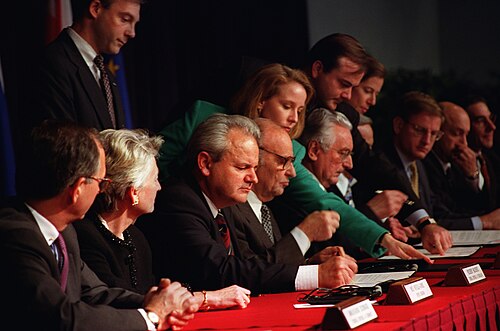
图:U.S. Air Force/Staff Sgt. Brian Schlumbohm · Public domain · 维基共享资源
- 时间
- 1995 年 11 月 21 日
- 地点
- 莱特-帕特森空军基地
- 参与方
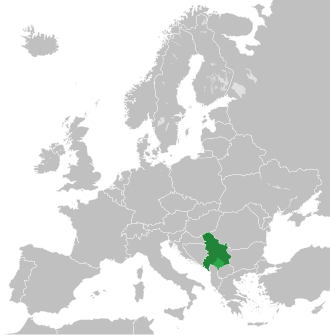
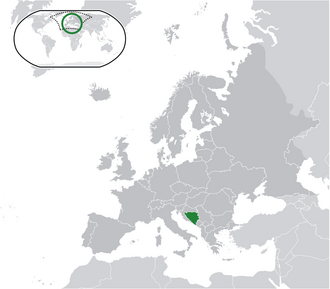
- 克罗地亚、南斯拉夫联盟共和国、波斯尼亚和黑塞哥维那共和国
- 类型
- 和平条约、作品版本或翻译
- 简述
- late-1995 treaty ending the Bosnian War
《代顿协议》,全称《波斯尼亚和赫塞哥维纳和平总框架协定》,又称《巴黎议定书》、《代顿·巴黎协议》,是波斯尼亚战争中交战各方在1995年12月14日于巴黎所正式签订的协定,同意中止这场长达3年8个月的内战。1995年11月,协议于美国俄亥俄州代顿市赖特-帕特森空军基地签署,因此得名。交战各方同意建立统一的波斯尼亚和黑塞哥维那主权国家。国家由两大实体组成:塞尔维亚族为主的塞族共和国与克罗地亚族、波斯尼亚族为主的波斯尼亚和赫塞哥维纳联邦。根据《代顿协议》,波黑于1996年加入军备控制条约《佛罗伦斯协定》。
详细介绍
内容
代顿协议的重点如下:
维持波斯尼亚和赫塞哥维纳领土不变成为采取邦联制度的国家,波黑联邦(穆克联邦)占有51%的领土,剩下的49%由塞族共和国所管理。
两边的政治实体设立其独自的总统和总理,在此之上设置一个全国性的两院制的立法机构和中央银行。
连接波斯尼亚东部和北边塞族共和国的布尔奇科地区由国际仲裁团决定其归属。
联合国部队以外的其他部队都必须要于30天内撤出,由联合国的维和部队监督停火,控制领空和执行协议等多方面的工作则由北约的部队来管理,该部队被称为“多国军事执行部队”,享有充分的执行权和在波斯尼亚赫塞哥维纳境内行动的自由。
和平协议在巴黎签署后六至九个月内中央政府和两方分别举行选举。
设立人权委员会调查违反人权的情况。
被国际法庭指控为战犯者不得参选公职。
正文摘自中文维基百科「岱顿协定」(删去了参考文献、表格和图片),按 CC BY-SA 4.0 使用
英文维基百科的更多内容
中文维基百科这一条比较短,下面是英文维基百科同一条目的节选,原文为英文,未翻译。
The General Framework Agreement for Peace in Bosnia and Herzegovina, also known as the Dayton Agreement or the Dayton Accords (Serbo-Croatian: Dejtonski mirovni sporazum / Дејтонски мировни споразум), and colloquially known as the Dayton (Serbo-Croatian: Dejton / Дејтон), is the peace agreement ending the three-and-a-half-year-long Bosnian War, an armed conflict part of the larger Yugoslav Wars. It was signed on 21 November 1995 in Dayton, Ohio, United States, at Wright-Patterson Air Force Base. It was re-signed ceremonially in Paris, France, on 14 December 1995.
The warring parties agreed to peace and to a single sovereign state known as Bosnia and Herzegovina composed of two parts: the largely Serb-populated Republika Srpska and mainly Croat-Bosniak-populated Federation of Bosnia and Herzegovina. Bosnia and Herzegovina entered into the related arms control treaty, the Florence Agreement, in 1996 under the Accords. The Dayton followed the Washington Agreement, signed the year prior, in collective efforts to delineate the country's geography.
Praised for establishing lasting peace in Bosnia and Herzegovina, the Dayton Accords have also been criticized for creating an unduly complex political governance system in the country, as well as entrenching regional ethnic cleansing.
Negotiation and signature
Though basic elements of the Dayton Agreement were proposed in international talks as early as 1992, these negotiations were initiated following the unsuccessful previous peace efforts and arrangements, the August 1995 Croatian military Operation Storm and its aftermath, the government military offensive against the Republika Srpska, conducted in parallel with NATO's Operation Deliberate Force.……
Content
The agreement's main purpose is to promote peace and stability in Bosnia and Herzegovina and to endorse regional balance in and around the former Yugoslavia (Article V, annex 1-B).
The present political divisions of Bosnia and Herzegovina and its structure of government were agreed upon (Annex 4). A key component of this was the delineation of the Inter-Entity Boundary Line to which many of the tasks listed in the Annexes referred.
Territorial changes
Before the agreement, Bosnian Serbs controlled about 46% of Bosnia and Herzegovina (23,687 km2), Bosniaks 28% (14,505 km2) and Bosnian Croats 25% (12,937 km2).
Bosnian Serbs got large tracts of mountainous territories back (4% from Bosnian Croats and some small amounts from Bosniaks), but they had to surrender Sarajevo and some vital Eastern Bosnian/Herzegovian positions. Their percentage grew to 49% (48% by excluding the Brčko District, 24,526 km2).
Control of Republika Srpska
About 89.5% (22,059 km2) was under control of Bosnian Serbs
Control of Federation of Bosnia and Herzegovina
Cantons
Herzeg-Bosnian Canton (Canton 10):
Appraisals
The immediate purpose of the agreement was to freeze the military confrontation and prevent it from resuming. It was therefore defined as a "construction of necessity".
The Dayton Agreement was aimed at allowing Bosnia and Herzegovina to move from an early post-conflict phase through reconstruction and consolidation, adopting a consociational power-sharing approach. Scholars such as Canadian professor Charles-Philippe David calls Dayton "the most impressive example of conflict resolution". American scholar Howard M.……
Disappearance of the Serbian and Bosnian copy
The copy that belonged to the Federal Republic of Yugoslavia (now Serbia) is believed to have disappeared or burned during the NATO bombing of 1999 or in October 2000 when it allegedly disappeared during the chaotic protests and popular overthrow of the regime of Slobodan Milošević, during which government buildings and archives were looted.……
正文摘自英文维基百科(原文为英文,未翻译)「Dayton Agreement」(节选,删去了参考文献、表格和图片),按 CC BY-SA 4.0 使用;在维基百科读全文 ›
相关政权
同时期、同地区的大事
- 九一一袭击事件2001 年 9 月 11 日 · 其他事件 · 北美洲
- 科伦拜校园事件1999 年 4 月 20 日 · 其他事件 · 北美洲
- 阿拉摩之战2001 年 9 月 11 日 · 战役 · 北美洲
- 挑战者号航天飞机灾难1986 年 1 月 28 日 · 其他事件 · 北美洲
- 俄克拉何马城爆炸案1995 年 4 月 19 日 · 屠杀与暗杀 · 北美洲
- 查科文化国家历史公园1980 年 12 月 19 日 · 其他事件 · 北美洲
- 美国航空11号班机恐怖袭击2001 年 9 月 11 日 · 屠杀与暗杀 · 北美洲
- 伊朗门事件1985 年 8 月 20 日—1987 年 3 月 4 日 · 其他事件 · 北美洲
- 蒙特利尔议定书1987 年 9 月 16 日 · 条约与会议 · 北美洲
- 弗吉尼亚理工大学校园枪击案2007 年 4 月 16 日 · 其他事件 · 北美洲
- 联合航空93号班机恐怖袭击2001 年 9 月 11 日 · 屠杀与暗杀 · 北美洲
- 哥伦比亚号航天飞机灾难2003 年 2 月 1 日 · 其他事件 · 北美洲
同时期的同类事件(条约与会议)
- 巴黎协议2015 年 12 月 12 日 · 条约与会议 · 欧洲
- 申根公约1985 年 6 月 14 日 · 条约与会议 · 欧洲
- 不扩散核武器条约1968 年 7 月 1 日 · 条约与会议 · 欧洲
- 国际刑事法院罗马规约1998 年 7 月 17 日 · 条约与会议 · 欧洲
- 贝尔法斯特协议1998 年 4 月 10 日 · 条约与会议 · 欧洲
- 赫尔辛基协议1975 年 8 月 1 日 · 条约与会议 · 欧洲
- 戴维营协议1978 年 9 月 17 日 · 条约与会议 · 北美洲
- 反假冒贸易协定2011 年 10 月 · 条约与会议 · 跨地区
- 禁止核武器条约2017 年 9 月 20 日 · 条约与会议 · 北美洲
- 别洛韦日协议1991 年 12 月 8 日 · 条约与会议 · 欧洲
- 关于持久性有机污染物的斯德哥尔摩公约2001 年 5 月 22 日 · 条约与会议 · 欧洲
- 渥太华条约1997 年 12 月 3 日 · 条约与会议 · 北美洲