 史鉴
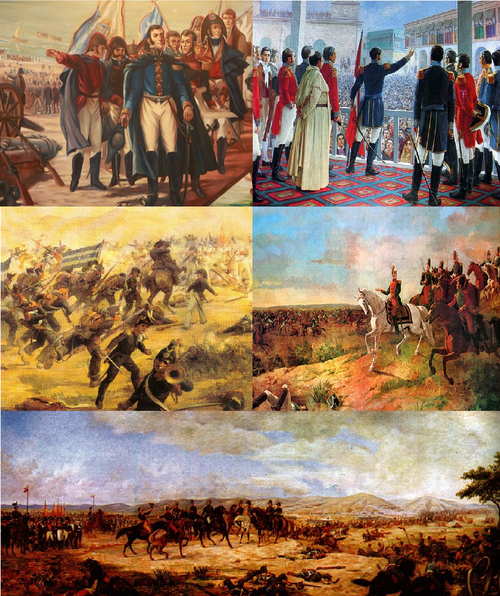
图:LLs · CC BY-SA 4.0 · 维基共享资源
- 时间
- 1821 年—1824 年
- 地点
- 秘鲁总督区
- 属于
- 西班牙美洲独立战争
- 类型
- 独立、独立战争
- 简述
- 1811–1824 war between Spanish Royalists and Patriot forces, which led to the Independence of Peru
秘鲁独立战争(西班牙语:Guerra de Independencia del Perú)是1811年至1826年秘鲁“爱国者”军队与西班牙殖民政府军之间爆发的一系列武装冲突。这场战争导致了秘鲁从西班牙殖民地中独立。
1811年,法兰西斯科·安东尼奥·德·泽拉(Francisco Antonio de Zela)在秘鲁南部城市塔克纳起兵,独立战争正式爆发。1814年安古罗兄弟(Hermanos Angulo)于库斯科发动叛乱,1821年秘鲁宣布独立并建立了秘鲁保护国。1822年,西蒙·玻利瓦尔和何塞·圣马丁在厄瓜多尔瓜亚基尔会面,在会谈中两人讨论关于秘鲁以及南美洲未来的政治体制。基于理念不合,何塞·圣马丁离开了秘鲁,玻利瓦于1824年成为秘鲁总统。1826年秘鲁攻下卡亚俄,秘鲁独立战争结束。
正文摘自中文维基百科「秘鲁独立战争」(删去了参考文献、表格和图片),按 CC BY-SA 4.0 使用
英文维基百科的更多内容
中文维基百科这一条比较短,下面是英文维基百科同一条目的节选,原文为英文,未翻译。
The Peruvian War of Independence (Spanish: Guerra de Independencia del Perú) was a series of military conflicts in Peru from 1809 to 1826. Part of the broader Spanish American wars of independence, it led to the dissolution of the Spanish Viceroyalty of Peru and the emergence of Peru as an independent state on 28 July 1821. The Battle of Ayacucho in 1824 secured the independence of Peru and definitively ended Spanish rule in South America. However, Peru achieved full sovereignty only after the end of Simon Bolívar's influence and the Gran Colombian military occupation. His Federation of the Andes project was discarded and the last Gran Colombian garrison returned the Real Felipe Fortress to the Peruvians on 16 February 1827.
Throughout the colonial period of Peru, there were several social uprisings, though none constituted a true independence movement. The Rebellion of Túpac Amaru II, although not the first or the last, was the most significant and culminated in violent repression by the viceregal authorities. This uprising erupted in response to the Bourbon Reforms and was the first time that viceregal documents used the term "insurgents." It was also a movement that proclaimed the abolition of slavery in Peru. However, there is debate as to whether the purpose of this rebellion was truly independence or a revolution of the viceregal social order.
The Atlantic liberal revolutions transformed the political map of both America and Europe. French Emperor Napoleon Bonaparte's 1808 invasion of Spain resulted in the abdications of Charles IV and Ferdinand VII in favour of Joseph Bonaparte. In Spanish America, autonomous governments arose in the power vacuum and instability of mainland Spain in Europe.……
Background
Some of the early Spanish conquistadors who explored Peru made the first attempts for independence from the Spanish crown. They tried to liberate themselves from the Viceroyalty, who governed on behalf of the king of Castile. Throughout the eighteenth century, there were several indigenous uprisings against colonial rule and their treatment by the colonial authorities.……
Junta movements and uprisings (1809–1814)
Despite the royalist tendencies of Upper Peru and overall lack of political unrest from the general public between the end of the Rebellion of Túpac Amaru II (which ended in 1783) and 1808, junta movements did emerge.……
Tacna rebellion (1811)
The first significant attempt of an armed rebellion was the 1811 Tacna rebellion, led by Francisco Antonio de Zela.……
Huánuco rebellion (1812)
Another significant movement, led by natives in Huánuco, began on 22 February 1812.……
Consolidation of Royalist power (1815–1820)
After the squashing of the aforementioned rebellion, Peru remained firmly in the hands of the Royalists.
Reinforced with the royalist regiments of Lima and Arequipa, and expeditionary elements from Europe, the Viceroy of Peru organised several expeditions against the Patriots in Chile, Bolivia and Argentina.……
Liberation campaigns of San Martín and Bolívar (1820–1825)
Liberating Expedition and the Peruvian Republic (1820-1822)
To achieve the liberation of Peru, leaders of Argentina and Chile signed a treaty on 5 February 1819 to prepare for an invasion. General José de San Martín believed that the liberation of Argentina would not be secure until the Royalist stronghold in Peru was defeated, thus moving focus to the region.
Peruvian campaign
The internal pacification of the Viceroyalty of Peru allowed the Viceroy to organize two expeditions against the Chilean patriots, composed of royalist regiments from Arequipa and Lima and European expeditionary battalions.……
Aftermath
The independence of Peru was an important chapter in the Hispano-American wars of independence. Spain renounced all their continental American territories ten years later in 1836 leaving very little of its vast empire intact.
Political dependence on Spain had been severed, but Peru was still economically dependent on Europe.……
Social consequences
The struggle for independence in 18th and 19th century Peru was a complex and multifaceted process, marked by indigenous uprisings, colonial resistance, and the emergence of strong regional identities.……
正文摘自英文维基百科(原文为英文,未翻译)「Peruvian War of Independence」(节选,删去了参考文献、表格和图片),按 CC BY-SA 4.0 使用;在维基百科读全文 ›
下属事件
- Battle of Huaqui1811 年 6 月 20 日 · 战役 · 拉丁美洲
- Battle of Riobamba1822 年 4 月 21 日 · 战役 · 拉丁美洲
- Battle of Ica1822 年 4 月 7 日 · 战役 · 拉丁美洲
- Battle of Zepita1823 年 8 月 25 日 · 战役 · 拉丁美洲
- 阿亚库乔战役1824 年 12 月 9 日 · 战役 · 拉丁美洲
- 胡宁战役1824 年 8 月 6 日 · 战役 · 拉丁美洲
- Battle of Corpahuaico1824 年 12 月 3 日 · 战役 · 拉丁美洲
- Iquicha War1825 年 3 月—1828 年 6 月 8 日 · 战争 · 拉丁美洲
相关人物


同时期、同地区的大事
- 西班牙美洲独立战争1808 年 9 月 25 日—1833 年 9 月 29 日 · 战争 · 拉丁美洲
- 五月革命1810 年 5 月 25 日 · 革命与起义 · 拉丁美洲
- 阿亚库乔战役1824 年 12 月 9 日 · 战役 · 拉丁美洲
- 阿根廷独立战争1810 年—1816 年 · 战争 · 拉丁美洲
- 阿根廷邦联1831 年 1 月 4 日—1861 年 12 月 12 日 · 时代与时期 · 拉丁美洲
- 多洛雷斯呼声1810 年 9 月 16 日 · 革命与起义 · 拉丁美洲
- 巴西独立1822 年 9 月 7 日 · 其他事件 · 拉丁美洲
- 西斯普拉蒂纳战争1825 年 12 月 10 日—1828 年 8 月 27 日 · 战争 · 拉丁美洲
- 波亚卡战役1819 年 8 月 7 日 · 战役 · 拉丁美洲
- 破衫战争1835 年 9 月 20 日—1845 年 3 月 1 日 · 战争 · 拉丁美洲
- 查卡布科战役1817 年 2 月 12 日 · 战役 · 拉丁美洲
- 智利独立战争1827 年 · 战争 · 拉丁美洲
同时期的同类事件(战争)
- 拿破仑战争1803 年—1815 年 · 战争 · 欧洲
- 1812年战争1812 年 6 月 18 日—1815 年 2 月 18 日 · 战争 · 北美洲
- 俄法战争1812 年 6 月 24 日—1812 年 12 月 14 日 · 战争 · 中亚与北亚
- 第一次鸦片战争1839 年 3 月 18 日—1842 年 8 月 29 日 · 战争 · 东亚
- 美墨战争1846 年 4 月 24 日—1848 年 2 月 2 日 · 战争 · 拉丁美洲
- 希腊独立战争1821 年—1829 年 · 战争 · 西亚
- 太平天国运动1851 年 1 月 11 日—1864 年 8 月 · 战争 · 东亚
- 半岛战争1808 年 5 月 2 日—1814 年 4 月 17 日 · 战争 · 欧洲
- 1848年匈牙利革命1848 年 3 月 15 日—1849 年 10 月 4 日 · 战争 · 欧洲
- 法国大革命战争1792 年 4 月 20 日—1802 年 3 月 25 日 · 战争 · 欧洲
- 墨西哥独立战争1800 年 9 月 16 日—1821 年 9 月 27 日 · 战争 · 北美洲
- 旺代战争1793 年 3 月 3 日—1796 年 7 月 16 日 · 战争 · 欧洲