 史鉴
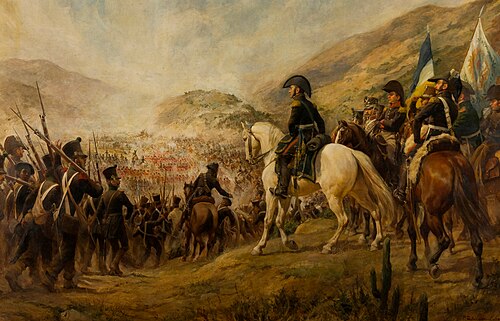
图:Pedro Subercaseaux · Public domain · 维基共享资源
- 时间
- 1817 年 2 月 12 日
- 地点
- 圣地亚哥
- 国家 / 地区
- 智利
- 属于
- 阿根廷独立战争、智利独立战争、西班牙美洲独立战争
- 类型
- 战役
- 简述
- 1817 battle of the Spanish American wars of independence
查卡布科战役(英语:Battle of Chacabuco)是1817年2月12日时,智利独立战争期间爆发的其中一场战斗。其中拉布拉他联合省上将荷西·德·圣马丁所领导的安第斯军击败了西班牙部队,并且宣告智利都督府的统治失败,之后西班牙为其控制的地区另外划入了秘鲁副王区政府。
正文摘自中文维基百科「查卡布科战役」(删去了参考文献、表格和图片),按 CC BY-SA 4.0 使用
英文维基百科的更多内容
中文维基百科这一条比较短,下面是英文维基百科同一条目的节选,原文为英文,未翻译。
The Battle of Chacabuco, fought during the Chilean War of Independence, took place on February 12, 1817. The Army of the Andes, from the United Provinces of the Río de la Plata and led by Captain–General José de San Martín, defeated a Spanish force commanded by Rafael Maroto. This victory was a significant defeat for the Captaincy General of Chile, the royalist government established after the division of the Viceroyalty of Peru.
Background
In 1814, after helping establish a popularly elected congress in Argentina, José de San Martín began considering how to expel the Spanish royalists from South America entirely. He recognized that the first step would be to drive them out of Chile, and with this in mind, he began recruiting and equipping an army. In under two years, he had assembled a force of approximately 6,000 men, 1,200 horses, and 22 cannons.
On January 17, 1817, San Martín set out with this force and commenced the challenging crossing of the Andes. Thanks to his careful planning, the royalist forces in Chile were misled into defending against threats that did not exist, allowing his crossing to go unchallenged.……
Prelude
San Martín received numerous reports on the Spanish plans from a spy disguised as a roto, a poverty-stricken Chilean peasant. The roto informed him that the Spanish general, Marcó, was aware of fighting in the mountains and had ordered his army to "run to the field," referring to Chacabuco. The spy also revealed the strategy of General Rafael Maroto, leader of the Talavera Regiment and a force of up to 2,000 volunteers. Maroto’s plan was to take control of the mountainside and launch an attack against San Martín.
On February 11, three days before his intended attack, San Martín convened a war council to decide on a plan. Their primary objective was to capture the Chacabuco Ranch, the royalist headquarters located at the foot of the hills. San Martín decided to divide his 2,000 troops into two groups, sending them down two separate roads on either side of the mountain.……
Battle
San Martín sent his troops down the mountain starting at midnight on the 11th to prepare for an attack at dawn. By dawn, his troops were much closer to the royalists than anticipated, but they fought hard and heroically. Meanwhile, Soler's troops had to descend a narrow path that proved long and arduous, taking longer than expected. General O’Higgins, supposedly overcome with passion upon seeing his homeland, abandoned the planned attack and charged ahead with his 1,500 men. What exactly transpired during this part of the battle is fiercely debated. O’Higgins claimed the royalists had stopped retreating and began advancing toward his troops. He argued that if he had ordered his men to retreat back up the narrow path, they would have been picked off one by one.……
Aftermath
The remaining royalist troops retreated to the southern tip of Chile, where they established a small enclave, forming what was essentially a mini Spanish Chile. They were reinforced by sea and continued to pose a threat to the Chilean nation until they were ultimately forced to withdraw by sea to Lima. Interim governor Francisco Ruiz-Tagle presided over an assembly that initially designated San Martín as governor. However, San Martín declined the position, calling for a new assembly, which appointed O'Higgins as Supreme Director of Chile. This marked the beginning of the "Patria Nueva" period in Chile's history.
The aftermath of the battle had several significant outcomes:
1. Reclamation of Santiago:
After the battle, the patriot forces re-entered Santiago, the capital of Chile.……
正文摘自英文维基百科(原文为英文,未翻译)「Battle of Chacabuco」(节选,删去了参考文献、表格和图片),按 CC BY-SA 4.0 使用;在维基百科读全文 ›
同时期、同地区的大事
- 西班牙美洲独立战争1808 年 9 月 25 日—1833 年 9 月 29 日 · 战争 · 拉丁美洲
- 五月革命1810 年 5 月 25 日 · 革命与起义 · 拉丁美洲
- 阿亚库乔战役1824 年 12 月 9 日 · 战役 · 拉丁美洲
- 阿根廷独立战争1810 年—1816 年 · 战争 · 拉丁美洲
- 阿根廷邦联1831 年 1 月 4 日—1861 年 12 月 12 日 · 时代与时期 · 拉丁美洲
- 多洛雷斯呼声1810 年 9 月 16 日 · 革命与起义 · 拉丁美洲
- 巴西独立1822 年 9 月 7 日 · 其他事件 · 拉丁美洲
- 西斯普拉蒂纳战争1825 年 12 月 10 日—1828 年 8 月 27 日 · 战争 · 拉丁美洲
- 秘鲁独立战争1821 年—1824 年 · 战争 · 拉丁美洲
- 波亚卡战役1819 年 8 月 7 日 · 战役 · 拉丁美洲
- 智利独立战争1827 年 · 战争 · 拉丁美洲
- 阿根廷内战1814 年—1880 年 · 战争 · 拉丁美洲
同时期的同类事件(战役)
- 滑铁卢战役1815 年 6 月 18 日 · 战役 · 欧洲
- 特拉法加海战1805 年 10 月 21 日 · 战役 · 欧洲
- 奥斯特里茨战役1805 年 12 月 2 日 · 战役 · 欧洲
- 百日王朝1815 年 3 月 20 日—1815 年 7 月 8 日 · 战役 · 欧洲
- 莱比锡战役1813 年 10 月 16 日—1813 年 10 月 19 日 · 战役 · 欧洲
- 博罗金诺战役1812 年 9 月 7 日 · 战役 · 欧洲
- 耶拿会战1806 年 10 月 14 日 · 战役 · 欧洲
- 埃及远征1798 年 7 月 1 日—1801 年 9 月 2 日 · 战役 · 非洲
- 尼罗河河口海战1798 年 8 月 1 日 · 战役 · 非洲
- 马伦哥战役1800 年 6 月 14 日 · 战役 · 欧洲
- 金字塔战役1798 年 7 月 21 日 · 战役 · 非洲
- 纳瓦里诺海战1827 年 10 月 20 日 · 战役 · 欧洲