 史鉴
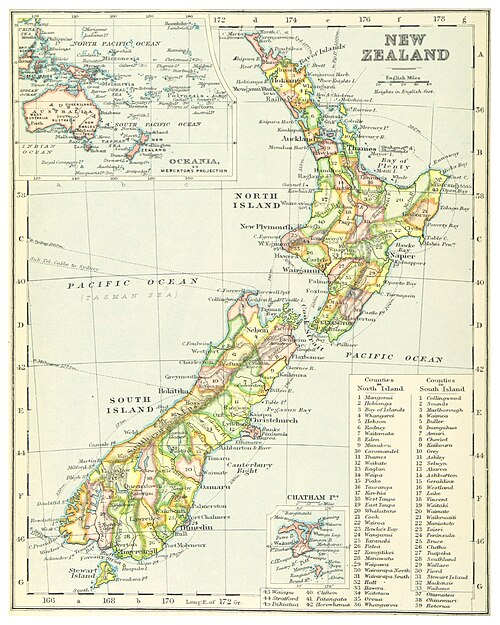
图:佚名 · Public domain · 维基共享资源
- 时间
- 1841 年 7 月 1 日—1907 年 9 月 26 日
- 国家 / 地区
- 新西兰
- 后一事件
- 新西兰
- 类型
- 直辖殖民地
- 简述
- constitutional monarchy in Oceania (1844–1907)
新西兰殖民地是大不列颠及爱尔兰联合王国的一块殖民地,主要位于现今的新西兰。它成立于1841年,最终于1907年废除。在新西兰殖民地成立之前,当地是新南威尔士殖民地的一部分。新西兰殖民地成立后,英国政府委托新西兰总督负责管理新西兰殖民地。殖民地成立初期,新西兰殖民地是英国的直辖殖民地,新西兰总督权力非常大。
1852年新西兰宪法法案通过后,新西兰殖民地获得自治权,成为英国一个自治殖民地。 1853年,新西兰殖民地举行选举,第一届议会由此产生。1856年,责任政府成立。此时新西兰总督已无法独裁,只有经过新西兰政府部长同意, 新西兰总督才能施政。1907年,新西兰殖民地变成新西兰自治领。
历史上曾有3个城市先后成为新西兰殖民地的首都。1841年新西兰殖民地成立时,首都位于奥基亚托。1841年至1865年期间,首都位于奥克兰。1865年,首都搬迁至惠灵顿。
正文摘自中文维基百科「新西兰殖民地」(删去了参考文献、表格和图片),按 CC BY-SA 4.0 使用
英文维基百科的更多内容
中文维基百科这一条比较短,下面是英文维基百科同一条目的节选,原文为英文,未翻译。
The Colony of New Zealand was a colony of the United Kingdom from 1841 to 1907. British authority was vested in a governor. The colony had three successive capitals: Okiato (or Old Russell) in 1841; Auckland from 1841 to 1865; and Wellington from 1865. Following the New Zealand Constitution Act 1852, the colony became a Crown colony with its first elected parliament in 1853. Responsible self-government was established in 1856 with the governor required to act on the advice of his ministers. In 1907, the colony became the Dominion of New Zealand.
History
Establishment
Following the extension of the boundaries of New South Wales in January 1840 by Governor Gipps to include New Zealand, William Hobson left Sydney for New Zealand.
The Treaty of Waitangi—between Māori chiefs and British representatives of Queen Victoria—was subsequently signed on 6 February 1840. Hobson declared British sovereignty over the islands of New Zealand on 21 May 1840 in two separate declarations. In the first declaration, Hobson declared sovereignty over the North Island on the basis of cession following the Treaty of Waitangi. In the English version of the treaty, Māori ceded sovereignty and received the rights, privileges and protections of being British subjects. The Māori version of the treaty refers to kāwanatanga which is often translated today as governance or government. This point of difference has been a subject of much controversy and political debate. In the second declaration, Hobson declared British sovereignty over the South Island and Stewart Island on the basis of discovery in 1769 by James Cook.
The relationship between New Zealand and the Colony of New South Wales was formalised after a new definition of NSW's boundaries, that included New Zealand, arrived from London on 15 June 1839. It stated that the NSW colony would include "any territory which is or may be acquired in sovereignty by Her Majesty ... within that group of Islands in the Pacific Ocean, commonly called New Zealand." This made Lieutenant-Governor Hobson answerable to his superior, the governor of New South Wales. By letters patent, the British government issued the Charter for Erecting the Colony of New Zealand on 16 November 1840. The Charter stated that the Colony of New Zealand would be established as a de jure Crown colony separate from New South Wales on 3 May 1841.
Issue of effective control and sovereignty
In its early years, British effective control over the whole colony was limited.……
Demography
Population summary for the census of 1901
Māori were counted separately and not as part of the official census. The total population of the Colony of New Zealand was 772,719 people with the number of "full-blooded" Māori being counted at 43,143 people. The number of "half-castes" living as members of Māori tribes, and others living with and counted as Europeans in the census were counted at 5,540 people.
Flags
The first flag used by the Colony of New Zealand was the British Union Flag. This began to change with the Colonial Naval Defence Act 1865, which required all ships owned by colonial governments to fly the defaced Royal Navy Blue Ensign with a colonial badge. New Zealand did not have a colonial badge, or indeed a coat of arms of its own at this stage, and so the letters "NZ" were added to the blue ensign. The Colony New Zealand used the same royal coat of arms as the United Kingdom.
In 1869, Albert Hastings Markham, a first lieutenant on the Royal Navy vessel HMS Blanche, submitted a national ensign design to Sir George Bowen, the Governor of New Zealand. It was initially used only on government ships, but was adopted as the de facto national flag in a surge of patriotism arising from the Second Boer War in 1902. To end confusion between the various designs of the flag, the Liberal Government passed the Ensign and Code Signals Bill, which was approved by King Edward VII on 24 March 1902, declaring the flag as New Zealand's national flag.
正文摘自英文维基百科(原文为英文,未翻译)「Colony of New Zealand」(节选,删去了参考文献、表格和图片),按 CC BY-SA 4.0 使用;在维基百科读全文 ›
同时期、同地区的大事
同时期的同类事件(时代与时期)
- 德意志邦联1815 年 6 月 10 日—1866 年 8 月 24 日 · 时代与时期 · 欧洲
- 维多利亚时代1837 年—1901 年 · 时代与时期 · 欧洲
- 明治1868 年 10 月 23 日—1912 年 7 月 30 日 · 时代与时期 · 东亚
- 大博弈1830 年 1 月 12 日—1895 年 9 月 10 日 · 时代与时期 · 中亚与北亚
- 坦志麦特1839 年—1876 年 · 时代与时期 · 西亚
- 美好年代1871 年 1 月 28 日—1914 年 7 月 28 日 · 时代与时期
- 第二次工业革命1860 年代—1890 年代 · 时代与时期
- 英属香港1841 年 1 月 26 日—1997 年 6 月 30 日 · 时代与时期 · 东亚
- 第一波女性主义1850 年—1940 年 · 时代与时期
- 不列颠治世1815 年—1914 年 · 时代与时期 · 欧洲
- 海峡殖民地1826 年—1946 年 · 时代与时期 · 东南亚
- 镀金时代1870 年代—1900 年 · 时代与时期 · 北美洲