 史鉴
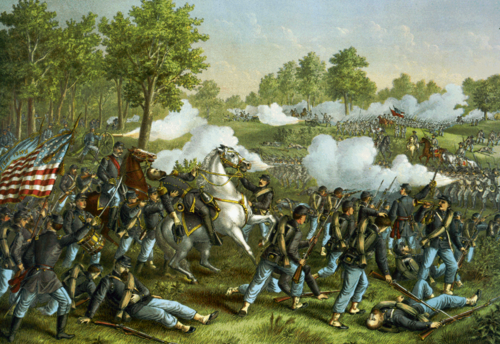
图:by Kurz and Allison · Public domain · 维基共享资源
- 时间
- 1861 年 8 月 10 日
- 地点
- 克里斯蒂安县、格林县
- 国家 / 地区
- 美国
- 属于
- Trans-Mississippi theater of the American Civil War
- 类型
- 战役
- 简述
- 1861 battle of the American Civil War
威尔逊溪之战(Battle of Wilson's Creek),又名桦树岭之战(Battle of Oak Hills),是南北战争期间的一场会战。1861年10月10日,会战在密苏里州斯普林菲尔德附近爆发。最终美利坚联盟国获胜。美利坚联盟国控制了密苏里州西南部。之后美利坚联盟国向北进攻,并引发第一次列星顿之战。
正文摘自中文维基百科「威尔逊溪之战」(删去了参考文献、表格和图片),按 CC BY-SA 4.0 使用
英文维基百科的更多内容
中文维基百科这一条比较短,下面是英文维基百科同一条目的节选,原文为英文,未翻译。
The Battle of Wilson's Creek, also known as the Battle of Oak Hills, was the first major battle of the Trans-Mississippi Theater of the American Civil War. It was fought on August 10, 1861, near Springfield, Missouri.
In August, Confederates under Brigadier General Benjamin McCulloch and Missouri State Guard troops under Maj. Gen. Sterling Price approached Brig. Gen. Nathaniel Lyon's Army of the West, camped at Springfield. On August 10, Lyon, in two columns commanded by himself and Col. Franz Sigel, attacked the Confederates on Wilson Creek about 10 miles (16 km) southwest of Springfield. Confederate cavalry received the first blow and retreated from the high ground. Confederate infantry attacked the Union forces three times during the day, but failed to break through. Eventually, Sigel's column was driven back to Springfield, allowing the Confederates to consolidate their forces against Lyon's main column. When Lyon was killed, Major Samuel D. Sturgis assumed command of the Union forces. When Sturgis realized that his men were exhausted and lacking ammunition, he ordered a retreat to Springfield. The battle was reckoned as a Confederate victory, but the Confederates were too disorganized and ill-equipped to pursue the retreating Union forces.
Although the state remained in the Union for the remainder of the war, the battle effectively gave the Confederates control of southwestern Missouri. The victory at Wilson's Creek also allowed Price to lead the Missouri State Guard north in a campaign culminating at the siege of Lexington, Missouri.
Background
Military and political situation
At the beginning of the American Civil War in 1861, the state of Missouri was a politically divided border state. Permitting slavery, the state had long-standing cultural and economic ties to the Southern United States, although these had declined in the years leading up to the outbreak of war.……
Opposing forces
Union
Lyon's army was known as the Army of the West. This army was formed from three bodies of troops: one that had accompanied Lyon south from Boonville; troops that had moved from Fort Leavenworth, Kansas, under the command of Sturgis; and a force that had moved down from St. Louis commanded by Sweeny. Sweeny's troops had left St. Louis before he did, and these soldiers were commanded by Sigel earlier in the campaign.……
Confederate
McCulloch's army lacked a formal name, although he referred to it as the Western Army.……
Battle
McCulloch's camp had withdrawn its pickets during the night, which allowed Lyon's column to surprise the opposing force. The first notice the Confederates and allied militia received was when a group of foragers from Rains' division sighted the Union approach early on the morning of August 10. Colonel James Cawthorn, who commanded Rains' cavalry, later sent out a patrol, which made contact with Lyon's force.……
Aftermath
The casualties were about equal on both sides – around 1,317 Union and an estimated 1,222 Confederate/Missourian/Arkansan soldiers were either killed, wounded, or captured. Nearly a quarter of Lyon's force had become casualties. Union percentage losses were heaviest in the 1st Missouri, 2nd Missouri, and 1st Kansas. The 1st Kansas's killed and mortally wounded was the seventh-highest for any Union regiment during the entire war.……
Battlefield preservation
The site of the battle has been protected as Wilson's Creek National Battlefield. The National Park Service operates a visitor center featuring exhibits, a fiber optic map displaying the course of the battle, and a research library. Living history programs depicting various aspects of the soldier's experience of that area are presented on weekends seasonally. The battlefield encompasses 1,750 acres (7.1 km2).……
正文摘自英文维基百科(原文为英文,未翻译)「Battle of Wilson's Creek」(节选,删去了参考文献、表格和图片),按 CC BY-SA 4.0 使用;在维基百科读全文 ›
相关人物
同时期、同地区的大事
- 南北战争1861 年 4 月 12 日—1865 年 4 月 9 日 · 战争 · 北美洲
- 葛底斯堡演说1863 年 11 月 19 日 · 其他事件 · 北美洲
- 盖茨堡之役1863 年 7 月 1 日—1863 年 7 月 3 日 · 战役 · 北美洲
- 阿拉斯加易手1867 年 3 月 30 日 · 条约与会议 · 北美洲
- 加利福尼亚淘金潮1848 年 1 月 24 日—1854 年 · 其他事件 · 北美洲
- 小大角战役1876 年 6 月 25 日 · 战役 · 北美洲
- 美国重建时期1863 年 12 月 8 日—1877 年 3 月 31 日 · 其他事件 · 北美洲
- 林肯遇刺案1865 年 4 月 15 日 · 屠杀与暗杀 · 北美洲
- 桑特堡战役1861 年 4 月 12 日—1861 年 4 月 14 日 · 战役 · 北美洲
- 安提塔姆之战1862 年 9 月 17 日 · 战役 · 北美洲
- 钱斯勒斯维尔战役1863 年 4 月 30 日—1863 年 5 月 6 日 · 战役 · 北美洲
- 盖兹登购地1853 年 · 条约与会议 · 北美洲
同时期的同类事件(战役)
- 色当会战1870 年 9 月 1 日—1870 年 9 月 2 日 · 战役 · 欧洲
- 索尔费里诺战役1859 年 6 月 24 日 · 战役 · 欧洲
- 巴拉克拉瓦战役1854 年 10 月 25 日 · 战役 · 欧洲
- 柯尼希格雷茨战役1866 年 7 月 3 日 · 战役 · 欧洲
- 第一次马纳沙斯之役1861 年 7 月 21 日 · 战役 · 北美洲
- 罗克渡口战役1879 年 1 月 22 日—1879 年 1 月 23 日 · 战役 · 非洲
- 圣哈辛托战役1836 年 4 月 21 日 · 战役 · 北美洲
- 弗雷德里克斯堡之役1862 年 12 月 11 日—1862 年 12 月 15 日 · 战役 · 北美洲
- 利萨战役 (1866年)1866 年 7 月 20 日 · 战役 · 欧洲
- 第二次马纳沙斯之役1862 年 8 月 28 日—1862 年 8 月 30 日 · 战役 · 北美洲
- 锡诺普海战1853 年 11 月 30 日 · 战役 · 西亚
- 伊散德尔瓦纳战役1879 年 1 月 22 日 · 战役 · 非洲