史鉴
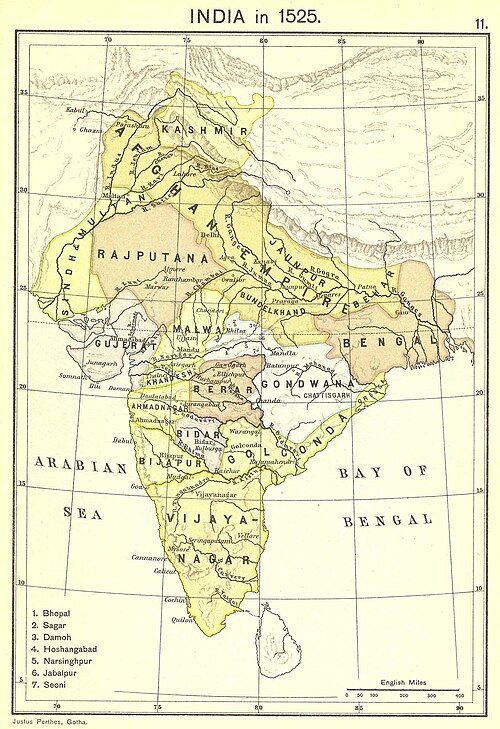
图:Charles Joppen · Public domain · 维基共享资源
- 存在时间
- 1401 年—1562 年
- 首都
- Mandu、达尔
- 类型
- 历史国家
- 所在大洲
- 亚洲
- 简述
- late medieval kingdom in northern India (1401–1562)
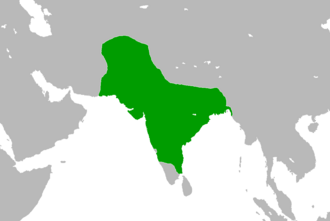
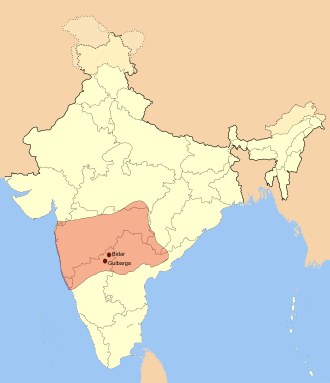
摩腊婆苏丹国(Malwa Sultanate)是一个中世纪后期位于摩腊婆地区的国家,该国范围涵盖了现今印度行政区中央邦和拉贾斯坦邦的东南部,该国是在帖木儿入侵印度,以及德里苏丹国解体后,由迪拉瓦尔汗于1401年所建立。
1519年的加格隆战役后,摩腊婆苏丹国的大部分地区一度被梅瓦尔的统治者拉纳·桑伽短暂控制,拉纳·桑加任命他手下的一位封臣梅迪尼·拉伊负责治理该国。1562年,摩腊婆苏丹国的最后一任统治者巴兹·巴哈杜尔被阿克巴大帝击败,该国自此成为蒙兀儿帝国辖下的摩腊婆苏巴。
正文摘自中文维基百科「摩腊婆苏丹国」(删去了参考文献、表格和图片),按 CC BY-SA 4.0 使用
英文维基百科的更多内容
中文维基百科这一条比较短,下面是英文维基百科同一条目的节选,原文为英文,未翻译。
The Malwa Sultanate was a late medieval kingdom in the Malwa region, covering the present day Indian states of Madhya Pradesh and south-eastern Rajasthan from 1401 to 1562. It was founded by the Afghan Dilawar Khan, who following Timur's invasion and the disintegration of the Delhi Sultanate, in 1401, made Malwa an independent realm.
Malwa was invaded and occupied by Muzaffar Shah of Gujarat in 1407 and restored in 1408 AD. Following the Battle of Gagron in 1519, much of the Sultanate came under the brief control of Maharana of Mewar Rana Sanga, and he appointed one of his vassals, Medini Rai, to rule over the Sultanate. In 1562, the Sultanate was conquered from its last ruler, Baz Bahadur, by the Mughal Empire under Akbar the Great, and it became a subah of the empire. The Sultanate was predominantly ruled by Afghan and Turco-Afghan dynasties throughout its existence.
History
Dilawar Khan Ghuri was an Afghan governor of the Delhi Sultanate. Dilawar Khan had ceased to pay tribute to Delhi after 1392. In 1437, the Ghurid dynasty of Dilawar Khan was overthrown by Mahmud Khan, a Khalji Afghan descendant of the Khalji dynasty of the Delhi Sultanate. After the Khaljis were deposed, it was ruled by Shujaat Khan, an Afghan governor of Malwa under Sher Shah Suri. Shujaat Khan's son, Baz Bahadur declared independence in 1555, and ruled until the end of the Malwa Sultanate.
Ghurid dynasty
The sultanate of Malwa was founded by Dilawar Khan Ghuri, the Afghan governor of Malwa for the Delhi Sultanate, who asserted his independence in 1392 and founded a "Ghurid dynasty", but did not actually assume the ensigns of royalty till 1401. Initially Dhar was the capital of the new kingdom, but soon it was shifted to Mandu, which was renamed Shadiabad (the city of joy). After his death, he was succeeded by his son Alp Khan, who assumed the title of Hoshang Shah.
The Muzaffarids under Zafar Khan Muzaffar Shah I accused Hoshang of parricide and invaded Malwa. Hoshang was defeated and captured as a prisoner, while a Muzaffarid governor was appointed at Dhar.
Khalji dynasty
The Ghurid dynasty, founded by Dilawar Khan Ghuri, was replaced by Mahmud Shah I, the Afghan who proclaimed himself king on 16 May 1436. The Khalji dynasty, founded by him, ruled over Malwa till 1531. Mahmud Shah I was related to the Khalji dynasty of Delhi, as his great-great-great-great grandfather, Malik Nasiruddin, was a cousin of sultan Jalaluddin Khalji, and was given the iqta of Amroha as his jagir. Mahmud was also a grandnephew of Dilawar Khan, the first sultan, through his sister. His father, Malik Mughlith, himself a nephew of Dilawar, played a key role in restoring his maternal cousin Hushang Shah to the throne after it had been seized by Ahmad Shah I. Mahmud had distinguished himself as a capable military commander, earning the title Khan from Hushang Shah in 1419 at the age of sixteen, who also gave him his daughter in marriage. Following Hushang’s death, Mahmud supported the accession of his oldest surviving son, Ghazni Khan, who took the regnal name Muhammad Shah. However, relations between the two deteriorated, as Muhammad Shah grew increasingly suspicious and repeatedly demanded assurances of Mahmud’s loyalty.……
Art
Many remarkable illustrated manuscripts were prepared during the period of the sultanate. An illustrated manuscript of Kalpa Sutra (1439) (presently in the National Museum, Delhi) was prepared in Mandu during the reign of Mahmud Shah I But the most interesting is a manuscript of the Nimat Nama, a treatise on the art of cooking, which bears many portraits of Ghiyas-ud-Din Shah but the colophon bears the name of Nasir-ud-Din Shah. The other notable illustrated manuscripts of this period are of the Miftah-ul-Fuzala, a dictionary of rare words, the Bustan (1502) painted by Haji Mahmud and the Aja'ib-us-San'ati (1508). Another manuscript of the Anwar-i-Suhaili (now in the National Museum, Delhi) probably also belong to this period.
正文摘自英文维基百科(原文为英文,未翻译)「Malwa Sultanate」(节选,删去了参考文献、表格和图片),按 CC BY-SA 4.0 使用;在维基百科读全文 ›
同时期、同地区的政权