史鉴

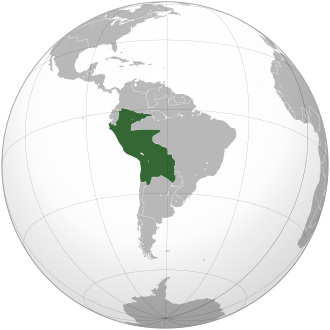
图:JanitoalevicCoastline extracted from: File:Ecuador location map.svg & File:Chile · CC BY-SA 3.0 · 维基共享资源
- 存在时间
- 1836 年 8 月 6 日—1839 年 8 月 25 日
- 官方语言
- 西班牙语
- 类型
- 历史国家
- 所在大洲
- 南美洲
- 简述
- republic within the Peru–Bolivian Confederation between 1836 and 1839.
北秘鲁共和国是秘鲁-玻利维亚邦联中的一个构成国。萨拉韦里—圣克鲁斯战争过后,安德烈斯·德·圣克鲁斯打算将秘鲁与玻利维亚合并,于是在1836年成立秘鲁-玻利维亚邦联,并将原来的秘鲁划为两个构成国,分成北秘鲁和南秘鲁。1839年秘鲁-玻利维亚邦联解散后,北秘鲁和南秘鲁重新合并,使统一的秘鲁复国。
正文摘自中文维基百科「北秘鲁共和国」(删去了参考文献、表格和图片),按 CC BY-SA 4.0 使用
英文维基百科的更多内容
中文维基百科这一条比较短,下面是英文维基百科同一条目的节选,原文为英文,未翻译。
The Republic of North Peru was one of the three constituent republics of the short-lived Peru–Bolivian Confederation of 1836–1839.
North Peru was one of two states—the other being South Peru—that arose from the division of the Peruvian Republic due to the civil wars of 1834 and 1835 to 1836. The states were founded in 1836 to be constituent Republics of the planned Peru-Bolivian Confederation, alongside Bolivia.
The Confederation came to an end three years later after continuous border wars with Argentina and Chile in the War of the Confederation, and after a chaotic civil conflict between north and south Peruvians. In August of 1839, Agustín Gamarra declared the Confederation dissolved; as a result, South Peru and North Peru reverted to being a unified Republic of Peru.
History
Background
After political instability in Peru and a coup d'état in 1835, a civil war broke out between newly self-declared president Felipe Santiago Salaverry and constitutional president Luis José de Orbegoso, who allowed Bolivian president Andrés de Santa Cruz to send his troops through the Peruvian border. After the latter's triumph in 1836, assemblies were soon established to make way for the creation of the Confederation, an idea that had been floating around since the era of independence.
Establishment
A constituent assembly known as the Huaura Assembly was held from 3 to 24 August 1836, and featured representatives from La Libertad, Lima, Huaylas, Maynas and Junín. On 11 August, North Peru was officially established through the promulgation of its constitution by the then President Orbegoso, naming Santa Cruz—who triumphantly entered Lima on 15 August—as the Supreme Protector of the state. Orbegoso also presented his resignation, but it was not approved by the assembly, who named him provisional president. The assembly also established the new territorial divisions of the country. Unlike its new southern neighbour, North Peru maintained the national symbols of its predecessor.
Provided, then, with all the legal elements granted by the assemblies of the three states, Santa Cruz decreed the establishment of the Peru-Bolivian Confederation, by decree given in Lima on 28 October 1836. A congress known today as the Congress of Tacna was ordered to meet in Tacna to establish the foundations of the confederation. The Pact of Tacna was signed without debate during the congress. It established the legal framework through which the state would operate, and also included the design of the Confederation's flag. Reactions to the pact were mixed even among its signatories, and disagreements led to the establishment of one constituent congress per member state. The act was later promulgated in 1837.
Development and dissolution
The Confederation generated resistance among several groups in both countries, which resented the dilution of national identities, and also among neighbouring countries. An important number of Peruvian politicians who opposed the Confederation, such as Agustín Gamarra and Ramón Castilla, fled to Chile where they received support, leading to the War of the Confederation.
Government
From 1837 until the confederation's dissolution, the state was controlled by a provisional president and a congress, both with limited powers and under the control of Marshal Andrés de Santa Cruz who was styled the supreme protector.
First president: General Luis Orbegoso (21 August 1837 – 30 July 1838). He declared secession of the Republic of North Peru from the Peru-Bolivian Confederation on 30 July 1838 but continued as Provisional President until 1 September 1838
Second president: General José de la Riva Agüero (11 August 1838 – 24 January 1839)
Administrative divisions
North Peru was divided into five departments which in turn were divided into provinces, and these into districts.
正文摘自英文维基百科(原文为英文,未翻译)「Republic of North Peru」(节选,删去了参考文献、表格和图片),按 CC BY-SA 4.0 使用;在维基百科读全文 ›
相关事件
- 秘鲁-智利同盟战争1836 年 12 月 28 日—1839 年 8 月 15 日 · 战争 · 拉丁美洲
同时期、同地区的政权