史鉴
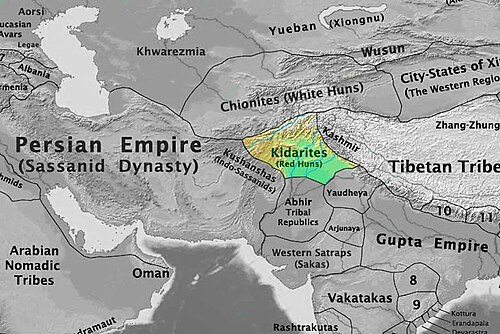
图:Thomas Lessman (Contact!) · CC BY-SA 3.0 · 维基共享资源
寄多罗人(Kidarites),是公元4至5世纪间,统治巴克特里亚及其周边部分中亚和印度地区,一个复杂的民族群体,他们在印度被统称为匈那人,于欧洲则被称作匈尼特人,而5世纪的拜占庭历史学家普利斯库斯称其为寄多罗匈人,中国史籍记载他们叫大月氏或小月氏。尽管存在争议,但匈那人/匈尼特人部落和大约在同一时期入侵东欧的匈人有所关联,他们与在一个世纪后兴起的嚈哒人截然不同。
寄多罗人得名自其统治者寄多罗,他们似乎是匈那人部落的一分子,拉丁文献中称其为“红匈人”。寄多罗人是中亚四个主要匈人政权中最早建立的,其余三者分别是阿尔琼匈人、嚈哒人和涅扎克匈人。
公元360年至370年间,寄多罗王朝在中亚地区建立,该地区此前由波斯萨珊帝国统治,当寄多罗王朝取代了贵霜-萨珊王国在巴克特里亚的势力后,萨珊帝国于该地区的统治疆域仅剩梅尔夫一带。随后在大约公元390年至410年间,寄多罗人入侵印度西北部,占领了原贵霜帝国在旁遮普地区的残存领土。
正文摘自中文维基百科「寄多罗人」(删去了参考文献、表格和图片),按 CC BY-SA 4.0 使用
英文维基百科的更多内容
中文维基百科这一条比较短,下面是英文维基百科同一条目的节选,原文为英文,未翻译。
The Kidarites, or Kidara Huns, were a dynasty that ruled Bactria and adjoining parts of Central Asia and Pakistan in the 4th and 5th centuries. The Kidarites belonged to a complex group of peoples known collectively in the Indus Valley as the Huna, and in Europe as the Chionites (from the Iranian names Xwn/Xyon), and may even be considered as identical to the Chionites. The 5th century Byzantine historian Priscus called them Kidarite Huns, or "Huns who are Kidarites". Chinese annals referred to them as the Ta Yüeh-chih, or Lesser Yüeh-chih. The Huna/Xionite tribes are often linked, albeit controversially, to the Huns who invaded Eastern Europe around the same period. They are entirely different from the Hephthalites, who replaced them about a century later.
The Kidarites were named after Kidara (Chinese: 寄多羅 Jiduoluo, MC: Kjie-ta-la) one of their main rulers. The Kidarites appear to have been a part of a Huna horde known in Latin sources as the "Kermichiones" (from the Iranian Karmir Xyon) or "Red Huna". The Kidarites established the first of four major Xionite/Huna states in Central Asia, followed by the Alchon, the Hephthalites and the Nezak.
In 360–370 CE, a Kidarite kingdom was established in Central Asian regions previously ruled by the Sasanian Empire, replacing the Kushano-Sasanians in Bactria. Thereafter, the Sasanian Empire was limited to Merv. Next, circa 390-410 CE, the Kidarites invaded northwestern India, where they replaced the remnants of the Kushan Empire in the area of Punjab.
Origins
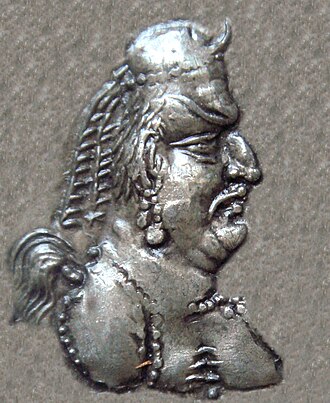
A nomadic people, the Kidarites appear to have originated in the Altai Mountains region. The terms Huns/Chionites seem to reflect the general ethnic appellation of these people, whereas Kidarites should be understood as a dynastic designation derived from the name of their king, Kidara. On Kidarite coins their rulers are depicted as beardless or clean-shaven – a feature of Altaic cultures at the time (as opposed, for example, to the Iranian cultures of South Central Asia). They may have been Oghuric speakers originally, as may have been the Chionites and the Hephthalites, before adopting the Bactrian language. The Kidarites were depicted as mounted archers on the reverse of coins. They were also known to practice artificial cranial deformation.
The Kidarites appear to have been synonymous with the Karmir Xyon ("Red Xionites" or, more controversially, "Red Huns"), – a major subdivision of the Chionites (Xionites), alongside the Spet Xyon ("White Xionites"). In a recently discovered seal with the image of a ruler similar to those of the Kidarite coins, the ruler named himself in Bactrian "King of the Huns and Great Kushan Shah" (uonano shao o(a)zarko (k)oshanoshao). The discovery was reportedly made in Swat.
Kidarite kingdom
First appearance in literary sources
The first evidence are gold coins discovered in Balkh dating from the mid-4th century. The Kushano-Sasanian ruler Varahran during the second phase of his reign, had to introduce the Kidarite tamga in his coinage minted at Balkh in Bactria, circa 340–345. The tamgha replaced the nandipada symbol which had been in use since Vasudeva I, suggesting that the Kidarites had now taken control, first under their ruler Kirada. Then ram horns were added to the effigy of Varahran on his coinage for a brief period under the Kidarite ruler Peroz, and raised ribbons were added around the crown ball under the Kidarite ruler Kidara. In effect, Varahran has been described as a "puppet" of the Kidarites. By 365, the Kidarite ruler Kidara I was placing his name on the coinage of the region, and assumed the title of Kushanshah. In Gandhara too, the Kidarites minted silver coins in the name of Varahran, until Kidara also introduced his own name there.
Archaeological, numismatic, and sigillographic evidence demonstrates the Kidarites ruled a realm just as refined as that of the Sasanians. They swiftly adopted Iranian imperial symbolism and titulature, as demonstrated by a seal;……
Migration into Bactria
Around 350, the Sasanian Emperor Shapur II (ruled 309 to 379) had to interrupt his conflict with the Romans, and abandon the siege of Nisibis, in order to face nomadic threats in the east: he was attacked in the east by Scythian Massagetae and other Central Asian tribes.……
正文摘自英文维基百科(原文为英文,未翻译)「Kidarites」(节选,删去了参考文献、表格和图片),按 CC BY-SA 4.0 使用;在维基百科读全文 ›