史鉴
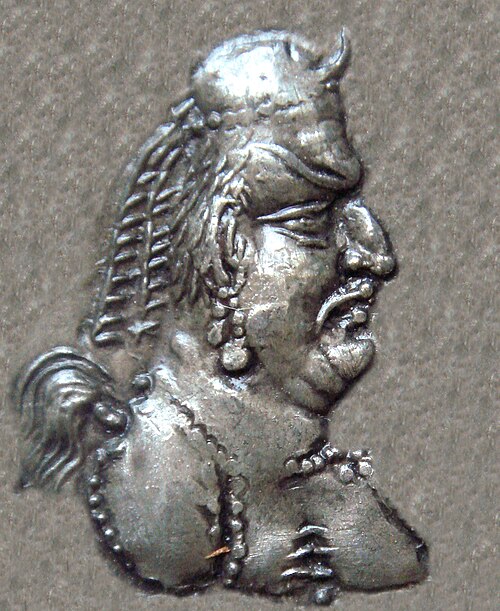
图:Original author User:PHGCOM · CC BY-SA 3.0 · 维基共享资源
- 存在时间
- 380 年—560 年
- 宗教
- 佛教、印度教
- 前身
- 寄多罗王朝
- 类型
- 部落、历史国家、前行政领土实体
- 简述
- Huns in South Asia in the 5-6th century CE
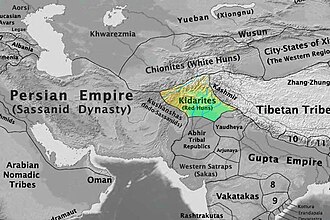
The Alchon Huns, (Bactrian: αλχον(ν)ο Alkhon(n)o or αλχαν(ν)ο Alkhan(n)o) also known as the Alkhan, Alchono, Alxon, Alkhon, Alakhana, and Walxon, were a nomadic people who established states in Central Asia and the Indian subcontinent during the 4th and 6th centuries CE. They were first mentioned as being located in Paropamisus, and later expanded south-east, into the Punjab and Central India, going as far as Eran and Kausambi. The Alchon invasion of the Indian subcontinent eradicated the Kidarite Huns who had preceded them by about a century, and contributed to the fall of the Gupta Empire, in a sense bringing an end to Classical India.
The invasion of India by the Huna peoples follows invasions of the subcontinent in the preceding centuries by the Yavana (Indo-Greeks), the Saka (Indo-Scythians), the Pahlava (Indo-Parthians), and the Kushana (Yuezhi). The Alchon Empire was the second of four major Huna states established in Central Asia and the Indian subcontinent. The Alchon were preceded by the Kidarites and succeeded by the Hephthalites and Nezak Huns in Bactria and the Hindu Kush respectively. The names of the Alchon kings are known from their extensive coinage, Buddhist accounts, and a number of commemorative inscriptions throughout the Indian subcontinent.
The Alchons have long been considered a part or a sub-division of the Hephthalites, or as their eastern branch, but are now regarded as a separate entity.
详细介绍
Identity
Name
The etymology of "Alchon" is disputed. It is only attested on the script of their coins and seals, where it appears as alkhon(n)o or alkhan(n)o in Bactrian script or lakhāna in Sanskrit. Frantz Grenet, pointing to the Middle Persian apocalyptic book Zand-i Wahman yasn, argued that a name attested there, Karmīr Xyōn ("red Chionites") could represent a translation of Alkhonno, with the first element, al being a Turkic word for red and the second element representing the ethnic name "Hun". An older suggestion, by H.……
Visual appearance
The Alchons are generally recognised by their elongated skull, a result of artificial skull deformation, which may have represented their "corporate identity".……
History
Invasion of Bactria (370 CE)
During the reign of Shapur II, the Sasanian Empire and the Kushano-Sasanians gradually lost the control of Bactria to these invaders from Central Asia, first the Kidarites from around 335 CE, then the Alchon Huns from around 370 CE, who would follow up with the invasion of India a century later, and lastly the Hephthalites from around 450 CE.
Invasion of Kabulistan (c.385 CE)
Around 380-385 CE, the Alchons emerged in Kapisa, taking over Kabulistan from the Sassanian Persians, while at the same time the Kidarites (Red Huns) ruled in Gandhara.……
Coinage
The Alchon Huns initially issued anonymous coins based on Sasanian designs.……
Religion and ethics
Buddhism
The four Alchon kings Khingila, Toramana, Javukha, and Mehama are mentioned as donors to a Buddhist stupa in the Talagan copper scroll inscription dated to 492 or 493 CE, that is, at a time before the Hunnic wars in India started. This corresponds to a time when the Alchons had recently taken control of Taxila (around 460 CE), at the center of the Buddhist regions of northwestern India. Numerous Alchon coins were found in the dedication compartment of the "Tope Kalān" stupa in Hadda.
Persecution of Buddhism
Later, however, the attitude of the Alchons towards Buddhism is reported to have been negative.……
Consequences for India
The Alchon invasions, although only spanning a few decades, had long term effects on India, and in a sense brought an end to the middle kingdoms of India.
Destructions
Indian urban culture was left in decline. Major traditional cities, such as Kausambi and probably Ujjain were in ruins, Vidisha and Mathura fell into decline. Buddhism, gravely weakened by the destruction of monasteries and the killing of monks, started to collapse. Great centers of learning were destroyed, such as the city of Taxila, bringing cultural regression.……
Political fragmentation
Soon after the invasions, the Gupta Empire, already weakened by these invasions and the rise of local rulers, ended as well.……
Rulers
The rulers of the Alchons practised skull deformation, as evidenced from their coins, a practice shared with the Huns that migrated into Europe. The names of the first Alchon rulers do not survive. Starting from 430 CE, names of Alchon kings survive on coins and religious inscriptions:
anonymous kings (400 - 430 CE)
Khingila (c. 430 – 490 CE)
Javukha/Zabocho (c. mid 5th – early 6th CE)
Mehama (c. 461 – 493 CE)
Lakhana Udayaditya (c. 490's CE)
Aduman
Toramana (c. 490 – 515 CE)
Mihirakula (c. 515 – 540 CE)
Toramana II (c. 530 – 570 CE)
Pravarasena (c. 530 – 590 CE)
Gokarna (c. 570 – 590 CE)
Coinage
Early Bactrian coinage based on Sasanian designs
The earliest Alchon Hun coins were based on Sasanian designs, often with the simple addition of the Alchon tamgha and a mention of "Alchon" or "Alkhan". Various coins minted in Bactria and based on Sasanian designs are known, often with busts imitating Sasanian kings Shapur II (r.309 to 379 CE) and Shapur III (r.383 to 388 CE), with attendants to a fire altar on the reverse.……
正文摘自英文维基百科(原文为英文,未翻译)「Alchon Huns」(节选,删去了参考文献、表格和图片),按 CC BY-SA 4.0 使用;在维基百科读全文 ›
相关事件
- Battle of Sondani528 年 · 战役 · 南亚