史鉴
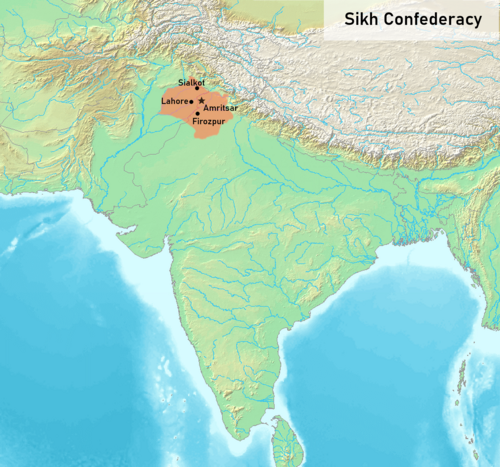
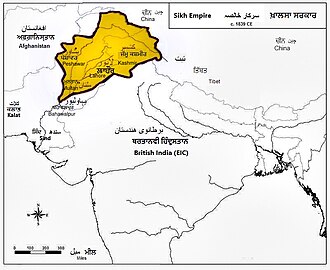
图:Borders by Rawn3012 using Gimp · CC BY 4.0 · 维基共享资源
- 存在时间
- 1748 年 3 月 29 日—1799 年 7 月 7 日
- 首都
- 阿姆利则
- 政体
- 联邦君主制
- 后继
- 卡普尔塔拉土邦
- 类型
- 历史国家
- 所在大洲
- 亚洲
- 简述
- Sikh military confederation (1748 – 1799)
锡克联盟(旁遮普语:Sikh Misalā)是印度次大陆西北部旁遮普地区历史上的一个贵族共和制邦联,由12个主权锡克邦组成,成立于1748年。1799年,兰季德·辛格将锡克联盟统一为锡克帝国。
正文摘自中文维基百科「锡克联盟」(删去了参考文献、表格和图片),按 CC BY-SA 4.0 使用
英文维基百科的更多内容
中文维基百科这一条比较短,下面是英文维基百科同一条目的节选,原文为英文,未翻译。
The Sikh Confederacy was a confederation of twelve sovereign Sikh states (each known as a Misl, derived from the Arabic word مِثْل meaning 'equal'; sometimes spelt as Misal) which rose during the 18th century in the Punjab region in the northwestern part of the Indian subcontinent. The misls were sovereign Sikh principalities originally formulated to defend the Darbar Sahib complex of Amritsar. It was governed decentrally, being described as decentralized unity that was flexible, with no single ruler being paramount or permanent and instead collective action being used that was based upon organisational discipline and shared legitimacy.
History
Background
In order to withstand the persecution of Shah Jahan and other Mughal emperors, several of the later Sikh Gurus established military forces and fought the Mughal Empire and Pahari Hill rajas in the 17th century and early 18th century. Banda Singh Bahadur continued Sikh resistance to the Mughal Empire until his defeat at the Battle of Gurdas Nangal.
Formation of a Sikh confederation
After the death of Banda Singh, the Sikhs were left without a main leader and entered in a period of hardship. The Sikhs (more precisely the Tat Khalsa faction) managed to gain control of Amritsar and established it as their centre after evicting the Bandai Sikhs from it. Bhai Mani Singh was appointed as the custodian of the Darbar Sahib shrine.……
Military
Each Misl was made up of members of soldiers, whose loyalty was given to the Misl's leader. A Misl could be composed of a few hundred to tens of thousands of soldiers. Any soldier was free to join whichever Misl he wished, and was free to cancel his membership of the Misl to whom he belonged. He could, if he wanted, cancel his membership of his old Misl and join another. The Barons would allow their armies to combine or coordinate their defences together against a hostile force if ordered by the Misldar Supreme Commander. These orders were only issued in military matters affecting the whole Sikh community. These orders would normally be related to defense against external threats, such as Afghan military attacks.……
Cavalry tactics
Fauja Singh considers the Sikh misls to be guerrilla armies, although he notes that the Sikh misls generally had greater numbers and a larger number of artillery pieces than a guerrilla army would.……
Administration
The misls formed a commonwealth that was described by Swiss adventurer Antoine Polier as a natural "aristocratic republic". Each misl was a confederacy of Sikh horsemen that was headed by a leader known as a sardar, who held the position of misldar. Although the misls were unequal in strength, and each misl attempted to expand its territory and access to resources at the expense of others, they acted in unison in relation to other states. The misls held biannual meetings of their legislature, the Sarbat Khalsa in Amritsar. According to Hans Herrli, the various misls were not organized along the same lines as one another. Some were akin to large, family clans whilst others resembled brotherhoods (Nishanwalia Misl), or religious-orders (Shaheedan Misl).……
Leadership
Jassa Singh Ahluwalia was initially appointed as the head of the misls in 1748.……
Territory
The two main divisions in territory between the misls were between those who were in the Malwa region and those who were in the Majha region. While eleven of the misls were north of the Sutlej river, one, the Phulkian Misl was south of the Sutlej. The Sikhs north of the Sutlej river were known as the Majha Sikhs while the Sikhs that lived south of the Sutlej river were known as the Malwa Sikhs. In the smaller territories were the Dhanigeb Singhs in the Sind Sagar Doab, the Gujrat Singhs in the Jech Doab, the Dharpi Singhs in the Rechna Doab, and the Doaba Singhs in the Jalandhar Doab.
Territories of specific misls
The various constituent misls did not have clearly defined territories from one another yet some areas had higher concentrations of Sikhs allying themselves with a particular misl.……
正文摘自英文维基百科(原文为英文,未翻译)「Sikh Confederacy」(节选,删去了参考文献、表格和图片),按 CC BY-SA 4.0 使用;在维基百科读全文 ›
相关事件
- Indian campaign of Ahmad Shah Durrani1748 年—1767 年 · 战役 · 南亚
前后承接的政权

同时期、同地区的政权