史鉴
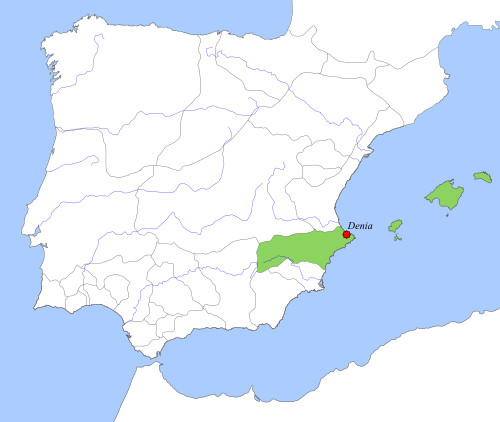
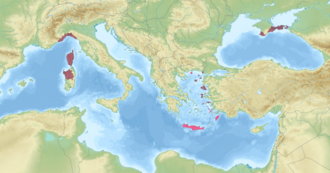
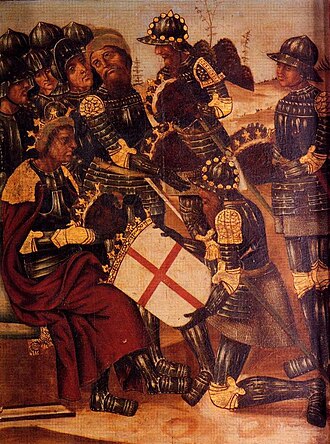
图:Tyk · CC BY-SA 3.0 · 维基共享资源
详细介绍
历史
德尼亚泰法成立于1010年,在后倭马亚王朝分裂后产生,由被释放的奴隶穆贾希达-阿米里创建,后者是哈里发的前高级官员,可能有斯拉夫血统(萨卡里巴)。这个王国有一个相对强大的海军,泰法在1015年用来控制巴利阿里群岛,从而入侵撒丁岛。在该岛北部建立了一个军营一年,作为下一次袭击比萨共和国的基地,但它被比萨和热那亚的舰队重新征服:在战斗中的穆贾希达的继承人,阿里·伊克巴被俘虏,并且在1032年被赎回。在那个时期,泰法的船只发动了几次对利古里亚大区和托斯卡纳海岸的袭击。
在11世纪20年代,穆贾希达利用巴伦西亚泰法的摄政的死亡来攻占他那个王国的南部。在巴伦西亚的阿卜杜勒·阿齐兹·伊本·阿米尔崛起之后,穆贾希德不断与他作斗争,征服穆尔西亚,洛尔卡,奥里韦拉和埃尔切,将他的权力扩展到塞古拉河。通过萨拉戈萨的苏莱曼·伊本·胡德的调解,他于1041年与巴伦西亚签署了和平条约。
在1227年,德尼亚泰法被阿拉贡王国合并。
正文摘自中文维基百科「德尼亚泰法」(删去了参考文献、表格和图片),按 CC BY-SA 4.0 使用
英文维基百科的更多内容
中文维基百科这一条比较短,下面是英文维基百科同一条目的节选,原文为英文,未翻译。
The taifa of Dénia (Arabic: طائفة دانية) was an Islamic kingdom in medieval Spain, ruling over part of the Valencian coast and Ibiza. With Dénia as its capital, the taifa included the Balearic Islands and parts of the Spanish mainland. It was founded in 1010 by the Slavic Muslim warlord Mujāhid al-ʿĀmirī.
History
The taifa was created in 1010, after the disintegration of the Caliphate of Córdoba, by the freed slave Mujāhid al-ʿĀmirī, a former high functionary of the caliphate, who probably had a Slavic origin. In 1011 Dénia was the first taifa to strike coins. The kingdom had a relatively powerful navy, which in 1015 was used to take control of the Balearic Islands and thence to invade Sardinia. The taifa settled a military camp in the north of the island for one year, as a base for the next attack against the Maritime Republic of Pisa, but it was reconquered by the fleets of Pisa and Genoa: in the fray Mujahid's heir, Ali Iqbal al-Dawla, was captured, and could be ransomed only in 1032. In that period the taifa's ships launched several other raids against the Ligurian and Tuscan coasts. The taifa's army employed many mercenaries from the Arab Banu Khazraj tribe. The taifa is best known for its active promotion of piracy against Christian coasts, as well as its failed conquest of Sardinia. The taifa of Dénia also had an influential Sephardic Jewish community which contributed greatly in the development of the taifa and was essential to its growth. The Jewish community held top positions in the government of the taifa.
In the 1020s Mujāhid took advantage of the death of the regents of the taifa of Valencia to capture the southern part of that kingdom, which he held for two years. A few years later he supported the rebellion of Ibn Jattab against Ibn Tahir of Murcia. After the rise of Abd al-Aziz al-Mansur in Valencia, Mujahid constantly struggled against him, conquering Murcia, Lorca, Orihuela and Elche, extending his power up to the Segura River. Through the mediation of Sulaymán ibn Hud of Zaragoza, he signed a treaty of peace with Valencia in 1041.
Mujahid, who had been educated as a slave in the court of the Andalusian ruler Al-Mansur Ibn Abi Aamir, was a patron of several intellectuals, especially writers and ulemas escaping the chaos ensuing the Córdoban dissolution. He protected Denia's Christian community in exchange for their declaration of loyalty, and worked with the Jewish mercantile community.
At the death of Mujahid al-Muwaffaq in 1045, he was succeeded by Ali Iqbal al-Dawla, a son by a Christian mother. He was able to maintain his father's conquests for some thirty years, starting a period of peace and prosperity, underpinned by a large commercial fleet based in Dénia. In 1050 the Balearic governor, Abd Allah ibn Aglab, gained autonomy for the islands. Dénia's power remained confined to its peninsular possessions until the conquest by the taifa of Zaragoza in 1076. The Balearic taifa of Mallorca remained independent until 1116.
List of Emirs
Amirid dynasty
- Mujahid al-Muwaffaq (in Valencia 1017–1021): 1010/12–1045
- 'Ali Iqbal ad-Dawla: 1045–1076
- To Zaragoza: 1060–1081 or 2/3
- To Tortosa: 1081 or 2/3–1092
- To Morocco: 1092–1224
- Abu Zayd 'Abd ar-Rahman (in Alzira, Xàtiva also): 1224–1227
To Aragon thereafter.
正文摘自英文维基百科(原文为英文,未翻译)「Taifa of Dénia」(节选,删去了参考文献、表格和图片),按 CC BY-SA 4.0 使用;在维基百科读全文 ›
相关事件
- 比萨-热那亚远征撒丁岛1014 年—1017 年 · 战役 · 欧洲
前后承接的政权
同时期、同地区的政权