史鉴
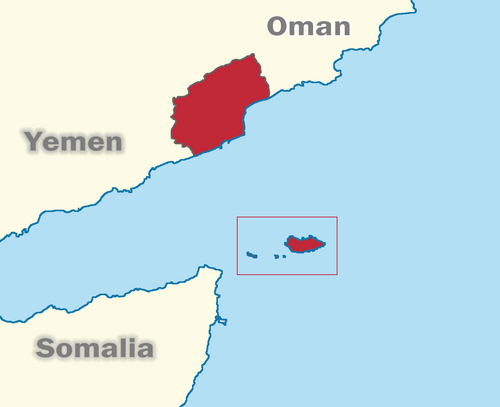
图:Wario2 · CC BY-SA 4.0 · 维基共享资源
- 存在时间
- 1432 年—1967 年
- 首都
- Qishn
- 政体
- 君主制
- 类型
- 历史国家
- 简述
- 1432–1967 sultanate in modern-day Yemen
The Mahra Sultanate, known in its later years as the Mahra State of Qishn and Socotra, or sometimes the Mahra Sultanate of Ghayda and Socotra, and formerly as the Afrari Arab Sultanate, was a sultanate that included the historical region of Mahra and the Guardafui Channel island of Socotra in what is now eastern Yemen. It was ruled by the Banu Afrar dynasty for most of its history.
The Sultanate was inhabited by the Mehri people who spoke the Mahri language, a modern South Arabian language. The Mehri share, with their regional neighbours on the island of Socotra and in Dhofar, cultural traditions like a modern South Arabian language, and frankincense agriculture. The region benefits from a coastal climate, distinct from the surrounding desert climate, with seasons dominated by the khareef or monsoon.
In 1886, the Sultanate came under the British-ruled Aden Protectorate and later under the Protectorate of South Arabia. The Sultanate was abolished in 1967 upon the founding of the People's Republic of South Yemen. With the departure of the British from the larger southern Arabian region, the Aden-based South Yemeni government divided the sultanate, creating the Al Mahra Governorate and Socotra was administered by the Aden Governorate. The sultanate is now part of the Republic of Yemen and the Sultanate of Oman.
详细介绍
History
As a sultanate
After the erosion of Abbasid authority in Yemen, the tribes of al-Mahra had grown distant from Arabic rule. The Ayyubids of Egypt held loose authority over the region, followed by the Rasulids of western Yemen.
Sultanate of Shihr
In 1432, the Ba Dujana family took control of the important coastal city of Shihr from the Rasulids, and then successfully repelled a Rasulid counterattack. In 1445, the Ba Dujana defended against an attack by the newly formed Kathiri state, securing their borders. The independent sultanate at Shihr was the first premodern state in Mahri lands.
Following the collapse of the Rasulid dynasty and the rise of the Tahirids, a number of former dignitaries from Aden came to Shihr as refugees, and told the reigning sultan, Muhammad bin Sa'd, that Aden was ripe for conquest. In 1456, Muhammad bin Sa'd launched a naval invasion of Aden with nine ships; however, much of the fleet was broken up in a storm and bin Sa'd was captured by the Tahirids. In retaliation, the Tahirid sultan sent an army commanded by Zayn al-Sunbuli to occupy Shihr. The campaign was only half-successful, and parts of the area were still held by the Ba Dujana. Determined to break the stalemate, Sultan Malik Amir bin Tahir led a great expedition across the desert coast from Aden to Mahra. Vastly outnumbered, the Ba Dujana retreated from Shihr ahead of the Tahirid advance. The Tahirids plundered the city and installed a governor who was loyal to their interests.
The city of Shihr was once more brought under the control of the Ba Dujana clan in 1478, when it was taken by their young leader, Sa'd bin Faris.……
Rulers
The Sultans of Mahra had the title of Sultan al-Dawla al-Mahriyya (Sultan Qishn wa Suqutra). Their descendants are active politicians nowadays. The Al-Mahra Sultanate was consistently ruled by the Al-Mahri dynasty from year 1750 till 1967.
Sultans
before the 20th century
- c. 1750 – 1780: `Afrar al-Mahri
- c. 1780 – 1800: Taw`ari ibn `Afrar al-Mahri
- c. 1800 – 1820: Sa`d ibn Taw`ari Ibn `Afrar al-Mahri
c. 1834: Sultan ibn `Amr (on Suqutra)
c. 1834: Ahmad ibn Sultan (at Qishn)
- c. 1835 – 1845: `Amr ibn Sa`d ibn Taw`ari Afrar al-Mahri
- c. 1845 – 18.. Taw`ari ibn `Ali Afrar al-Mahri
- 18.. – 18.. Ahmad ibn Sa`d Afrar al-Mahri
- 18.. – 18.. `Abd Allah ibn Sa`d Afrar al-Mahri
- 18.. – 18.. `Abd Allah ibn Salim Afrar al-Mahri
Mehri camels
Al-Mahra is home to the Mehri camel, which has been an integral part of Al-Mahra army's military success during the Islamic conquests of Egypt and North Africa against the Byzantine Empire. During the conquests the cavalry unit from Al-Mahra introduced the Mehri camel to northern Africa, and now it is found throughout the area. It is better known as the Mehari camel in most of northern Africa, and is sometimes also known as the Sahel camel.
It is a special breed originating in Al-Mahra. They are renowned for their speed, agility and toughness. They have a large but slender physique, and because of its small hump it is perfectly suited for riding.
During the colonial period in northern Africa, the French government took advantage of the Mehri camel's proven military capabilities, and established a camel corps called the Méhariste which was part of the Armée d'Afrique. It patrolled the Sahara using the Mehri camel. The French Méhariste camel corps was part of the Compagnies Sahariennes the French Army of the Levant.
In 1968, France's car maker Citroën introduced the Citroën Méhari, which was a light off-road vehicle named after the famous Mehri camel. The Citroën Méhari was a variant of the Citroën 2CV, and Citroën built more than 144,000 Méhari between 1968 and 1988. A new, 2016 electric model called the Citroën E-Méhari is now being sold in Europe; it is a compact SUV like the Méhari.
正文摘自英文维基百科(原文为英文,未翻译)「Mahra Sultanate」(节选,删去了参考文献、表格和图片),按 CC BY-SA 4.0 使用;在维基百科读全文 ›
同时期、同地区的政权