史鉴

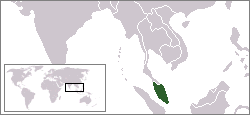
图:5ysksos6 · CC0 · 维基共享资源
- 存在时间
- 1526 年—1860 年
- 首都
- 马辰、Martapura、Pemakuan、North Kuin
- 政体
- 绝对君主制
- 前身
- 尼贾拉·达哈
- 后继
- 荷属东印度
- 类型
- 历史国家、苏丹国
- 所在大洲
- 亚洲
- 简述
- Sultanate based in South Kalimantan (1520–1860/1905), restored in 2010
班贾尔苏丹国(马来语:Kesultanan Banjar)是历史上位于现今印尼南加里曼丹省的一个穆斯林国家。起讫时间为1520年-1905年。该国的首都大部分时间位于班贾尔巴鲁,不过一度搬迁到不远处的马塔普拉。该国后来被荷兰消灭。该国通用班查语。
正文摘自中文维基百科「班贾尔苏丹国」(删去了参考文献、表格和图片),按 CC BY-SA 4.0 使用
英文维基百科的更多内容
中文维基百科这一条比较短,下面是英文维基百科同一条目的节选,原文为英文,未翻译。
The Sultanate of Banjar (Banjar: كسلطانن بنجر, romanized: Kasultanan Banjar) was a nation-state of the Banjar in the form of an Islamic sultanate in Borneo which was founded in 1526 and existed until its dissolution in 1860 by the colonial government of the Dutch East Indies and its collapse in 1905. The Banjar Sultanate was restored in the 2010 restoration, but without political power.
When the capital was in Kayu Tangi, the Sultanate was referred to as the "Kayu Tangi Kingdom". After a long civil war that destroyed the Negara Daha, Surianshah of Banjar (r. 1526–1540) emerged victorious and crowned himself as the first Sultan of Banjar, and founded the Banjar sultanate with its capital in Kuin. Soon after the stabilization of the new state, he ordered a massive expansion to Sambas and the Sulu Archipelago. The vast territory was maintained by his son, Rahmatullah of Banjar (r. 1540–1570).
Despite the loss of a number of territories, the reign of Mustain Billah of Banjar (r. 1595–1642) was the peak of Banjar's glory with the development of the pepper trade and Banjar's dominance over the surrounding seas, which became a strategic trading point from the Straits of Malacca and Brunei to Gowa and Maluku. At the end of his reign, Mustain Billah faced conflict with the Dutch East India Company (VOC) which culminated in a failed attack on Banjarmasin in 1633. This failed VOC attack strengthened Mustain Billah's position and the conflict continued during the reign of his son, Inayatullah of Banjar (r. 1642–1645). In the end, the Dutch agreed to sign a peace treaty during the reign of Rakyatullah of Banjar (r. 1660–1663).
From 1663 to 1679, there was a civil war between Sultan Agung of Banjar (r. 1663–1679) based in Banjarmasin and Tahlilullah of Banjar (r. 1663–1679;……
History
The second king of Negara Daha, Maharaja Sukarama, had four commoner wives, and four sons and one daughter. As Maharaja Sukarama followed the traditional belief of Negara Dipa requiring the king to be of royal blood, he arranged the marriage of his sole daughter, Putri Galuh Baranakan, and the son of his brother, Raden Bagawan, with the name Raden Mantri. The goal of this union (of Mantri and Galuh) was to produce the ideal heir to rule Daha as they would have patrilineal and matrilineal royal blood. The union resulted in Raden Samudra, who was prepared by Sukarama to rule.
However, after Sukarama's death, this succession was challenged by his sons, Pangeran Mangkubumi and Pangeran Tumanggung, who usurped the throne. Raden Samudra escaped from the Kingdom of Daha to the Barito River area, because his safety was in danger, and established a new kingdom at Banjarmasin. With help from Mangkubumi Aria Taranggana, Raden Samudra converted to Islam on 24 September 1526, changing his name to Sultan Surianshah. Banjar at first paid tribute to the Sultanate of Demak. That state met its demise in the mid-16th century, however, and Banjar was not required to send tribute to the new power in Java, the Sultanate of Pajang.
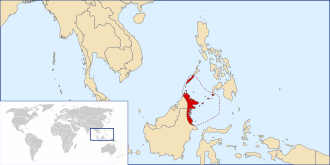
Banjar rose in the first decades of the 17th century as a producer and trader of pepper. In the 16th to 17th century The Banjar Sultanate once conquered almost the entire island of Borneo, such as: The entire region of South Kalimantan, Dayak Besar The large area of Central Kalimantan, Kotawaringin, Sukadana, Sintang, Sanggau, Sekadau, Lawai, Landak, Sambas (southern and western regions), Paser, Kutai, Berau, Tawau Division, And Sulu Archipelago (eastern and northern regions). All conquered territories had to pay tribute to the Banjar Sultanate. were paying tribute to the sultanate.……
Revival
As of 2010, the sultanate was revived for cultural purposes in Martapura by Ir. Haji Gusti Khairul Saleh, an Indonesian politician and regent of Banjar Regency who claimed to be a descendant of the royal family. He also planned to rebuild the Banjar royal palace using his own private fund.
正文摘自英文维基百科(原文为英文,未翻译)「Sultanate of Banjar」(节选,删去了参考文献、表格和图片),按 CC BY-SA 4.0 使用;在维基百科读全文 ›
相关事件
- 马辰战争1859 年—1863 年 · 战争 · 东南亚
前后承接的政权
同时期、同地区的政权