史鉴
- 存在时间
- 1820 年—1970 年
- 首都
- 马斯喀特
- 政体
- 绝对君主制
- 货币
- 波斯湾卢比、Said rial
- 前身
- 马斯喀特苏丹国
- 后继
- 桑给巴尔苏丹国
- 类型
- 地理、地域意义上的国家、地区、历史国家、苏丹国、英国保护国
- 所在大洲
- 亚洲
- 简述
- monarchy on the Arab Peninsula between 1820-1970
马斯喀特和阿曼苏丹国(英语:Sultanate of Muscat and Oman,阿拉伯语:سلطنة مسقط وعمان)是阿曼帝国于1856年分裂后,位于阿曼本土的政权。十九世纪后半,英国在当地的影响力剧增,到了十九世纪末马斯喀特和阿曼苏丹国已实质上沦为英国保护国。统治王朝是布赛义德王朝(Al Bu Said),首都位于马斯喀特。
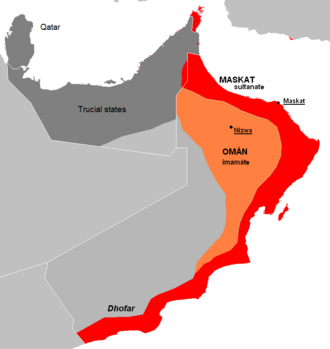
1856年,随着苏丹赛义德·本·苏丹去世,阿曼帝国分裂为本土的马斯喀特和阿曼苏丹国以及非洲东岸的桑给巴尔苏丹国。英国于十九世纪时在波斯湾建立停战诸国体系,马斯喀特和阿曼苏丹国本身也被纳入停战诸国的一环;阿曼的沿海地区逐渐落入英国控制。内陆方面,已统治阿曼内陆数世纪之久的阿曼伊玛目国不认可苏丹的统治权而起兵叛乱,直到在1920年的锡布条约中,马斯喀特和阿曼苏丹泰穆尔·本·费萨尔同意阿曼伊玛目国的自治权。然而泰穆尔之子,赛义德·本·泰穆尔继位后,在英国支持下计划入侵内陆的伊玛目国,1954年绿山战争(Jebel Akhdar War)爆发,最终赛义德·本·泰穆尔取得胜利,阿曼伊玛目国解散。
1963年,佐法尔解放阵线(Dhofar Liberation Front,DLF)在阿曼西南部的佐法尔省起义,佐法尔战争爆发。1970年赛义德·本·泰穆尔之子卡布斯·本·赛义德发动政变篡位,将国号改为阿曼苏丹国,开始阿曼现代化的改革。
正文摘自中文维基百科「马斯喀特和阿曼苏丹国」(删去了参考文献、表格和图片),按 CC BY-SA 4.0 使用
英文维基百科的更多内容
中文维基百科这一条比较短,下面是英文维基百科同一条目的节选,原文为英文,未翻译。
Muscat and Oman (Arabic: مسقط و عُمان), officially known as the Sultanate of Muscat and Oman (Arabic: سلطنة مسقط وعُمان, romanized: Salṭanat Masqaṭ wa-‘Umān), also known briefly as the State of Muscat and Oman (Arabic: دولة مسقط وعُمان, romanized: Dawlat Masqaṭ wa-‘Umān) during the rule of Taimur bin Faisal, was a state that was under de facto British protection which existed in the second half of the 19th century and 20th century. It encompassed the present-day Sultanate of Oman and parts of present-day United Arab Emirates and Pakistan.
In 1856, upon the death of the last ruler of the Omani Empire, Said bin Sultan, the empire split into two separate political entities: the Sultanate of Muscat and Oman and the Sultanate of Zanzibar. The former continued to be led by the Al Busaid dynasty, but transitioned into a new form of government after the palace coup of 23 July 1970 in which the sultan Said bin Taimur was overthrown by the British and his son, Qaboos bin Said, who established the modern-day Sultanate of Oman.
Name
In medieval and early modern times, the area of southeastern Arabia was divided into 4 regions: Oman, Muscat, Dhofar, and the Pirate Coast.
Strictly speaking, Oman (Imamate of Oman, Arabic: عُمان الوسطى, ʿUmān al-Wusṭā) is the inner, continental part of the region without access to the coast and with the capital in the cities of Nizwa and Rustaq. Muscat is the coastal region looking onto the Gulf of Oman. Its rulers often carried out expansion, including overseas. Historical Muscat and Oman are separated by the Green Mountain plateau (Al Jabal Al Akhdar (Arabic: الجبل الأخضر)).
Background
Although there was a Portuguese presence in the region, the Yaruba imams expelled them in the 17th century. The imams later expanded their own maritime empire to the Persian Gulf and Zanzibar, expelling the Portuguese from the wider region, before falling to the Persians. Persian hegemony in Muscat and Oman was ended in 1749 by a defeat at the hands of the elected Imam Ahmad bin Said. The British Empire was keen to dominate southeast Arabia to curb the influence of other European powers and to weaken the Omani Empire in the 18th century. The British empire thus backed the Albusaidi Sultans of Muscat that came to power in the second half of the 18th century.……
Consolidation and decline
In the early 1820s, the Sultanate lost most of its territories in the Persian Gulf, which became the Trucial States under British protection. The fifth Sultan of the Al Said dynasty, Said bin Sultan, consolidated the Sultanate's territorial holdings and economic interests and Oman prospered. However, the Omani fleet was unable to compete with the more technically advanced European fleets and the Sultanate lost much of the trade with South Asia. Pressure by the British to abandon the slave trade further led to the loss of political and economic clout of the Sultanate.
On 4 June 1856, Said bin Sultan died without appointing an heir to the throne and members of the Al Said dynasty could not agree on a ruler.……
Insurgency and oil drilling
The discovery of oil in the Persian Gulf exacerbated the dispute between the Sultan in Muscat and the Imams of Oman. Oil exploration had begun in the early 1920s by the Anglo-Persian Oil Company. The course of World War II severely disrupted such activities. Further, the Sultanate of Muscat during that time was experiencing terrible social, economic and political conditions. The Sultanate was underdeveloped with no infrastructure or telephones, and Sultan Said bin Taimur prohibited anything that he considered "decadent", including radios.……
正文摘自英文维基百科(原文为英文,未翻译)「Muscat and Oman」(节选,删去了参考文献、表格和图片),按 CC BY-SA 4.0 使用;在维基百科读全文 ›
相关事件
- 阿可达山战争1954 年—1959 年 · 战争
人物
前后承接的政权
同时期、同地区的政权