史鉴
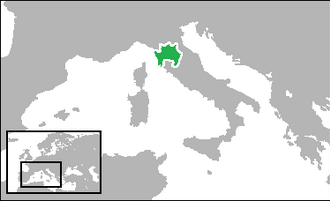
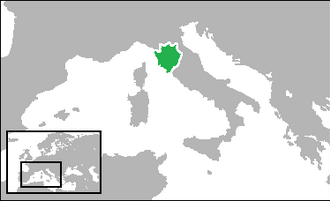
图:Gabagool · CC BY 3.0 · 维基共享资源
详细介绍
历史
1115年,佛罗伦萨脱离托斯卡纳侯国领,获得自治权,成立共和国。
1293年,制定新宪法《正义法规》,规定市政会负责人为正义旗手,兼任军队总指挥。
1378年,爆发梳毛工起义。
1434年美第奇家族建立僭主政治。15世纪洛伦佐·德·美第奇当政时,佛罗伦萨为意大利文艺复兴的名城。
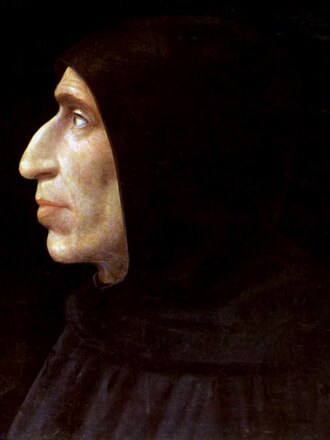
1494年法国国王查理八世入侵佛罗伦斯,当时的当政者皮耶罗二世·德·美第奇被流放,美第奇家族的统治被推翻。道明会修士萨佛纳罗拉成为佛罗伦萨新的精神和世俗领袖。但是很快萨佛纳罗拉严厉苛刻的统治引起了广大百姓的不满,加上他反教廷的言论,遭到教皇亚历山大六世的愤恨。
1498年,萨佛纳罗拉被推翻,并被以异端罪火刑烧死。之后由索德里尼继续统领佛罗伦萨共和国。
1512年美第奇家族在教皇儒略二世的军队支援下,进入佛罗伦萨,共和国随之瓦解。乔凡尼·美第奇成为佛罗伦萨统治者。
1527年美第奇家族再次被逐。
1530年在神圣罗马帝国军队协助下,美第奇家族重返佛罗伦萨。
1532年罗马教皇克勉七世任命亚历山德罗·德·美第奇为佛罗伦萨世袭公爵,共和国成为佛罗伦萨公国。
正文摘自中文维基百科「佛罗伦萨共和国」(删去了参考文献、表格和图片),按 CC BY-SA 4.0 使用
英文维基百科的更多内容
中文维基百科这一条比较短,下面是英文维基百科同一条目的节选,原文为英文,未翻译。
The Republic of Florence (Old Italian: Republica di Fiorenza; contemporary Italian: Repubblica di Firenze), also known as the Florentine Republic (Latin: Res publica Florentina; Old Italian: Republica Fiorentina; contemporary Italian: Repubblica Fiorentina [reˈpubblika fjorenˈtiːna]), was a medieval and early modern state that was centered on the Italian city of Florence in Tuscany. The republic originated in 1115, when the Florentine people rebelled against the Margraviate of Tuscany upon the death of Matilda of Tuscany, who controlled vast territories that included Florence. The Florentines formed a commune in Rabodo's (Matilda's successor) successors' place. The republic was ruled by a council known as the Signoria of Florence. The signoria was chosen by the gonfaloniere (titular ruler of the city), who was elected every two months by Florentine guild members.
During the Republic's history, Florence was an important cultural, economic, political and artistic force in Europe. Its coin, the florin, was the dominant trade coin of Western Europe for large scale transactions and became widely imitated throughout the continent. During the Republican period, Florence was also the birthplace of the Renaissance, which is considered a fervent period of European cultural, artistic, political and economic "rebirth".
The republic had a checkered history of coups and countercoups against various factions. The Medici faction gained governance of the city in 1434 under Cosimo de' Medici. The Medici kept control of Florence until 1494. Giovanni de' Medici, who later became Pope Leo X, reconquered the republic in 1512.
Florence repudiated Medici authority for a second time in 1527, during the War of the League of Cognac.……
Background
The city of Florence was established in 59 BC by Julius Caesar. Since 846 AD, the city had been part of the Marquisate of Tuscany. After Margravine Matilda of Tuscany died in 1115, the city did not submit readily to her successor, Rabodo (r. 1116–1119), who was killed in a dispute with the city.
It is not known precisely when Florence formed its own republican/oligarchical government independent of the marquisate, although the death of Rabodo in 1119 should be a turning point. The first official mention of the Florentine republic was in 1138, when several cities around Tuscany formed a league against the then-margrave of Tuscany, Duke Henry X of Bavaria. The country was nominally part of the Holy Roman Empire.
History
12th century
The newly independent Florence prospered in the 12th century through extensive trade with foreign countries. This, in turn, provided a platform for the demographic growth of the city, which mirrored the rate of construction of churches and palazzi. This prosperity was shattered when Emperor Frederick I Barbarossa invaded the Italian Peninsula in 1185. As a result, the margraves of Tuscany reacquired Florence and its townlands. The Florentines reasserted their independence when Emperor Henry VI died in 1197.
13th century
Florence's population continued to grow into the 13th century, reaching 30,000 inhabitants. As has been said, the extra inhabitants supported the city's trade and vice versa.……
Administrations of the Republic
Florence was governed by a council called the signoria, which consisted of nine men. The head of the signoria was the gonfaloniere, who was chosen every two months in a lottery, as was his signoria. To be eligible, one had to have sound finances, no arrears or bankruptcies, he had to be older than thirty, had to be a member of Florence's seven main guilds (merchant traders, bankers, two clothe guilds, and judges). The lottery was often pre-determined, and the results were usually favourable to influential families. The roster of names in the lottery were replaced every five years.
The main organs of government were known as the tre maggiori. They were: the twelve good men, the standard bearers of the gonfaloniere, and the signoria.……
正文摘自英文维基百科(原文为英文,未翻译)「Republic of Florence」(节选,删去了参考文献、表格和图片),按 CC BY-SA 4.0 使用;在维基百科读全文 ›
相关事件
- Battle of Montecatini1315 年 8 月 29 日 · 战役 · 欧洲
- Scaliger War1336 年 6 月 22 日—1339 年 1 月 24 日 · 战争 · 欧洲
- War of the Eight Saints1375 年—1378 年 7 月 · 战争 · 欧洲
- Battle of Casalecchio1402 年 6 月 26 日 · 战役 · 欧洲
- 伦巴底战争1423 年—1454 年 · 战争 · 欧洲
- 莫利内拉战役1467 年 7 月 25 日 · 战役 · 欧洲
- 康布雷同盟1508 年 2 月—1516 年 12 月 · 战争 · 欧洲
- 干邑同盟战争1526 年—1530 年 · 战争 · 欧洲
- Siege of Florence1529 年 10 月 24 日—1530 年 8 月 10 日 · 战役 · 欧洲
- Battle of Gavinana1530 年 8 月 3 日 · 战役 · 欧洲
- 蒙泰穆尔洛战役1537 年 8 月 2 日 · 战役 · 欧洲
人物









前后承接的政权
同时期、同地区的政权