史鉴
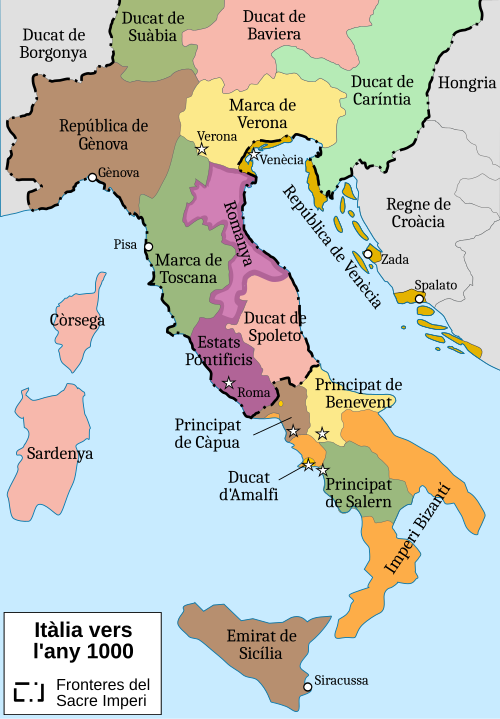
图:Bestiasonica · CC BY-SA 3.0 · 维基共享资源
- 时间
- 846 年—1197 年
- 国家 / 地区
- 神圣罗马帝国、意大利王国 (神圣罗马帝国)
- 类型
- 神圣罗马帝国内的国家
- 简述
- Italian mark
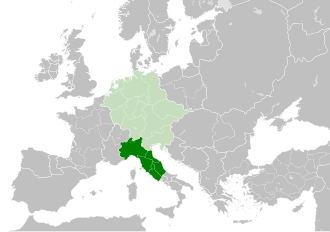
托斯卡纳侯国(意大利语:Marca di Tuscia)是中世纪时神圣罗马帝国和意大利王国的一个边疆侯爵(Margravate)领地。
它位于意大利中西部,南部与教宗国接壤,西临利古里亚海,北部与伦巴第王国接壤,最初以卢卡为中心。
详细介绍
历史
托斯卡纳侯国开始于法兰克帝国的加洛林王朝,是伦巴底人建立的托斯卡纳公国的继承国。法兰克国王干预了伦巴底人与教宗斯德望二世的冲突。通过丕平献土,托斯卡纳南部成为新成立的教宗国的一部分,而北部(伦巴第托斯卡纳)发展成为托斯卡纳侯国。伦巴第王国、托斯卡纳侯国和维罗纳侯国一起成为意大利王国的主体部分。
第一个托斯卡纳边境侯爵是阿尔伯特一世,他在846年获得了这个头衔。在第九世纪末和十世纪初期,托斯卡纳的支持对任何有意成为意大利国王的候选人都有极大的帮助。
931年,阿尔勒的休成为意大利国王,他企图巩固意大利所有重要的封地在他的亲属手中,他将托斯卡纳授予他的兄弟博索。直到1001年。它仍然对选举造成影响。直到1027年,雷尼尔才被神圣罗马帝国皇帝康拉德二世罢免,因为他反对他作为神圣罗马皇帝。
1027年,公国被授予卡诺莎家族统治。博尼费斯三世是神圣罗马帝国皇帝的盟友,他的力量是如此之大,以至于威胁到在伦巴第的意大利王国。他将在艾米利亚的卡诺萨遗产与托斯卡纳传给了他的女儿玛蒂尔达。除了艾米利亚,她最大的资产是托斯卡纳。随着玛蒂尔达于1115年去世,封建主的时代在北意大利已经过去,取而代之的是城邦,海上共和国和中世纪公社的统治。
正文摘自中文维基百科「托斯卡纳侯国」(删去了参考文献、表格和图片),按 CC BY-SA 4.0 使用
英文维基百科的更多内容
中文维基百科这一条比较短,下面是英文维基百科同一条目的节选,原文为英文,未翻译。
The March of Tuscany was a march of the Kingdom of Italy and the Holy Roman Empire during the Middle Ages. Located in northwestern central Italy, it bordered the Papal States to the south, the Ligurian Sea to the west and Lombardy to the north. It comprised a collection of counties, largely in the valley of the River Arno, originally centered on Lucca.
History
The march was a Carolingian creation, a successor of the Lombard Duchy of Tuscia. After the fall of the Western Roman Empire, Tuscia from 568 had been part of the Italian Kingdom of the Lombards (Langobardia Major) until, in 754, the Frankish kings intervened in the conflict with Pope Stephen II. By the Donation of Pepin, the southern part of Tuscia around Viterbo became part of the newly established Papal States, while the northern part (or Lombard Tuscany) developed into the Imperial March of Tuscany after Charlemagne had finally conquered the Lombard kingdom in 773/74. Lombardy proper became the nucleus of the Imperial kingdom of Italy, together with the marches of Tuscany and Verona.
The first Tuscan margrave was Adalbert I, who was granted that title in 846. Before him, his father and grandfather, Count Boniface I of Lucca and Boniface II, probably of Bavarian origin, had controlled most of the counties of the region and had held higher titles as well, such as prefect of Corsica or duke of Lucca. The Bonifacii held the march until 931. During the late ninth and early tenth century, the support of the margraves of Tuscany was instrumental for any candidate intent on becoming king of Italy.
In 931, Hugh of Arles, who had made himself king of Italy, dispossessed the Bonifacii in an attempt to consolidate all the important fiefs of Italy in his relatives' hands. He granted Tuscany to his brother Boso. It remained in the hands of members of the family known as the Bosonids down to 1001. It also retained its influence regarding royal elections. As late as 1027, Rainier was deposed from the march by Holy Roman Emperor Conrad II for opposing him as king.
In 1027, the duchy was granted to the counts of Canossa. Boniface III used the title dux et marchio: duke and margrave.……
Margraves of Tuscany, 812–1197
House of Boniface
These were originally counts of Lucca who extended their power over the neighbouring counties.
- Boniface I, 812–823
- Boniface II, 828–834
- Aganus, 835–845
- Adalbert I, 847–886
- Adalbert II the Rich, 886–915
- Guy, 915–929
- Lambert, 929–931
House of Boso
These were the (mostly illegitimate) relatives of Hugh of Arles, King of Italy, whom he appointed to their post after removing the dynasty of Boniface
- Boso, 931–936
- Humbert, 936–961
- Hugh the Great, 961–1001
House of Hucpold
Boniface (III), 1004–1011
Nondynastic
Rainier, 1014–1027
House of Canossa
These were the descendants of the Counts of Canossa.
- Boniface III, 1027–1052
- Frederick, 1052–1055
- Matilda, 1055–1115
Beatrice of Bar, 1052–1069 (regent as mother of Frederick and Mathilda)
Godfrey the Bearded, Duke of Lower Lorraine, 1053–1069 (regent as husband of Beatrice and step-father to Frederick and Matilda)
Godfrey the Hunchback, Duke of Lower Lorraine, 1069–1076 (co-ruler as husband of Matilda)
Welf II, 1089–1095 (co-ruler as husband of Matilda)
Nondynastic
- Rabodo, 1116–1119
- Conrad, 1119/20–1129/31
- Rampret, c. 1131
- Engelbert, 1134/5–1137
- Henry the Proud, 1137–1139
Ulrich of Attems, 1139–1152 (imperial vicar)
- Welf VI, 1152–1160
- Welf VII, 1160–1167
Rainald of Dassel, Archbishop of Cologne, 1160–1163 (imperial vicar)
Christian of Buch, Archbishop of Mainz 1163–1173 (imperial vicar)
- Welf VI, 1167–1173
- Philip, 1195–1197
In 1197 Philip was elected King of Germany and the majority of the Tuscan nobility, cities and bishops formed the Tuscan League with Papal backing.
Frederick of Antioch, 1246–51 (imperial vicar and King of Tuscany)
After this, Tuscany was splintered between the competing republics of Florence, Pisa, Siena, Arezzo, Pistoia and Lucca. Since the 14th century, Florence gained dominance over Pistoia (1306, officially annexed 1530), Arezzo (1384), Pisa (1406), and Siena (1559).……
正文摘自英文维基百科(原文为英文,未翻译)「March of Tuscany」(节选,删去了参考文献、表格和图片),按 CC BY-SA 4.0 使用;在维基百科读全文 ›