史鉴
- 存在时间
- 1818 年—1891 年 1 月 24 日
- 首都
- 利雅得
- 官方语言
- 阿拉伯语
- 宗教
- 伊斯兰教
- 前身
- 德拉伊耶酋长国、埃及省、Second Bani Khalid Emirate
- 后继
- 内志与哈萨酋长国
- 类型
- 历史国家
- 所在大洲
- 亚洲
- 简述
- 1818– 1891 country in Arabian Peninsula
内志酋长国,又称内志第二王国或第二沙特王国,是继德拉伊耶酋长国之后内志地区的第二个由沙特家族统治的国家,存在于19世纪。先前的德拉伊耶酋长国在1818年被奥斯曼帝国击败,内志酋长国建立。内志酋长国和德拉伊耶酋长国相比,尽管内志酋长国的君主仍然保持着伊玛目的头衔,并且依然雇有瓦哈比派学者,内志酋长国的宗教信仰热情也较之前少,领土扩张规模也显得小了许多。
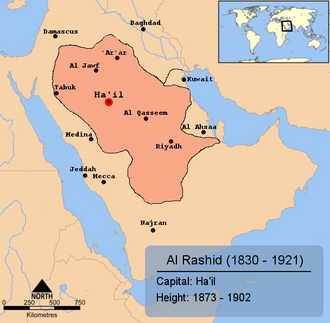
1824年,内志酋长国将旧都利雅得从奥斯曼帝国埃及省的统治下夺了回来。内志酋长国存在期间,沙特家族内部存在着非常激化的矛盾,使得酋长国最终为敌对拉希德家族的舍迈尔山酋长国所灭。
详细介绍
统治者
- 伊玛目图尔基·本·阿卜杜拉(第一次)1819年–1820年
- 伊玛目图尔基·本·阿卜杜拉(第二次)1824年–1834年
- 伊玛目米沙里·本·阿卜杜勒·拉赫曼·本·米沙里(篡位者)1834年
- 伊玛目费萨尔·本·图尔基(第一次)1834年–1838年
- 伊玛目哈立德·本·沙特 1838年–1841年
- 伊玛目阿卜杜拉·本·图纳扬·沙特1841年–1843年
- 伊玛目费萨尔·本·图尔基(第二次)1843年–1865年
- 伊玛目阿卜杜拉·本·费萨尔(第一次)1865年–1871年
- 伊玛目沙特·本·费萨尔(第一次)1871年
- 伊玛目阿卜杜拉·本·费萨尔(第二次)1871年––1873年
- 伊玛目沙特·本·费萨尔(第二次)1873年–1875年
- 伊玛目阿卜杜勒-拉赫曼·本·费萨尔(第一次)1875年–1876年
- 伊玛目阿卜杜拉·本·费萨尔(第三次)1876年–1889年
- 伊玛目阿卜杜勒-拉赫曼·本·费萨尔(第二次)1889年–1891年
正文摘自中文维基百科「内志酋长国」(删去了参考文献、表格和图片),按 CC BY-SA 4.0 使用
英文维基百科的更多内容
中文维基百科这一条比较短,下面是英文维基百科同一条目的节选,原文为英文,未翻译。
The second Saudi state (Arabic: الدَّوْلَةُ السُّعُودِيَّةُ الثَّانِيَةُ, romanized: ad-Dawla as-Suʿūdiyya ath-Thāniyya), officially known as the Emirate of Najd, was a state that existed between 1824 and 1891 in the Najd region of what is now Saudi Arabia. Saudi rule was restored to central (Najd) and Eastern Arabia after the first Saudi state having previously been brought down by the Ottoman Empire's Egypt Eyalet in the Ottoman–Wahhabi War.
The second Saudi period was marked by less territorial expansion and less religious zeal, although the Saudi leaders continued to be called Imam and still employed Wahhabist religious scholars. Turki bin Abdullah's reconquest of Riyadh from Ottoman-Egyptians forces in 1824 is generally regarded as the beginning of the second Saudi state. Severe internal conflicts within the House of Saud eventually led to the dynasty's downfall at the Battle of Mulayda in 1891, between the forces loyal to the last Saudi imam, Abdul Rahman bin Faisal, and the Rashidi dynasty of Hail.
History
The first Saudi to attempt to regain power after the fall of the First Saudi state in 1818 was Mishari bin Saud, a brother of the last ruler in Diriyah, Abdullah ibn Saud but he was soon captured by Ottoman Egypt and killed. In 1824, Turki bin Abdullah, a grandson of the first Saudi imam Muhammad bin Saud who had managed to evade capture by the Ottomans, was able to expel Ottoman–Egyptian forces and their local allies from Riyadh and its environs and is generally regarded as the founder of the second Saudi dynasty as well as the ancestor of the kings of modern-day Saudi Arabia. He made his capital in Riyadh and was able to enlist the services of many relatives who had escaped captivity in Ottoman Egypt, including his son Faisal bin Turki.
Turki was assassinated in 1834 by order of Mishari bin Abdul Rahman, a distant cousin. Mishari was soon besieged in Riyadh and later executed by Faisal, who went on to become the most prominent ruler of the Saudis' second reign. Faisal, however, faced a re-invasion of Najd organised by Muhammad Ali. The local population was unwilling to resist, and Faisal was defeated and taken to Ottoman Egypt as a prisoner for the second time in 1838.
The Ottomans installed Khalid bin Saud, who had spent many years in the Ottomans–Egyptian court, as ruler in Riyadh and supported him with Ottomans–Egyptian troops. Khalid was the last surviving brother of Abdullah bin Saud bin Abdulaziz, a great-grandson of Muhammad ibn Saud. However, following the 1840 Convention of London imposed by European powers, the Ottoman Empire withdrew their military presence in the Arabian Peninsula, leaving Khalid with minimal support. Perceived by most locals as little more than an Ottoman–Egyptian governor, Khalid was toppled soon afterwards by Abdullah bin Thunayan, of the collateral Al Thunayan branch.
To restore equilibrium and counteract British influence, Muhammad Ali directed his aides to empower Faisal bin Turki, who had been imprisoned during his campaign in Najd, facilitating his escape from Ottoman Egypt. Faisal's return was seen as crucial for maintaining balance, given his rightful claim to rule in Najd, which had been under Abdullah bin Thunayan's control. Faisal's relationship with Muhammad Ali appears to have been pragmatic, governed by mutual interests.
Assisted by the House of Rashid rulers of Ha'il, Faisal swiftly eliminated his rival and retook Riyadh, resuming his rule. He later appointed his son Abdullah bin Faisal as heir apparent, and divided his dominions among his three sons Abdullah, Saud, and Muhammad. This time Faisal recognised Ottoman suzerainty and paid an annual tribute; in exchange he was recognised as "ruler of all the Arabs" by the Ottomans.
正文摘自英文维基百科(原文为英文,未翻译)「Second Saudi state」(节选,删去了参考文献、表格和图片),按 CC BY-SA 4.0 使用;在维基百科读全文 ›
前后承接的政权

同时期、同地区的政权