史鉴
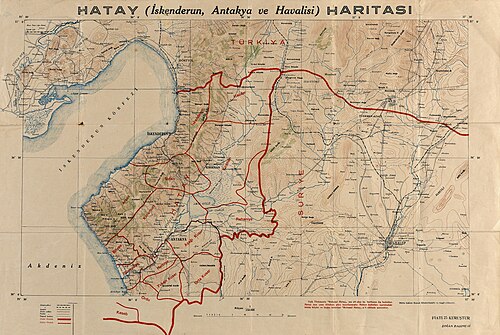
图:佚名 · Public domain · 维基共享资源
- 存在时间
- 1938 年 9 月 7 日—1939 年 6 月 29 日
- 首都
- 安条克
- 政体
- 共和制
- 官方语言
- 法语、土耳其语、阿拉伯语
- 货币
- 土耳其里拉、叙利亚镑
- 前身
- 法属叙利亚和黎巴嫩托管地、亚历山大勒塔桑贾克、叙利亚第一共和国
- 后继
- 哈塔伊省
- 类型
- 历史国家
- 所在大洲
- 亚洲
- 所处时代
- 战间期
- 简述
- former country in western Asia
哈塔伊国(土耳其语:Hatay Devleti;阿拉伯语:دولة خطاي;法语:État du Hatay),非正式名称为哈塔伊共和国(阿拉伯语:جمهورية حطاي,罗马化:Jumhūriyyat Ḥaṭāy),是一个过渡性政治实体,存在于1938年9月7日至1939年6月29日。位于法属叙利亚的北部。 该州于1939年7月7日从法律上转变为土耳其的哈塔伊省,事实上于1939年7月23日加入土耳其。
正文摘自中文维基百科「哈塔伊国」(删去了参考文献、表格和图片),按 CC BY-SA 4.0 使用
英文维基百科的更多内容
中文维基百科这一条比较短,下面是英文维基百科同一条目的节选,原文为英文,未翻译。
Hatay State (Turkish: Hatay Devleti; French: État du Hatay; Arabic: دولة حطاي, romanized: Dawlat Ḥaṭāy), also known informally as the Republic of Hatay (Arabic: جمهورية حطاي, romanized: Jumhūriyyat Ḥaṭāy), was a transitional nation that existed from 2 September 1938 to 29 June 1939, being located in the territory of the Sanjak of Alexandretta of the French Mandate of Syria. The state was transformed de facto into the Hatay Province of Turkey on 7 July 1939, de jure joining the country on 23 July 1939.
History
Background
Formerly part of the Aleppo Vilayet of the Ottoman Empire, the Sanjak of Alexandretta was occupied by France at the end of the First World War and constituted part of the French Mandate of Syria.
The Sanjak of Alexandretta was an autonomous sanjak from 1921 to 1923, as a result of the Franco-Turkish Treaty of Ankara, as it had a large Turkish community as well as its Arab and Armenian population. Then it was attached to the State of Aleppo, then in 1925 it was directly attached to the State of Syria, still with a special administrative status.
Marshal Mustafa Kemal Pasha (later known as Mustafa Kemal Atatürk), refused to accept the Sanjak of Alexandretta as part of the Mandate and, in a speech on 15 March 1923 in Adana, he described the Sanjak as "A homeland where Turks lived for centuries and can't be a captive at the hands of enemy". Turkish policy aimed at annexing the Sanjak of Alexandretta when the French mandate of Syria was due to expire in 1935. Turks in Alexandretta initiated reforms in the style of Atatürk's, and formed various organisations and institutions in order to promote the idea of union with the Republic of Turkey.
In 1936, the elections returned two Syrian independentist MPs (favouring the independence of Syria from France) in the sanjak, and this prompted communal riots and passionate articles in the Turkish and Syrian press. In particular, Arab nationalist Zaki al-Arsuzi was influential.
In response, the Atatürk government coined the name Hatay for the Sanjak of Alexandretta, as a reference to Hittites (Syro-Hittite states), and raised the "Issue of Hatay" (Turkish: Hatay Meselesi) at the League of Nations. On behalf of the League of Nations, representatives of France, the United Kingdom, the Netherlands, Belgium and Turkey prepared a constitution for the sanjak. The new statute came into power in November 1937, the sanjak becoming 'distinct but not separated' from Syria on the diplomatic level, linked to both France and Turkey for military matters.
On 2 September 1938, the sanjak assembly proclaimed the Sanjak of Alexandretta as the Hatay State. The State lasted for one year under joint French and Turkish military supervision.
On 29 June 1939, following a referendum, the Hatay legislature voted to disestablish the Hatay State and join Turkey. This referendum has been labelled both "phoney" and "rigged", as the Turkish government organised tens of thousands of Turks originating from but not living in Alexandretta to return to and register as citizens and vote. The French encouraged the annexation, hoping it would act as an incentive to Turkey to reject an alliance with Nazi Germany.
Constitution
The constitution of the Hatay State had additionally been mirrored from Turkey.
Population and demographics
According to the estimates of the French High Commission in 1936, out of a population of 220,000, 39% were Turks, 28% Alawite Arabs, 11% Armenians, 10% Sunni Arabs, 8% other Christians and 4% were Circassians, Kurds and Jews. Although Turks formed the largest single ethno-religious group, Arabic speakers, including Sunnis, Alawites and Christians, were more numerous.
In 1937, most sources pointed that out of a total population of 186,000 people (which is according to the French government's 1932 report) in sanjak of Alexandretta, 85,000 people were Turks, 25,000 were Armenians, and the remainder was largely made up of Arabs with some Greeks, Jews, Kurds, and Circassians.
正文摘自英文维基百科(原文为英文,未翻译)「Hatay State」(节选,删去了参考文献、表格和图片),按 CC BY-SA 4.0 使用;在维基百科读全文 ›
人物
前后承接的政权

同时期、同地区的政权