史鉴
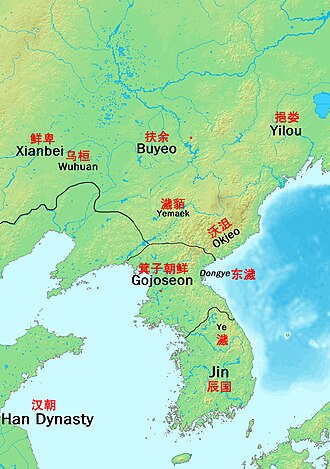
弁(biàn)韩,亦称“弁辰”,是朝鲜半岛古代南部的国家联盟。与“马韩”、“辰韩”合称“三韩”。他们是现在朝鲜民族的直系祖先之一,也是如今韩国国名得来的原因。
据《三国志》记载,弁韩由十二国联合组成,每个国家都有自己的城、文武大臣和头目。其法律、社会习俗非常严厉。
弁韩与辰韩杂居,与辰韩语言和文化相似。 弁韩以铁器生产闻名,其生产的铁器销售到朝鲜半岛。和中国一样,弁韩也以铁为货币流通工具,并给汉四郡铸币。 弁韩土地肥美,弁韩人擅长种植五谷及稻米,也会种桑育蚕,织布,乘驾牛马。弁韩人以大鸟的羽毛送葬死者,其意欲使死者飞扬。
弁韩后以集权化的伽倻联盟形成的表现。伽倻联盟后来被新罗吸收。
正文摘自中文维基百科「弁韩」(删去了参考文献、表格和图片),按 CC BY-SA 4.0 使用
英文维基百科的更多内容
中文维基百科这一条比较短,下面是英文维基百科同一条目的节选,原文为英文,未翻译。
Byeonhan (Korean: 변한; Hanja: 弁韓), also known as Byeonjin (변진; 弁辰), was a loose confederacy of chiefdoms that existed from around the beginning of the Common Era to the 4th century in the southern Korean Peninsula. Byeonhan was one of the Samhan (or "Three Hans"), along with Mahan and Jinhan.
Etymology
Byeonhan (弁韓) is believed to be a combination of Old Korean words. Byeon (변) in native Korean meant "Shiny/Shimmering" while han (한) meant "big", giving the meaning of Byeonhan, the "Big Nation of Shimmering".
As part of the Samhan, Jinhan meant "Big Nation of the East" and Mahan meant "Big Nation of the South".
History
This early part of the Three Kingdoms period is sometimes called the Proto–Three Kingdoms period. Byeonhan, like the other Samhan confederacies, appears to be descended from the Jin state of southern Korea.
Archaeological evidence indicates an increase in military activity and weapons production among the Byeonhan in the 3rd century, especially an increase in iron arrowheads and cuirasses (Barnes 2000). This may be associated with the decline of Byeonhan and the rise of the more centralized Gaya confederacy, which most Byeonhan states joined. Gaya was subsequently annexed by Silla, one of the Three Kingdoms of Korea.
Various cultural aspects supposedly unique to Byeonhan overlap with Jinhan, but are not universal in Byeonhan. One notable tradition was tattooing, which was done by both men and women. Another tradition was the burying of feathers and pottery in graves alongside the dead body as it was believed that the feathers helped the afterlife souls fly into the sky.
Culture and language
The Dongyi ("Eastern Barbarian") in the Book of Wei section of the Chinese book, Records of the Three Kingdoms states that the culture of Byeonhan was similar to that of Jinhan (言語法俗相似) and that their populations lived "intermingled together" (弁辰與辰韓雑居), while having similar language and customs.
The fifth century Book of the Later Han, however, notes on differences in their language and customs as "languages and customs have differences" (言語風俗有異), after stating that their enclosed settlements and clothing are the same.
Furthermore, the Wei shu states that "Jinhan men and women are close to Wa (男女近倭)", the ethnonym for the contemporary inhabitants of the Japanese archipelago, and like the Wa tattoo their bodies. The Book of the Later Han however identifies this with Byeonhan, stating that "their country is close to Wa, therefore they frequently have tattoos."
The linguist John Whitman summarizes the situation as such:
In fact, the texts indicate a more complex (and plausible) interrelationship between language, ethnicity, and protopolitical grouping. [...] The Jinhan population lives intermixed with Pyŏnhan;……
Politics and trade
Byeonhan may have simply been a political description for decentralized polities south and west of the Nakdong river valley that were not formal members of the Jinhan confederacy.
Byeonhan was internationally known for its production of iron, which was also its main export good to the Lelang commandery to the northwest, the Japanese archipelago, and the rest of the Korean Peninsula. It was also a center of stoneware manufacture.
Member statelets
According to the Records of Three Kingdoms, Byeonhan consisted of 12 statelets:
Mirimidong (미리미동국; 彌離彌凍國), present-day Miryang.
Jeopdo (접도국; 接塗國), present-day Haman.
Gojamidong (고자미동국; 古資彌凍國), present-day Goseong.
Gosunsi (고순시국; 古淳是國), present-day Jinju, Sacheon or Goseong.
Ballo (반로국; 半路國), present-day Seongju.
Nangno (낙노국; 樂奴國), present-day Hadong or Namhae.
Gunmi (군미국; 軍彌國), present-day Sacheon.
Mioyama (미오야마국; 彌烏邪馬國), present-day Changwon.
Gamno (감로국; 甘路國), present-day Gimcheon.
Guya (구야국; 狗邪國), present-day Gimhae.
Jujoma (주조마국; 走漕馬國), present-day Gimcheon.
Anya (안야국; 安邪國), present-day Haman.
Dongno (독로국; 瀆盧國), present-day Dongnae.
正文摘自英文维基百科(原文为英文,未翻译)「Byeonhan confederacy」(节选,删去了参考文献、表格和图片),按 CC BY-SA 4.0 使用;在维基百科读全文 ›
前后承接的政权
同时期、同地区的政权