史鉴
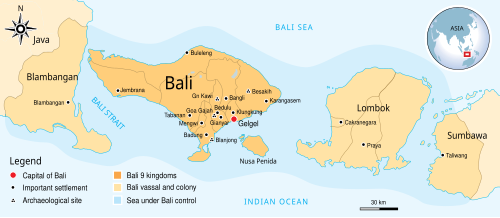
图:Gunawan Kartapranata · CC BY-SA 4.0 · 维基共享资源
- 存在时间
- 914 年—1908 年
- 后继
- 荷属东印度
- 类型
- 王国、历史国家
- 简述
- 巴厘岛的古政权
巴厘王国(巴厘语:᭚ᬓᭂᬭᬚ᭡ᬦ᭄ᬩᬮᬶ;罗马化: Kĕrajaan Bali )是914年至1908年期间曾统治现今印度尼西亚小巽他群岛巴厘省的一系打印度教和佛教王国。19世纪中叶起,荷属东印度开始讨伐巴厘王国。20世纪初,荷兰人彻底征服了巴厘岛。
正文摘自中文维基百科「巴厘王国」(删去了参考文献、表格和图片),按 CC BY-SA 4.0 使用
英文维基百科的更多内容
中文维基百科这一条比较短,下面是英文维基百科同一条目的节选,原文为英文,未翻译。
The Bali Kingdom (Balinese: ᭚ᬓᭂᬭᬚ᭡ᬦ᭄ᬩᬮᬶ, romanized: Kĕrajaan Bali) was a series of Hindu-Buddhist kingdoms that once ruled some parts of the volcanic island of Bali, in Lesser Sunda Islands, Indonesia. With a history of native Balinese kingship spanning from the early 10th to early 20th centuries, Balinese kingdoms demonstrated sophisticated Balinese court culture where native elements of spirit and ancestral reverence combined with Hindu influences—adopted from India through ancient Java intermediary—flourished, enriched and shaped Balinese culture.
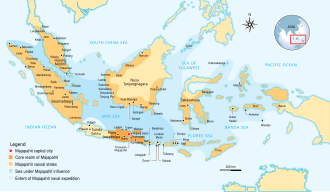
Because of its proximity and close cultural relations with the neighbouring island of Java during the Indonesian Hindu-Buddhist period, the history of the Bali Kingdom was often intertwined with and heavily influenced by its Javanese counterparts, from Mataram (c. 9th century) to the Majapahit empire in the 13th to 15th centuries. The culture, language, arts and architecture of the island was influenced by Java. Javanese influences and presences grew even stronger with the fall of the Majapahit empire in the late 15th century. After the empire fell to its Muslim vassal the Demak Sultanate, a number of Hindu Majapahit courtiers, nobles, priests, and artisans found refuge on the island of Bali. As a result, Bali became what historian Ramesh Chandra Majumdar describes as the last stronghold of Indo-Javanese culture and civilisation. The Bali Kingdom in the following centuries expanded its influence to neighboring islands and began to establish colonies;……
History
Prehistory
Bali has been inhabited by humans since Paleolithic times (1 Million BCE to 200,000 BCE), testified by the finding of ancient tools such as hand axes in Sembiran and Trunyan villages in Bali, followed by the Mesolithic period (200,000–3,000 BCE). However, the ancestors of the current Balinese inhabitants reached the island around 3,000 to 600 BCE during the Neolithic period, characterised by rice-growing technology and speaking Austronesian languages. The Bronze Age period followed, from around 600 BCE to 800 CE.
Early kingdom
The historical period in Bali started in c. 8th century, marked by the discovery of inscribed Buddhist votive clay tablets. These Buddhist votive tablets, found in small clay stupa figurines called "stupikas", are the first known written inscriptions in Bali and date from around the 8th century CE. Such stupikas have been found in the regency of Gianyar, and the villages of Pejeng, Tatiapi, and Blahbatuh. The bell-shaped stupikas bear resemblances to the style of the 8th-century stupas of Central Javanese Buddhist art found in Borobudur and other Buddhist temples dating from that period, which suggested the Sailendra link to Buddhist pilgrims or inhabitants in the early history of Bali.
In the early 10th century, a king called Sri Kesari Warmadewa issued the Belanjong pillar inscription found near the southern strip of Sanur Beach. It is the oldest inscription found in Bali that names the ruler who issued it. The pillar is dated 914 CE according to the Indian Saka calendar. Three other inscriptions by Kesari are known in central Bali, which suggest conflict in the mountainous interior of the island. Sri Kesari is the first known ruler to bear the Warmadewa title, which was used by rulers for several generations before Javanese expansion.
It is not known precisely where the capital of the kingdom was during the 10th and 11th centuries, but the political, religious, and cultural centre of the kingdom may have been in the present-day Gianyar Regency, inferred from the concentration of archaeological finds in this area. The stone cave temple and bathing place of Goa Gajah, near Ubud in Gianyar, was made around the same period. It shows a combination of Buddhist and Hindu Shivaite iconography. Several carvings of stupas, stupikas (small stupas), and images of Boddhisattvas suggest that the Warmadewa dynasty was a patron of Mahayana Buddhism. Nevertheless, Hinduism was also practised in Bali during this period.
正文摘自英文维基百科(原文为英文,未翻译)「Bali Kingdom」(节选,删去了参考文献、表格和图片),按 CC BY-SA 4.0 使用;在维基百科读全文 ›
前后承接的政权
同时期、同地区的政权