史鉴
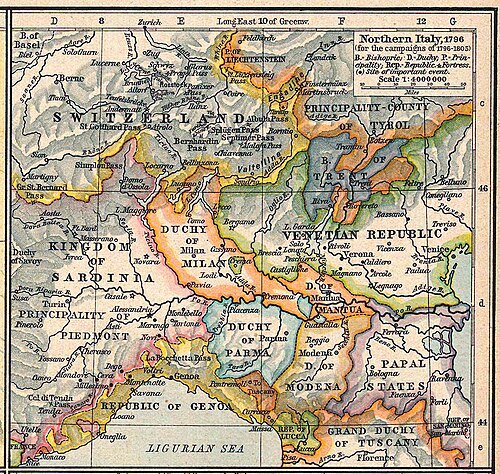
图:William Robert Shepherd · Public domain · 维基共享资源
- 存在时间
- 1160 年—1805 年 6 月 22 日
- 首都
- 卢卡
- 政体
- 共和制、aristocratic republic、中世纪公社
- 宗教
- 天主教会
- 货币
- Luccan pound
- 类型
- 法国姊妹共和国、历史国家
- 简述
- 意大利的历史城市姊妹共和国
The Republic of Lucca (Italian: Repubblica di Lucca) was a medieval and early modern state that was centered on the Italian city of Lucca in Tuscany, which lasted from 1160 to 1805.
Its territory extended beyond the city of Lucca, reaching the surrounding countryside in the north-western part of today's Tuscany region, to the borders with Emilia-Romagna and Liguria.
The Republic of Lucca remained independent until 1799. Later the state continued to exist but was, de facto, dependent upon Napoleonic France, and ceased officially its existence in 1805, when it was transformed into the Principality of Lucca and Piombino.
详细介绍
Background
Within the Imperial Kingdom of Italy, the city of Lucca had been the residence of the Margraves of Tuscany until the time of Margrave Hugh. A certain autonomy was granted by a 1084 diploma issued by Emperor Henry IV, while on his Italian campaign during the Investiture controversy with Pope Gregory VII. No feudal castle could be built in the range of 6 miles from the city wall. More privileges were granted by the following emperors.
Rise of the Republic
After the death of Margravine Matilda of Tuscany in 1115, the City of Florence began to constitute itself an independent commune, with an administration officially acknowledged by Margrave Conrad in 1120 and by Emperor Frederick in 1162. The city bought the feudal rights from Margrave Welf VI in 1160, hence became subject only to the emperors. For more than 500 years, Lucca remained as an independent republic.
At the end of the 12th century, Lucca and other cities of Tuscany created an alliance to fight the neighbour feudal lords and subjugate their lands. This allowed Lucca and Florence in particular to control large territories and to compete for military supremacy in the region. The 13th century was characterised by political fights inside many communes, including Lucca. As a consequence, the republic witnessed the rise of the populist faction and change in government structure, as well as participating in a long series of wars between Guelphs and Ghibellines. In 1273 and again in 1277 Lucca was ruled by a guelph capitano del popolo (captain of the people) named Luchetto Gattilusio.
Lucca in the 14th century became one of the most important cities of the Italian Middle Ages.……
Renaissance and onwards
During the 15th century the republic was of less importance than the two great republics of Florence and Siena. In the first decades of the century, Lucca falls under the pseudo-tyranny of the Guinigi family.
A judgment of the important historian Giovanni Sercambi from Lucca has been preserved on this period, he especially highlights the conferment of all offices to supporters of the dominant family and also mentions the provisions to prevent the largest assembly of citizens (the General Council) from meeting. The role of this was taken by a Commission made up of twelve or eighteen partisans of the ruling house. Sercambi remembers more generally the restriction of all expenses, except those in favour of the mercenaries, considered indispensable to not live in continuous fears and dangers, and which had to be kept happy, as well as the secret acts of violence committed to get rid of the most rebels dangerous.
The alliance between the Republic at the time was controlled by the Guinigi family and the Duchy of Milan led Lucca into the ruinous war against the Republic of Venice and Republic of Florence;……
The end of the Republic
Early 19th century
After the war of the First Coalition, which ended with the Treaty of Campo Formio, the Government of the Republic of Lucca decided to start negotiations with the newly formed Cisalpine Republic with the aim of maintaining its independence. The jurist Luigi Matteucci, the father of the more famous Felice, was sent to Milan to negotiate with Napoleon.
The republic was the only territory in all of continental Italy that the French army had not yet invaded and Matteucci's proposals were rejected, so much so that on 22 January 1799 the French troops entered the city, overthrowing the oligarchic republic and establishing a new centralized republic, with a democratic constitution, under the French protectorate. The constitution granted the government to an Executive Directory, with a bicameral legislature composed of the Council of Juniors and the Council of Seniors. The democracy did not last long.
On 17 July 1799, during the war of the Second Coalition, the Austrian Habsburg army occupied Lucca and established a Provisional government. Upon Napoleon's return from Egypt, however, the situation reversed just as quickly. On 9 July 1800, the French occupied the city, installing a provisional government under the control of Antoine Christophe Saliceti.……
正文摘自英文维基百科(原文为英文,未翻译)「Republic of Lucca」(节选,删去了参考文献、表格和图片),按 CC BY-SA 4.0 使用;在维基百科读全文 ›
人物
同时期、同地区的政权