史鉴
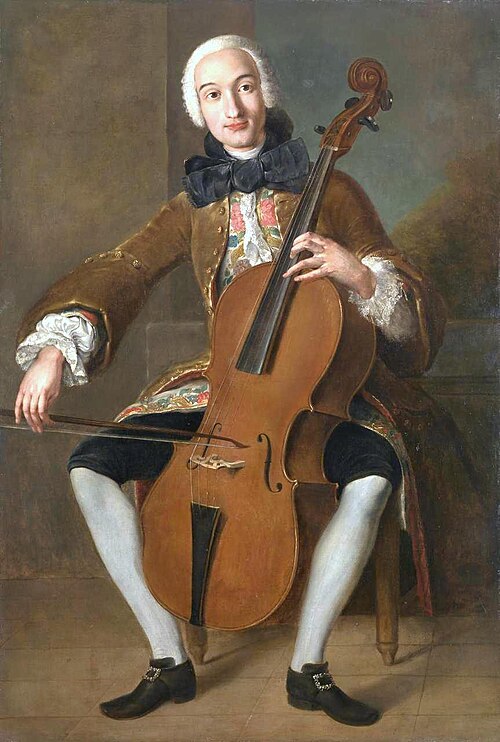
图:Pompeo Batoni · Public domain · 维基共享资源
- 生卒
- 1743 年 2 月 19 日—1805 年 5 月 28 日
- 出生地
- 卢卡
- 去世地
- 马德里
- 国籍 / 所属
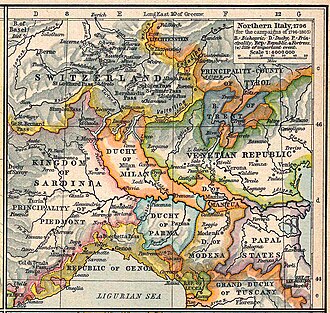
- 卢卡共和国
- 身份
- 作曲家、指挥家、道具组、大提琴家、古典钢琴家
- 代表作
- Symphony Op. 12 No. 4 (Boccherini)、String Quintet in E major
- 原文名
- Luigi Boccherini
- 死因
- 结核病
- 简述
- 意大利作曲家,大提琴家
路易吉·鲁道夫·博凯里尼(意大利语:Luigi Rodolfo Boccherini,1743年2月19日—1805年5月28日)是一名意大利作曲家和大提琴家。
详细介绍
生平
博凯里尼1743年生于意大利卢卡的一个音乐世家。早年在罗马学习。1757年到维也纳。1761年到马德里,成为西班牙王子Don Luis的宫廷音乐家,此后一直居住在西班牙,1805年死于马德里。
音乐
博凯里尼是古典主义时期最重要的器乐作曲家之一。他的大量交响曲,弦乐三重奏,四重奏,五重奏等作品音调和谐优雅,旋律优美动听。虽然在音乐形式上不如同时期的海顿完美,但更为平易近人。作为大提琴演奏家,他的大提琴协奏曲在音乐史上占有很高地位。博凯里尼的作品在长时间被埋没后,现在已得到广泛复兴。
正文摘自中文维基百科「路易吉·博凯里尼」(删去了参考文献、表格和图片),按 CC BY-SA 4.0 使用
英文维基百科的更多内容
中文维基百科这一条比较短,下面是英文维基百科同一条目的节选,原文为英文,未翻译。
Ridolfo Luigi Boccherini (, also US: ; Italian: [riˈdɔlfo luˈiːdʒi bokkeˈriːni] ; 19 February 1743 – 28 May 1805) was an Italian composer and cellist of the Classical era whose music retained a courtly and galante style even while he matured somewhat apart from the major classical musical centers. He is best known for the minuet from his String Quintet in E, Op. 11, No. 5 (G 275), and the Cello Concerto in B♭ major (G 482). The latter work was long known in the heavily altered version by German cellist and prolific arranger Friedrich Grützmacher, but has recently been restored to its original version. He is also particularly well known for his Musica notturna delle strade di Madrid (Night Music of the Streets of Madrid).
Boccherini's output also includes several guitar quintets. The final movement of the Guitar Quintet No. 4 in D (G 448) is a fandango, a lively Spanish dance.
Biography
Boccherini was born into a musical family in Lucca, Italy in 1743. He was the third child of Leopoldo Boccherini, a cellist and double-bass player, and the brother of Giovanni Gastone Boccherini, a poet and dancer who wrote libretti for Antonio Salieri and Joseph Haydn. Luigi received his first music lessons at age five from his father, who taught him cello, and then continued his studies at age nine with Abbé Vanucci, music director of a local cathedral, at San Martino. When his son reached thirteen, Leopoldo Boccherini sent him to study in Rome with Giovanni Battista Costanzi. In 1757 Luigi Boccherini and his father both went to Vienna, where the court employed them as musicians in the Burgtheater.
In 1768 Boccherini went to Madrid, entering in 1770 the employ of Infante Luis Antonio of Spain (1727–1785), younger brother of King Charles III of Spain. There, Boccherini flourished under royal patronage, until one day when the King expressed his disapproval at a passage in a new trio, and ordered Boccherini to change it.……
Works
Much of Boccherini's chamber music follows models established by Joseph Haydn; however, Boccherini is often credited with improving Haydn's model of the string quartet by bringing the cello to prominence, whereas Haydn had frequently relegated it to an accompaniment role. Some sources for Boccherini's style are in the works of a famous Italian cellist, Giovanni Battista Cirri, who was born before Boccherini and before Haydn.
A virtuoso cellist, Boccherini often played violin repertoire on the cello, at pitch, a skill he developed by substituting for ailing violinists while touring. This supreme command of the instrument brought him much praise from his contemporaries (notably Pierre Baillot, Pierre Rode, and Bernhard Romberg), and is evident in the cello parts of his compositions (particularly in the quintets for two cellos, treated often as cello concertos with string quartet accompaniment).
Recordings
Complete Symphonies, Vol. I–VII, Deutsche Kammerakademie Neuss, Johannes Goritzki, CPO 999401-2
Cello Concertos, Enrico Bronzi, Accademia I Filarmonici di Verona, Brilliant Classics 92618 (2005)
Complete Flute Quintets, Vol. I–III, Rafael Ruibérriz de Torres, Francisco de Goya String Quartet, Brilliant Classics 96074 (2021)
Early Italian String Quartets, String Quartet in C minor, op. 1 No. 2, Butter Quartet
Guitar Quintets, Vol. I–III, Zoltán Tokos, Danubius String Quartet, Naxos 8.503255
String Quintets, Vol. I–X, La Magnifica Comunita, Enrico Casazza, violin, Brilliant Classics 92503, 92889, 93076, 93346, 93566, 93820, 93744, 94002, 93977, 94961 (2005–2011)
Boccherini's music is heard in the 2003 feature film Master and Commander: The Far Side of the World, including the little known Passa Calle, from La Musica Notturna di Madrid.
Media
(All performed by Jacques Lochet, violin and synthesiser.)
正文摘自英文维基百科(原文为英文,未翻译)「Luigi Boccherini」(节选,删去了参考文献、表格和图片),按 CC BY-SA 4.0 使用;在维基百科读全文 ›
所属政权
同时代、同地区的人物



同时代、同身份的人物(艺术与音乐)