史鉴
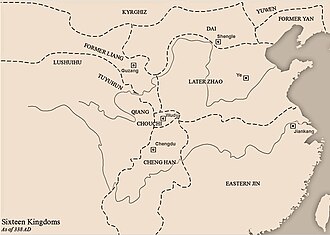
代(338年-376年)是十六国时期鲜卑拓跋部建立的政权,是北魏的前身。
魏晋时期鲜卑拓跋部原游牧于云中(今内蒙古托克托东北)一带。曹魏甘露三年(258年)大人拓跋力微徙居盛乐(今内蒙古和林格尔北),召集诸部,确立了在部落中的大酋长地位。力微卒,诸部离叛。晋元康五年(295年)力微子禄官统部,分国人为中、东、西三部,自领东部。永嘉元年(307年)禄官卒,其侄猗卢继任酋长总领三部,有骑士40余万。
永嘉之乱后五胡乱华,当时仍孤悬华北坚守晋阳的晋并州刺史刘琨经常受到鲜卑、铁弗刘虎等部落袭扰;此时猗卢与刘琨结盟,协助其击败鲜卑白部及铁弗刘虎,故刘琨与其结拜为兄弟,赠其土地并向东晋朝廷表请封猗卢为代公,后再进封代王。
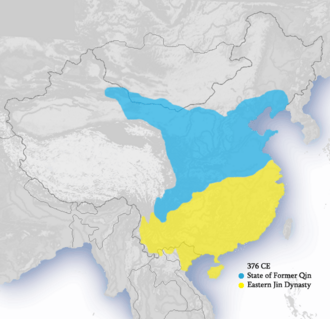
以后数代传至拓跋什翼犍。什翼犍曾为质子在后赵都襄国(今河北邢台)生活多年,深受汉文化影响。咸康四年(338年)即代王位,置百官,制法律,由部落联盟最终转变为国家形式。代建国三年(340年)定都云中盛乐城(又名石卢城),后又在故城南筑盛乐新城,发展农业。建国三十九年(376年)前秦苻坚发兵击代。什翼犍兵败奔逃后被杀。代亡。
统治地区包括今内蒙古中南部、山西北部。以其所据之地为秦朝时代郡故地,故称代王。又王室为拓跋,故又称“拓跋代”。
386年代国被拓跋珪重建,同年改国号为“魏”,史称“北魏”。
正文摘自中文维基百科「代 (十六国)」(删去了参考文献、表格和图片),按 CC BY-SA 4.0 使用
英文维基百科的更多内容
中文维基百科这一条比较短,下面是英文维基百科同一条目的节选,原文为英文,未翻译。
Dai, also rendered as Tai and sometimes known in historiography as the Tuoba Dai (Chinese: 拓跋代), was a dynastic state of China ruled by the Tuoba clan of Xianbei descent, during the era of Sixteen Kingdoms (although it is not listed as one of the 16). It existed from AD 310 to 376, with its capital at Shengle (near modern Horinger County of Hohhot, Inner Mongolia, China).
The name "Dai" originated when Tuoba Yilu was appointed the Duke of Dai (代公) by the Western Jin dynasty in 310, as a reward for helping Liu Kun, the Governor of Bingzhou (并州), fight against the Han-Zhao dynasty. The fief was later promoted from a duchy to a principality in 315. Dai was conquered in 376 by the Former Qin dynasty, and its descendants later established the Northern Wei dynasty in 386.
History
Background
In 258, the Tuoba chieftain, Tuoba Liwei led his people to occupy the abandoned Han dynasty city of Shengle in Yunzhong Commandery. At Shengle, Liwei submitted to the Cao Wei and later the Western Jin, and he began subjugating neighbouring tribes to expand his influence. Despite the Tuoba's vassalage, the Jin court was wary of their growing power. Before Liwei's death in 277, the Jin sowed discord among the Tuoba chieftains and coerced Liwei into killing his heir, Tuoba Shamohan. As a result, the Tuoba were in disarray for many years after Liwei died, and when Tuoba Luguan became chieftain in 294, he decided to split the Tuoba domain into three. Luguan retained control over the east while his nephew, Tuoba Yituo held the central and his other nephew, Tuoba Yilu ruled the west.
In 304, the tribes of the Five Divisions in Bing province rebelled and established the Han-Zhao dynasty while the Jin princes were in civil war. Though divided, the Tuoba saw the newly-formed Han state as a common threat and thus cooperated with each other to provide Jin with cavalry support against them. After Tuoba Yituo and Tuoba Luguan died in succession, Tuoba Yilu was acclaimed supreme chief and reunified the Tuoba in 307. He later formed an alliance with the Jin Inspector of Bing, Liu Kun after assisting him in putting down the rebellion of the Tiefu chieftain, Liu Hu in 310.
Reign of Tuoba Yilu
Tuoba Yilu and Liu Kun became sworn brothers, and as reward for helping him, Liu Kun petitioned the Jin court to bestow Yilu the title of Duke of Dai. The Tuoba became a vital fighting force for Jin in their war against Han, with Liu Kun being almost entirely dependent on their military strength. Shortly after attaining his fief, Yilu forced Liu Kun to grant him five counties north of the mountain ranges. In 312, after Liu Kun lost his capital, Jinyang, Yilu sent his forces to successfully reclaim it for him. For his services, the Jin court elevated Yilu's title to Prince of Dai and allowed him to grant offices to his subordinates in 315.
Yilu showed preference towards his younger son, Tuoba Biyan (拓跋比延), which upset his older son, Tuoba Liuxiu (拓跋六脩). In 316, after Liuxiu refused to take orders from his father, Yilu led his troops to punish him but was instead killed in battle. Dai was entered a state of confusion, with its people suspecting and killing one another or fleeing the state. Yilu's nephew, Tuoba Pugen managed to kill Liuxiu and proclaimed himself the new Prince of Dai, but he was unable to put an end to the crisis.
正文摘自英文维基百科(原文为英文,未翻译)「Dai (Sixteen Kingdoms)」(节选,删去了参考文献、表格和图片),按 CC BY-SA 4.0 使用;在维基百科读全文 ›
前后承接的政权
同时期、同地区的政权