史鉴
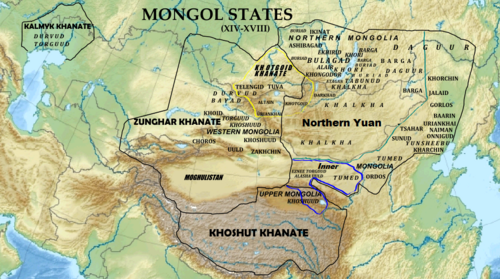
图:Khiruge · CC BY-SA 4.0 · 维基共享资源
- 存在时间
- 1650 年代—1724 年 (Wikidata 的日期只记到十年,非确切年份)
- 首都
- 拉萨市
- 政体
- 汗国
- 类型
- 汗国、历史国家
- 简述
- Tibetan kingdom from 1642-1717
和硕特汗国(蒙古语:ᠬᠣᠱᠤᠳ ᠤᠨᠬᠠᠭᠠᠨᠲᠣᠤᠯᠤᠰ,鲍培转写:Khoshuud-in qaγan-tu Ulus,西里尔字母:Хошуудын хаант улс;藏语:ཧོ་ཤོད།),是1642年卫拉特蒙古和硕特部首领固始汗在青藏高原建立的政权,从此确立了藏传佛教格鲁派(黄教)在西藏的统治。
汗国始于1642年固始汗应达赖喇嘛的邀请入藏,于1717年亡于准噶尔汗国。
详细介绍
历史
帕木竹巴政权后期,历经仁蚌巴、辛夏巴专权,藏传佛教噶举派权倾朝野,大肆打击迫害格鲁派。藏巴汗取代帕竹政权后,与青海却图汗、康巴白利土司和蒙古林丹汗组成反黄教联盟,欲将格鲁派势力彻底消除。
1634年,格鲁派的四世班禅与五世达赖邀请蒙古和硕特部首领图鲁拜琥(即后来的顾实汗)入藏。1641年,顾实汗发兵攻打藏巴汗,包围了日喀则的藏巴汗府邸。1642年,藏巴汗兵败被俘,不久遇害。顾实汗继续西进,降服了后藏地区,并亲自驻守日喀则,命其长子达延汗驻守拉萨,分兵控制西藏各地,成为实际统治西藏的汗王和格鲁派的护教法王,被清朝顺治皇帝封为“遵行文义敏慧顾实汗”。顾实汗将八个儿子留在青海,护卫汗国,史称八台吉。
1716年,准噶尔汗国出兵征服西藏,攻打拉萨。1717年,准噶尔军队攻入拉萨,杀死了和硕特汗国末任可汗拉藏汗,和硕特汗国灭亡。其后准噶尔军于1720年兵败逃出卫藏,清军经过与当地小国及部落的零星冲突之后,控制了西藏的主要地区,成为清朝治藏的开始。
正文摘自中文维基百科「和硕特汗国」(删去了参考文献、表格和图片),按 CC BY-SA 4.0 使用
英文维基百科的更多内容
中文维基百科这一条比较短,下面是英文维基百科同一条目的节选,原文为英文,未翻译。
The Khoshut Khanate was a Mongol Oirat khanate based in the Tibetan Plateau from 1642 to 1717. Based in modern Qinghai, it was founded by Güshi Khan in 1642 after defeating the opponents of the Gelug school of Tibetan Buddhism in Tibet. The 5th Dalai Lama established a civil administration known as Ganden Phodrang with the aid of Güshi Khan. The role of the khanate in the affairs of Tibet has been subject to various interpretations. Some sources claim that the Khoshut did not interfere in Tibetan affairs and had a priest and patron relationship between the khan and Dalai Lama while others claim that Güshi appointed a minister, Sonam Rapten, as de facto administrator of civil affairs while the Dalai Lama was only responsible for religious matters. Güshi Khan accepted the nominal suzerainty of the Qing dynasty in 1654, when seal of authority and golden sheets were granted by the Shunzhi Emperor. In the last years of the khanate, Lhazang Khan murdered the Tibetan regent and deposed the 6th Dalai Lama in favor of a pretender Dalai Lama.
The Khoshut Khanate was ended in 1717 when the Dzungar prince Tseren Dondup invaded Tibet, killed Lhazang Khan, and installed the 7th Dalai Lama.
History
Oirats
The Oirats were originally from the area of Tuva during the early 13th century. Their leader, Quduqa Bäki, submitted to Genghis Khan in 1208 and his house intermarried with all four branches of the Genghisid line. During the Toluid Civil War, the Four Oirat (Choros, Torghut, Dörbet, and Khoid) sided with Ariq Böke and therefore never accepted Kublaid rule. After the Yuan dynasty's collapse, the Oirats supported the Ariq Bökid Jorightu Khan Yesüder in seizing the Northern Yuan throne. The Oirats held sway over the Northern Yuan khans until the death of Esen Taishi in 1455, after which they migrated west due to Khalkha Mongol aggression. In 1486, the Oirats became embroiled in a succession dispute which gave Dayan Khan the opportunity to attack them. In the latter half of the 16th century, the Oirats lost more territory to the Tumed.
In 1620, the leaders of the Choros and Torghut Oirats, Khara Khula and Mergen Temene, attacked Ubashi Khong Tayiji, the first Altan Khan of the Khalkha. They were defeated and Khara Khula lost his wife and children to the enemy. An all out war between Ubashi Khong Tayiji and the Oirats lasted until 1623 when Ubashi Khong Tayiji was killed.
Güshi (1642-1655)
In 1625, a conflict erupted between the Oirat Khoshut Galwas chief Chöükür and his uterine brother Baibaghas over inheritance issues.……
Relationship with Tibet
The Ganden Phodrang, named after the 5th Dalai Lama's residence in Drepung Monastery, was set up as a Gelug led government of Tibet in 1642. The Khoshut Khanate played a pivotal role in its founding by defeating the enemies of the Gelug school and part of the Ganden Phodrang's military defense continued to be handled by the Mongols after its establishment. There are various interpretations of the khan's role in the government. Some sources claim that the khan had little to do with the actual administration of Tibet and maintained only a priest and patron relationship with the Dalai Lama. According to Glenn Mullin, Güshi Khan was the appointee of three Mongol chieftains to represent their interests in Tibet and after having finished his business he returned to rule in Kokonor. René Grousset says that the Khoshut realm encompassed Kokonor and the Qaidam Basin while Tibet was a protectorate. Mullin points out that at the enthronement ceremony of the 5th Dalai Lama in 1642, Güshi sat on the same level as Sonam Rapten on a seat lower than the Dalai Lama. However Mullin also claims that until the death of Sonam Rapten in 1657, the 5th Dalai Lama was a figurehead while Sonam Rapten was the de facto ruler.
Khoshut khans
Güshi Khan: 1642–1655
Dayan Khan: 1655–1668 (son)
Tenzin Dalai Khan: 1668–1696 (son)
Tenzin Wangchuk Khan: 1696–1697 (son)
Lhazang Khan: 1697–1717 (brother)
正文摘自英文维基百科(原文为英文,未翻译)「Khoshut Khanate」(节选,删去了参考文献、表格和图片),按 CC BY-SA 4.0 使用;在维基百科读全文 ›
人物
同时期、同地区的政权