史鉴
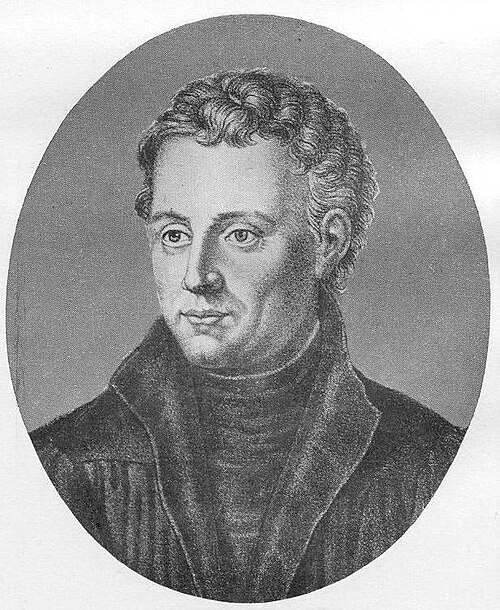
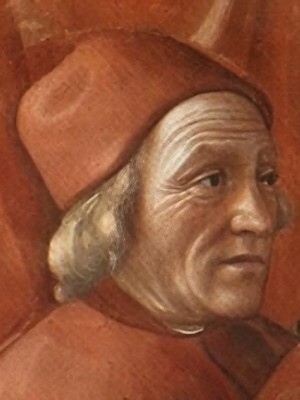
图:佚名 · Public domain · 维基共享资源
- 生卒
- 1455 年 1 月 29 日—1522 年 6 月 30 日 (日期为儒略历)
- 出生地
- 普福尔茨海姆
- 去世地
- 斯图加特
- 国籍 / 所属
- 神圣罗马帝国
- 身份
- 大学教师、哲学家、希伯来思想研究者、humanist、作家、法学家、译者、神学家
- 父亲
- Georg Reuchlin
- 母亲
- Elisabeth Eck
- 原文名
- Johannes Reuchlin
- 宗教
- 路德教会
- 就读
- 奥尔良大学、弗赖堡大学、巴塞尔大学、普瓦捷大学、Old University of Orléans
- 任职机构
- 蒂宾根大学、巴塞尔大学、因戈尔施塔特大学
- 领域
- 希伯来语学
- 流派 / 运动
- 德国文艺复兴时期
- 简述
- German humanist and scholar of Greek and Hebrew (1455-1522)
约翰内斯·罗伊希林(德语:Johannes Reuchlin,1455年1月29日—1522年6月30日),文艺复兴时期德国希伯来语、希腊语学者。他于1455年出生在普福尔茨海姆,父亲是当地圣斯蒂凡修道院的管家。他积极倡导人文主义,曾努力劝说皇帝马克西米连一世不要下令全部销毁犹太书籍和抄本。最终获得成功。
正文摘自中文维基百科「约翰内斯·罗伊希林」(删去了参考文献、表格和图片),按 CC BY-SA 4.0 使用
英文维基百科的更多内容
中文维基百科这一条比较短,下面是英文维基百科同一条目的节选,原文为英文,未翻译。
Johann Reuchlin (; German: [ˈjoːhan ˈʁɔʏçlɪn]; 29 January 1455 – 30 June 1522), sometimes called Johannes, was a German Catholic humanist and a scholar of Greek and Hebrew, whose work also took him to modern-day Austria, Switzerland, Italy, and France. Most of Reuchlin's career centered on advancing German knowledge of Greek and Hebrew.
Early life
Johann Reuchlin was born at Pforzheim in the Black Forest in 1455, where his father was an administrative officer of the Dominican monastery. According to the fashion of the time, his name was graecized by his Italian friends into Capnion (Καπνίων), a nickname which Reuchlin used as a sort of transparent mask when he introduced himself as an interlocutor in the De Verbo Mirifico. He remained fond of his home town; he constantly calls himself Phorcensis, and in the De Verbo he ascribes to Pforzheim his inclination towards literature.
Here he began his Latin studies in the monastery school, and, though in 1470 he was for a short time at Freiburg, that university seems to have taught him little. Reuchlin's career as a scholar appears to have turned almost on an accident; his fine voice gained him a place in the household of Charles I, Margrave of Baden, and soon, having some reputation as a Latinist, he was chosen to accompany Frederick, the third son of the prince, to the University of Paris.
Frederick was some years his junior, and was destined for an ecclesiastical career. This new connection did not last long, but it determined the course of Reuchlin's life.……
Teaching and writing career
At Basel, Reuchlin took his master's degree in 1477 and began to lecture, teaching a more classical Latin than was then common in German schools, and explaining Aristotle in Greek. He continued his Greek studies at Basel under Andronicus Contoblacas. In Basel he made the acquaintance of the bookseller Johann Amerbach, for whom he prepared a Latin lexicon (Vocabularius Breviloquus, 1st edition, 1475–76), which ran through many editions. This first publication, and Reuchlin's account of his teaching at Basel in a letter to Cardinal Adrian (Adriano Castellesi) in February 1518, show that he had already found his life's work. He was a born teacher, and this work was not to be done mainly from the professor's chair.
By 1477, Reuchlin had left Basel to seek further Greek training with George Hermonymus in Paris, and to learn to write a fair Greek hand that he might support himself by copying manuscripts. And now he felt that he must choose a profession. His choice fell on law, and he was thus led to the great school of Orléans (1478), and finally to Poitiers, where he became licentiate in July 1481.
Hebrew studies and advocacy
For many years Reuchlin had been increasingly absorbed in Hebrew studies, which had for him more than a mere philological interest. He was interested in the reform of preaching as shown in his De Arte Predicandi (1503) — a book that became a sort of preacher's manual — but above all, as a scholar, he was eager that the Bible should be better known, and could not tie himself to the authority of the Vulgate.
The key to the Hebraea veritas was the grammatical and exegetical tradition of the medieval rabbis, especially of David Kimhi, and when he mastered this, he was resolved to open it to others. In 1506, appeared his epoch-making De Rudimentis Hebraicis — grammar and lexicon — mainly after Kimhi, yet not a mere copy of one man's teaching. The edition was costly and sold slowly. One great difficulty was that wars in Italy prevented Hebrew Bibles from coming into Germany. But for this also Reuchlin found help by printing the Penitential Psalms with grammatical explanations (1512), and other helps followed from time to time. But his Greek studies had interested him in those fantastical and mystical systems of later times with which the Kabbala has no small affinity.……
Works
De Verbo Mirifico (The Wonder-Working Word, 1494)
De Arte Cabalistica (On the Art of Kabbalah, 1517)
正文摘自英文维基百科(原文为英文,未翻译)「Johann Reuchlin」(节选,删去了参考文献、表格和图片),按 CC BY-SA 4.0 使用;在维基百科读全文 ›
所属政权
同时代、同地区的人物




同时代、同身份的人物(思想与学术)