史鉴
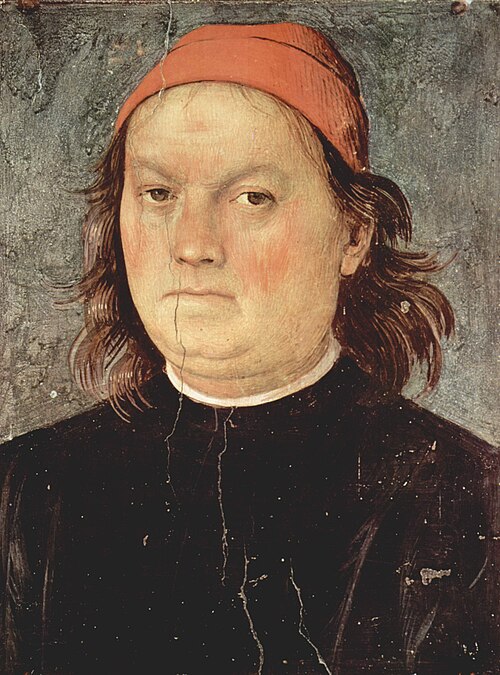
图:Pietro Perugino · Public domain · 维基共享资源
- 生卒
- 1448 年—1523 年
- 出生地
- 皮耶韦城
- 去世地
- Fontignano
- 身份
- 画家
- 代表作
- Pietà、God the Father with Two Saints、Banner of Justice、哀悼基督之死、Crucifixion of Christ with saints、San Francesco al Prato Resurrection、荣光中的圣母与圣人们、Saint Bartholomew 等 19 项
- 原文名
- Pietro Perugino
- 领域
- 绘画
- 流派 / 运动
- 文艺复兴、Umbrian school
- 死因
- 黑死病
- 简述
- Italian Renaissance painter of the Umbrian school (1448–1523)
彼得罗·佩鲁吉诺(意大利语:Pietro Perugino,意大利语:[ˈpietro peruˈdʒiːno];1446年至1452年间 – 1523年),是一位意大利文艺复兴时期的画家,活跃于文艺复兴全盛期。其最著名的学生是拉斐尔。
详细介绍
生平
佩鲁吉诺的出生名为彼得罗·万努奇(Pietro Vannucci),出生地在翁布里亚的皮耶韦城,父亲名为克里斯托弗罗·万努奇(Cristoforo Vannucci)。他们家是当地镇上最富有的家族之一。常用名和昵称“佩鲁吉诺”来自温布里亚的主要城市的佩鲁贾。 他的具体出生时间不详,基于其传记作家乔尔乔·瓦萨里和乔瓦尼·桑蒂所述,应该在1446年至1452年间。
佩鲁吉诺很有可能是在佩鲁贾开始学习绘画的,可能在巴托罗缪·卡波拉里或菲奥伦佐·迪·洛伦佐的工作室里呆过。 后来在1466/1470年,最迟到1479年前往佛罗伦萨。
佩鲁吉诺此后一度回到佩鲁贾,创作《三博士来朝》。在大约1480年时应教皇西斯都四世之召前往罗马,在西斯廷小堂绘制湿壁画,西斯廷小堂的一些著名湿壁画,例如《基督受洗》和《交钥匙》是他的作品。《交钥匙》是他完全的对透视法(La perspective)的一次练习。创作完成后再度前往佛罗伦萨。
他的最后一幅作品在1521年完成于特雷维的一座教堂中。1523年他身处丰蒂纳诺,在这里感染了黑死病,也死于此地。因为当时黑死病瘟疫蔓延,他的遗体也像其他死者一样被草草地掩埋了,具体地点未知。
正文摘自中文维基百科「彼得罗·佩鲁吉诺」(删去了参考文献、表格和图片),按 CC BY-SA 4.0 使用
英文维基百科的更多内容
中文维基百科这一条比较短,下面是英文维基百科同一条目的节选,原文为英文,未翻译。
Pietro Perugino (US: PERR-ə-JEE-noh, -oo-; Italian: [ˈpjɛːtro peruˈdʒiːno]; born Pietro Vannucci or Pietro Vanucci; c. 1446/1452 – 1523) was an Italian Renaissance painter of the Umbrian school who developed some of the qualities that found classic expression in the High Renaissance. Raphael became his most famous pupil.
Early years
Pietro Vannucci was born in Città della Pieve, Umbria, the son of Cristoforo Maria Vannucci. His nickname characterizes him as from Perugia, the chief city of Umbria. Scholars continue to dispute the socioeconomic status of the Vannucci family. While certain academics maintain that Vannucci worked his way out of poverty, others argue that his family was among the wealthiest in the town. His exact date of birth is not known, but based on his age at death that was mentioned by Vasari and Giovanni Santi, it is believed that he was born between 1446 and 1452.
Pietro most likely began studying painting in local workshops in Perugia such as those of Bartolomeo Caporali or Fiorenzo di Lorenzo. The date of the first Florentine sojourn is unknown; some make it as early as 1466–1470, others push the date to 1479.……
Rome
Perugino returned from Florence to Perugia, where his Florentine training showed in the Adoration of the Magi for the church of Santa Maria dei Servi of Perugia (c. 1476). In about 1480, he was called to Rome by Sixtus IV to paint fresco panels for the Sistine Chapel walls. The frescoes he executed there included Moses and Zipporah (often attributed to Luca Signorelli), the Baptism of Christ, and Delivery of the Keys. Pinturicchio accompanied Perugino to Rome, and was made his partner, receiving a third of the profits. He may have done some of the Zipporah subjects. The Sistine frescoes were the major high Renaissance commissions in Rome. The altar wall was also painted with the Assumption, the Nativity, and Moses in the Bulrushes. These works were later destroyed to make space for Michelangelo's Last Judgement.
Later career
In 1496, the guild of the cambio (money-changers or bankers) of Perugia asked him to decorate their audience hall, the Sala delle Udienze del Collegio del Cambio. The humanist scholar Francesco Maturanzio acted as his consultant. This extensive scheme, which may have been finished by 1500, comprised the painting of the vault, showing the seven planets and the signs of the zodiac (Perugino being responsible for the designs and his assistants most probably for the majority of the execution), and the representation on the walls of two sacred subjects: the Nativity and Transfiguration; in addition, the Eternal Father, the cardinal virtues of Justice, Prudence, Temperance, Fortitude, Cato as the emblem of wisdom, and numerous life-sized figures of classic worthies, prophets, and sibyls figured in the program.……
Monuments
Perugia dedicated an important monument to Perugino built in 1923 by the sculptor Enrico Quattrini and today visible in the Carducci Gardens.
Select works
Delivery of the Keys (1481–1482) — Fresco, 335 × 600 cm, Sistine Chapel, Vatican City
Galitzin Triptych (1480s) — painted for San Domenico at San Gimignano; National Gallery, Washington
Pietà (c. 1483–1493) — Oil on panel, 168 × 176 cm, Uffizi Gallery, Florence
Cathedral of Saint Romulus of Fiesole — altarpiece, Fiesole, Italy
Annunciation of Fano (c. 1488–1490) — Oil on panel, 212 × 172 cm, church of Santa Maria Nuova, Fano
Portrait of Lorenzo di Credi (1488) — Oil on panel transferred to canvas, National Gallery of Art, Washington, D.C.
Saint Sebastian (c. 1490) — Oil on panel, 174 × 88 cm, Nationalmuseum, Stockholm
Saint Sebastian (c. 1490–1500) — Panel, 176 × 116 cm, Louvre, Paris
Saint Sebastian (after 1490) — Oil on wood, 110 × 62 cm, Galleria Borghese, Rome
The Vision of Saint Bernard (c. 1490–1494) — Oil on wood, 173 × 170 cm, Alte Pinakothek, Munich
正文摘自英文维基百科(原文为英文,未翻译)「Pietro Perugino」(节选,删去了参考文献、表格和图片),按 CC BY-SA 4.0 使用;在维基百科读全文 ›
同时代、同地区的人物




同时代、同身份的人物(艺术与音乐)