史鉴
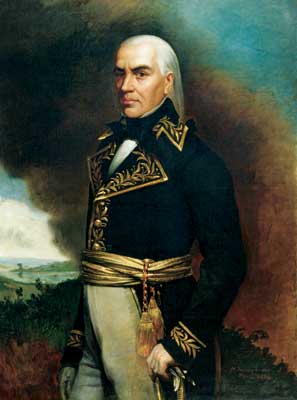
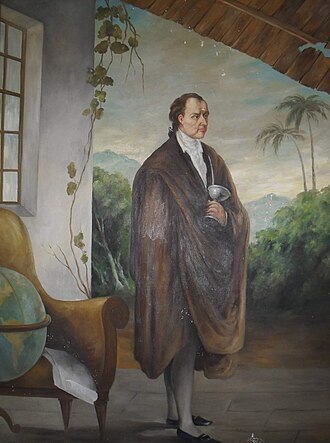
图:Martin Tovar y Tovar · Public domain · 维基共享资源
- 生卒
- 1750 年 3 月 28 日—1816 年 7 月 14 日
- 出生地
- 加拉加斯
- 去世地
- 加的斯
- 国籍 / 所属
- 西班牙、委内瑞拉
- 身份
- 作家、政治人物、译者、革命家、士兵
- 职位
- 委内瑞拉总统
- 父亲
- Sebastián de Miranda Ravelo
- 参与
- 法国大革命、委内瑞拉独立战争、美国独立战争、法国大革命、委内瑞拉独立
- 原文名
- Apodado "El Catire"、Sebastián Francisco de Miranda y Rodríguez Espinoza
- 就读
- 委内瑞拉中央财经大学
- 简述
- 委内瑞拉革命
塞巴斯蒂安·弗朗西斯科·德·米兰达·罗德里格斯·德·埃斯皮诺萨(西班牙语:Sebastián Francisco de Miranda y Rodríguez de Espinoza;1750年—1816年),一般简称为弗朗西斯科·德米兰达(Francisco de Miranda),委内瑞拉军事领导人、革命家。虽然他的西属美洲独立计划没有成功,但是他被认为是西蒙·玻利瓦尔革命的先驱者。
米兰达于1750年出生于加拉加斯的富商家庭,祖先来自加那利群岛。1771年,前往西班牙参军,1780年随军参加美国独立战争。1784年前往欧洲,游历各国为美洲革命寻求援助未果。1792年参加法国大革命。1806年起,米兰达组织革命军在委内瑞拉多地发起革命,1806年8月占领科罗,但革命最终失败,米兰达流亡伦敦。1810年4月,委内瑞拉再度爆发革命,米兰达和发动革命的玻利瓦尔等人会面,并受邀返回委内瑞拉领导革命军,授予中将军衔。7月,委内瑞拉执政府宣布委内瑞拉独立。1812年,新生的委内瑞拉共和国不敌西班牙殖民军,被迫投降,米兰达被捕入狱,1813年被押解至加的斯。1816年7月14日于狱中去世,葬于万人冢中。
正文摘自中文维基百科「弗朗西斯科·德·米兰达」(删去了参考文献、表格和图片),按 CC BY-SA 4.0 使用
英文维基百科的更多内容
中文维基百科这一条比较短,下面是英文维基百科同一条目的节选,原文为英文,未翻译。
Sebastián Francisco de Miranda y Rodríguez de Espinoza (28 March 1750 – 14 July 1816), commonly known as Francisco de Miranda (Latin American Spanish: [fɾanˈsisko ðe miˈɾanda]), was a Venezuelan military leader and revolutionary who fought in the American Revolutionary War, the French Revolution and the Spanish American wars of independence. He is regarded as a precursor of South America's liberation from the Spanish Empire, and remains known as the "First Universal Venezuelan" and the "Great Universal American".
Born in Caracas in the Viceroyalty of New Granada into a wealthy family, Miranda left to pursue an education in Madrid in 1771 and subsequently enlisted in the Spanish army.
In 1780, following Spain's entry into the American Revolutionary War, he was sent to Cuba and fought the British at Pensacola. Accused of espionage and smuggling, he fled to the United States in 1783. Miranda returned to Europe in 1785 and travelled through the continent, gradually formulating his plans for Spanish American independence. From 1791 on, he took an active part in the French Revolution, serving as a general during the Battle of Valmy and the Flanders campaign. An associate of the Girondins, he became disillusioned by the Revolution and was forced to leave for Britain.
In 1806, Miranda launched an unsuccessful expedition to liberate Venezuela with volunteers from the United States. He returned to Caracas following the outbreak of the Venezuelan War of Independence in 1810 and was granted dictatorial powers after the establishment of the First Republic. In 1812, the republic collapsed and Miranda was forced to finalize an armistice with Spanish royalists.……
Early life
Miranda was born in Caracas, Venezuela Province, in the Spanish colonial Viceroyalty of New Granada, and baptized on 5 April 1750.……
Education
Miranda's father, Sebastián, always strove to improve the situation of the family, and in addition to accumulating wealth and attaining important positions, he ensured his children an advanced education.……
Issues of ethnic lineage
Beginning in 1767, Miranda's studies were disrupted in part due to his father's rising prominence in Caracas society.……
Voyage to Spain (1771–1780)
After the court victory of his father, Miranda decided to pursue a new life in Spain, and, on 25 January 1771, Miranda left Caracas from the port of La Guaira for Cádiz, Spain, on a Swedish frigate, the Prince Frederick.……
In Madrid
On 28 March 1790 Miranda travelled to Madrid and took an interest in the libraries, architecture, and art that he found there.……
Missions in America (1781–1784)
The American Revolution
Spain became involved in the American Revolutionary War in order to expand their territories in Louisiana and Florida and to seek a recapture of Gibraltar.……
The Antilles
Miranda remained prominent while in Pensacola, and in August 1781, Cagigal secretly sent Miranda to Jamaica to arrange for the release of 900 prisoners-of-war, see to their immediate needs, and acquire auxiliary vessels for the Spanish Navy.……
In Europe (1785–1790)
Great Britain
On 15 December 1784, Miranda left the port of Boston in the merchant frigate Neptuno for London and arrived in England on 10 February 1785. While in London, Miranda was discreetly watched by the Spanish, who were suspicious of him.……
Prussia
The first secretary of the U.S.……
Sweden
Between September and December 1787 Miranda travelled through Sweden, and visited Norway.……
Miranda and the French Revolution (1791–1798)
Starting in 1791, Miranda took an active part in the French Revolution as a maréchal de camp. In Paris, he befriended the Girondins Jacques Pierre Brissot and Jérôme Pétion de Villeneuve.……
Expeditions in South America (1804–1808)
Diplomatic negotiations, 1804–1805
In 1804 with informal British help, Miranda presented a military plan to liberate the Captaincy General of Venezuela from Spanish rule. At the time, Britain was at war with Spain, an ally of Napoleon.……
Venezuela and the Caribbean, 1806
Miranda then went to Washington for private meetings with President Thomas Jefferson and Secretary of State James Madison, who met with Miranda but did not involve themselves or their nation in his plans, which would have been a violation of the Neutrality Act of 1794.……
The First Republic of Venezuela (1811–1812)
Return to Venezuela
Venezuela achieved de facto independence on Maundy Thursday 19 April 1810, when the Supreme Junta of Caracas was established and the colonial administrators deposed. The Junta sent a delegation to Great Britain to get British recognition and aid.……
Decay of the First Republic of Venezuela
Crisis of the Republic
The following year Miranda and the young Republic's fortunes turned.……
Last years (1813–1816)
Miranda never saw freedom again. He was reminded to Fort San Carlos of La Guaira, San Felipe Castle of Puerto Cabello and then to El Morro de San Juan of Puerto Rico.……
Miranda's ideals
Political beliefs
Miranda has long been associated with the struggle of the Spanish colonies in Latin America for independence. He envisioned an independent empire consisting of all the territories that had been under Spanish and Portuguese rule, stretching from the Mississippi River to Cape Horn.……
Personal life
After fighting for Revolutionary France, Miranda finally made his home in London, where he had two children, Leandro (1803 – Paris, 1886) and Francisco (1806 – Cerinza, Colombia, 1831), with his housekeeper, Sarah Andrews, whom he later married.……
正文摘自英文维基百科(原文为英文,未翻译)「Francisco de Miranda」(节选,删去了参考文献、表格和图片),按 CC BY-SA 4.0 使用;在维基百科读全文 ›
参与的事件
所属政权

同时代、同地区的人物




同时代、同身份的人物(帝王与政治)