史鉴
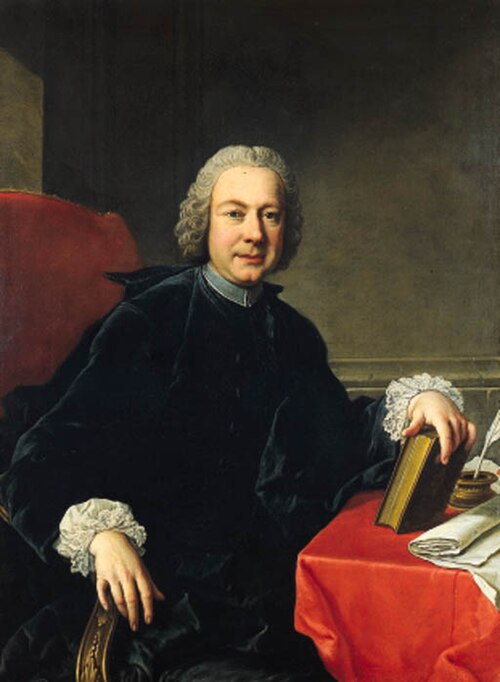
图:Attributed to Martin van Meytens / Attributed to Pompeo Batoni · Public domain · 维基共享资源
- 生卒
- 1698 年 1 月 3 日—1782 年 4 月 12 日
- 出生地
- 罗马
- 去世地
- 维也纳
- 身份
- 作家、诗人、剧作家、天主教神父、词曲作家、剧本作者
- 本名
- Pietro Antonio Domenico Bonaventura Trapassi
- 宗教
- 天主教会
- 所属组织
- 亚凯迪亚学会、秕糠学会
- 简述
- 意大利诗人、台本作家(1698-1782)
Pietro Antonio Domenico Trapassi (3 January 1698 – 12 April 1782), better known by his pseudonym of Pietro Metastasio (Italian: [ˈpjɛːtro metaˈstaːzjo]), was an Italian poet and librettist, considered the most important writer of opera seria libretti.
详细介绍
Early life
Metastasio was born in Rome, where his father, Felice Trapassi, a native of Assisi, had taken service in the Corsican regiment of the papal forces. Felice married a Bolognese woman, Francesca Galasti, and became a grocer in the Via dei Cappellari. The couple had two sons and two daughters; Pietro was the younger son.
Pietro, while still a child, is said to have attracted crowds by reciting impromptu verses on a given subject. On one such occasion in 1709, two men of distinction stopped to listen: Giovanni Vincenzo Gravina, famous for legal and literary erudition as well as his directorship of the Arcadian Academy, and Lorenzini, a critic of some note. Gravina was attracted by the boy's poetic talent and personal charm, and made Pietro his protégé; in the course of a few weeks he adopted him. Felice Trapassi was glad to give his son the chance of a good education and introduction into society.
Gravina hellenized the boy's name Trapassi into Metastasio, and intended his adopted son to be a jurist like himself. He therefore made the boy learn Latin and law. At the same time he cultivated his literary gifts, and displayed the youthful prodigy both at his own house and in the Roman coteries. Metastasio soon found himself competing with the most celebrated improvvisatori of his time in Italy. However, his days full of study and evenings devoted to improvising poetry took a toll on Pietro's health.
Roman fame
Metastasio was now twenty. During the last four years he had worn the costume of abbé, having taken the minor orders without which it was then useless to expect advancement in Rome. His romantic history, personal beauty, charming manners and distinguished talents made him fashionable. Within two years he had spent his money and increased his reputation. He decided to apply himself seriously to the work of his profession. He migrated to Naples, and entered the office of an eminent lawyer named Castagnola, who exercised severe control over his time and energies.
While slaving at the law, Metastasio in 1721 composed an epithalamium, and probably also his first musical serenade, Endimione (about Endymion), on the occasion of the marriage of his patroness Donna Anna Francesca Ravaschieri Pinelli di Sangro (later 6th Principessa di Belmonte) to the Marchese Don Antonio Pignatelli (later His Serene Highness Prince of Belmonte). In 1722, while Naples was under Austrian rule, the birthday of Empress Elisabeth Christine had to be celebrated with more than ordinary honours, and the viceroy asked Metastasio to compose a serenata for the occasion. Metastasio accepted, but kept his authorship secret. He wrote Gli orti esperidi, which was set to music by Nicola Porpora, and sung by Porpora's pupil, the castrato Farinelli, making a spectacular début, it won the most enthusiastic applause. The Roman prima donna, Marianna Bulgarelli, who played Venus in this opera, spared no pains until she had discovered its author.
Vienna
In the early summer of 1730, Metastasio settled at Vienna in an apartment in the so-called 'Michaelerhaus'. This date marks a new period in his artistic activity. Between the years 1730 and 1740 his finest dramas, Adriano in Siria, Demetrio, Issipile, Demofoonte, Olimpiade, La clemenza di Tito, Achille in Sciro, Temistocle and Attilio Regolo, were produced for the imperial theatre. Some of them had to be composed for special occasions, with almost incredible rapidity: Achille in eighteen days, Ipermestra in nine. Poet, composer, musical copyist and singer did their work together in frantic haste. Metastasio understood the technique of his peculiar art in its minutest details. The experience gained at Naples and Rome, quickened by the excitement of his new career at Vienna, enabled him almost instinctively, and as it were by inspiration, to hit the exact mark aimed at in the opera.
The libretto Adriano in Siria was used by more than 60 other composers in the 18th and early 19th century: Antonio Caldara (1732), Giovanni Battista Pergolesi (1734), Francesco Maria Veracini (1735), Baldassare Galuppi (1740), Carl Heinrich Graun (1746), Johann Adolph Hasse (1752), Johann Christian Bach (1765), Luigi Cherubini (1782) and in Adriano in Siria (Mysliveček) from 1776.
In Vienna Metastasio met with no marked social success. His plebeian birth excluded him from aristocratic circles.……
Works
The name of the first composer to set the respective text to music is indicated next to the title
正文摘自英文维基百科(原文为英文,未翻译)「Pietro Metastasio」(节选,删去了参考文献、表格和图片),按 CC BY-SA 4.0 使用;在维基百科读全文 ›
受其影响的人物
同时代、同地区的人物



同时代、同身份的人物(宗教)