史鉴

图:佚名 · Public domain · 维基共享资源
- 生卒
- 941 年—1014 年 4 月 23 日 (日期为儒略历)
- 出生地
- 基拉卢
- 去世地
- 克朗塔夫(爱尔兰)
- 国籍 / 所属
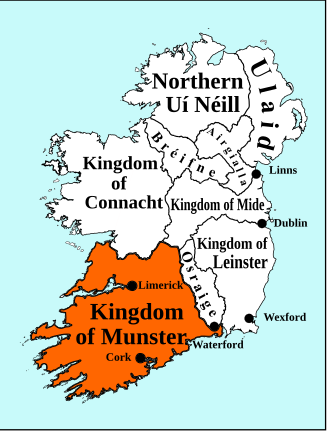
- 明斯特王国
- 职位
- 爱尔兰智尊王、King of Munster
- 父亲
- Cennétig mac Lorcáin
- 母亲
- Bé Binn inion Urchadh
- 配偶
- Gormflaith ingen Murchada、Dub Chablaigh ingen Cathal、Mor (?)、Echrad (?)
- 子女
- Donnchad mac Briain、Tadc mac Briain、Murchad mac Briain、Sláine ingen Briain、Dearbforgail (?)
- 参与
- Battle of Cathair Cuan、克朗塔夫之战、格伦麻码之战
- 原文名
- Brian Bóruma mac Cennétig
- 宗教
- 天主教
- 简述
- High King of Ireland
布莱恩·博鲁(英语:Brian Boru、古爱尔兰语:Brian Bóruma mac Cennétig、中古爱尔兰语:Brian Bóruma、现代爱尔兰语:Brian Bóramha,约941年—1014年4月23日),是一位爱尔兰至尊王。
布莱恩·博鲁一生都在四处征战,978年统一芒斯特王国全境,成为芒斯特国王。1002年推翻麦尔·舍赫奈尔·马克·多姆奈尔,自立为爱尔兰至尊王。1014年在与丹麦人的决战中被杀,但这场决战也使爱尔兰摆脱丹麦人的奴役。
正文摘自中文维基百科「布赖恩·博鲁」(删去了参考文献、表格和图片),按 CC BY-SA 4.0 使用
英文维基百科的更多内容
中文维基百科这一条比较短,下面是英文维基百科同一条目的节选,原文为英文,未翻译。
Brian Boru (Middle Irish: Brian Bóruma mac Cennétig; modern Irish: Brian Bóramha; c. 941 – 23 April 1014) was the High King of Ireland from 1002 to 1014. He ended the domination of the the High Kingship of Ireland by the Uí Néill dynasty and is responsible for ending Viking invasions of Ireland. Brian Boru is mentioned in the Annals of Inisfallen and in Chronicon Scotorum as "Brian mac Cennétig" (Brian, son of Cennétig). The name Brian of Bóruma or Brian Boru was given to him posthumously. Brian built on the achievements of his father, Cennétig mac Lorcain, and especially his elder brother, Mathgamain. Brian first made himself king of Munster, then subjugated Leinster, eventually becoming High King of Ireland. He was the founder of the O'Brien dynasty, and is widely regarded as one of the most successful and unifying monarchs in medieval Ireland.
With a population of under 500,000 people, Ireland had over 150 kings, with greater or lesser domains. The Uí Néill king Máel Sechnaill mac Domnaill, abandoned by his northern kinsmen of the Cenél nEógain and Cenél Conaill, acknowledged Brian as High King at Athlone in 1002. In the decade that followed, Brian campaigned against the northern Uí Néill, who refused to accept his claims; against Leinster, where resistance was frequent; and against the Norse-Gaelic Kingdom of Dublin. Brian was described in the Annals of Ulster as ardrí Gaidhel Erenn & Gall & Bretan, August iartair tuaiscirt Eorpa uile (High King of the Gaels of Ireland and the Norse foreigners and the Britons, Augustus of all north-western Europe), the only Irish king to receive that distinction in the annals.
Family background
Brian Boru was one of the twelve sons of Cennétig mac Lorcáin (d. 951), who was King of Dál gCais and king of Tuadmumu (Thomond), modern County Clare, then a sub-kingdom in the north of Munster.……
Early life
Brian was born at Kincora, his father's residence or fort in Killaloe, a town in the region of Tuadmumu. Brian's posthumous cognomen "Bóruma" (anglicised as Boru) may have referred to "Béal Bóruma", a fort north of Killaloe, where the Dál gCais held sway.……
Reign of Mathgamain
In 964, Brian's older brother, Mathgamain, claimed control over the entire province of Munster by capturing the Rock of Cashel, capital of the ancient Eóganachta, the hereditary overlords or High Kings of Munster, but who in dynastic strife and with multiple assassinations had weakened themselves to the point they were now impotent.……
Early reign in Munster
Despite the death of Mathgamain, the Dál gCais remained a powerful force. Mathgamain was succeeded as King of Thomond by Brian, who quickly proved to be as fine a commander of armies as his brother was.……
Clashes with the High King
Having established unchallenged rule over his home Province of Munster, Brian turned to extending his authority over the neighboring provinces of Leinster to the east and Connacht to the north-west.……
Struggle for Ireland
Brian made it clear that his ambitions had not been satisfied by the compromise of 997 when, in the year 1000, he led a combined Munster-Leinster-Dublin army in an attack on High King Máel Sechnaill mac Domnaill's home province of Meath.……
High kingship
Brian, then in his 60s, spent the next decade or so of his life subjugating and accepting the submissions of the last of the lesser kingdoms and regions which had not already submitted to him.……
Ulster campaigns
Ulster's geography presented a formidable challenge.……
Death
There are many accounts of how Brian was killed. Some suggest he was killed during heroic man-to-man combat, although others specify that he was not involved in the battle
due to his advanced age and frailty.……
Historical view
For the last 250 years there has been a debate among historians about Ireland's Viking age and the Battle of Clontarf. The standard, and "popular", view, is that the battle ended a war between the Irish and Vikings by which Brian Boru broke Viking power in Ireland.……
Wives and children
Brian's first wife was Mór, daughter of the king of Uí Fiachrach Aidne of Connacht. She is said to have been the mother of his sons Murchad, Conchobar and Flann.……
Family heritage
The descendants of Brian were known as the Uí Briain (O'Brien) clan, hence the surnames Ó Briain, O'Brien, O'Brian etc. O was originally Ó which in turn came from Ua, which means 'grandson or descendant' (of a named person).……
Ancestry
Ancestry of Brian Boru
Cultural heritage
Literature
Finnegans Wake (1939), by James Joyce, makes multiple references to Brian Boru and Clontarf, in neologisms typical of that book ("clontarfminded") and obscure references (e.g.……
Music
His name is remembered in the title of one of the oldest tunes in Ireland's traditional repertoire: "Brian Boru's March".……
External resources
Battle of Clontarf website produced by Trinity College Dublin Archived 2 October 2017 at the Wayback Machine
正文摘自英文维基百科(原文为英文,未翻译)「Brian Boru」(节选,删去了参考文献、表格和图片),按 CC BY-SA 4.0 使用;在维基百科读全文 ›
参与的事件
所属政权
同时代、同地区的人物