史鉴
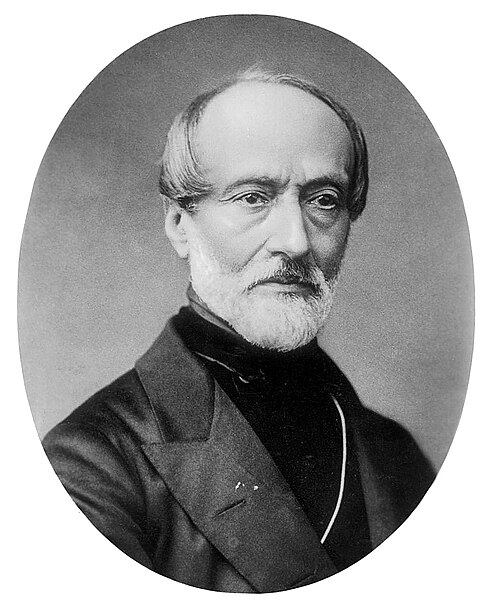
图:佚名 · Public domain · 维基共享资源
- 生卒
- 1805 年 6 月 22 日—1872 年 3 月 10 日
- 出生地
- 热那亚
- 去世地
- 比萨
- 国籍 / 所属
- 法国、意大利王国
- 身份
- 作家、律师、政治人物、法学家、新闻工作者、革命家、文学评论家、哲学家
- 职位
- member of the Chamber of Deputies of the Kingdom of Italy
- 父亲
- Giacomo Mazzini
- 母亲
- Maria Drago
- 原文名
- Giuseppe Mazzini
- 就读
- 热那亚大学
- 领域
- 新闻工作者
- 死因
- 胸膜炎
- 简述
- 意大利国族运动人物,政治家和哲学家
朱塞佩·马志尼(意大利语:Giuseppe Mazzini,意大利语发音:[dʒuˈzɛppe matˈtsiːni];1805年6月22日—1872年3月10日),意大利作家、政治家,意大利统一运动的重要人物,出生于热那亚。
1830年,马志尼加入秘密革命组织烧炭党。1831年,他前往马赛,在那里创立意大利青年党。此党的座右铭是“天主与人民”,并提出“恢复古罗马光荣”的口号,基本信念是将意大利半岛上的数个国家统一成为单一的共和国,为真正自由的意大利奠基。他从未接受君主制,因此在意大利统一之后继续为建立民主及共和制而努力。他所带领的政治运动后来成为意大利共和党,一直到今天还存在。
他的政治思想被称为马志尼主义。他著有《论人的责任》。
正文摘自中文维基百科「朱塞佩·马志尼」(删去了参考文献、表格和图片),按 CC BY-SA 4.0 使用
英文维基百科的更多内容
中文维基百科这一条比较短,下面是英文维基百科同一条目的节选,原文为英文,未翻译。
Giuseppe Mazzini (22 June 1805 – 10 March 1872) was an Italian politician, lawyer, journalist, philosopher, and political activist who worked for the unification of Italy (Risorgimento) and was a major leader of the Italian revolutionary movement. His efforts helped bring about the independent and unified Italy in place of the several separate states, many dominated by foreign powers, that existed until the 19th century. An Italian nationalist in the historical radical tradition and a proponent of a republicanism of social-democratic inspiration, Mazzini "helped define the European movement for popular democracy in a republican state." He is widely known as the "Prophet of Italian Nationalism".
Mazzini's thoughts influenced the Italian and European republican movements, the Constitution of Italy, and Europeanism, as well as later political leaders including Benito Mussolini, who was later the Fascist leader of Italy, former U.S. President Woodrow Wilson, former U.K. Prime Minister David Lloyd George, Indian independence movement figures such as Subhas Chandra Bose, Mahatma Gandhi, Jawaharlal Nehru, and Vinayak Damodar Savarkar, the founder of Hindutva. His ideas also influenced Sun Yat-sen, former President of the Provisional Government of the Republic of China (1912–1913), and founder of the Three Principles of the People (also known as Tridemism). In addition, Giuseppe Garibaldi, one of his most devoted followers, was deeply inspired by Mazzini's revolutionary vision and later played a decisive role in the Risorgimento through his military campaigns.
However, Mazzini's methods were often criticised, as his reliance on secret revolutionary groups and uprisings led to repeated failures and repression.……
Biography
Early years
Mazzini was born in Genoa, which had recently been annexed by the First French Empire. His father Giacomo Mazzini, originally from Chiavari, was a university professor who had adhered to Jacobin ideology, while his mother Maria Drago was renowned for her beauty and religious Jansenist fervour. From a very early age, Mazzini showed good learning qualities as well as a precocious interest in politics and literature. He was admitted to university at the age of 14, graduating in law in 1826 and initially practised as a "poor man's lawyer".……
Failed insurrections
In 1831, Mazzini went to Marseille, where he became a popular figure among the Italian exiles.……
Ideology
An Italian nationalist, Mazzini was a fervent advocate of republicanism and envisioned a united, free and independent Italy. Unlike his contemporary Giuseppe Garibaldi, who was also a republican, Mazzini refused to swear an oath of allegiance to the House of Savoy until after the Capture of Rome. He and his followers were sensitive to the question of social justice, starting a dialogue with socialism, and Mazzini in particular finding many affinities with the Saint-Simonians.……
Legacy
Mazzini's socio-political thought has been referred to as Mazzinianism and his worldview as the Mazzinian conception, terms that were later used by Mussolini and Italian fascists, such as Giovanni Gentile, to describe their political ideology and spiritual conception of life.
In the first volume of his Reminiscences, Carl Schurz gives a biographical sketch of Mazzini and recalls two meetings he had with him when they were both in London in 1851. While the book 10,000 Famous Freemasons by William R.……
Works
Warfare Against (1825)
On Nationality (1852)
A Cosmopolitanism of Nations: Giuseppe Mazzini's Writings on Democracy, Nation Building, and International Relations Recchia, Stefano, and Urbinati, Nadia, editors. Princeton University Press, 2009.
Articles
"Is it Revolt or a Revolution?" in Tait's Edinburgh Magazine, June 1840, pp. 385–390
正文摘自英文维基百科(原文为英文,未翻译)「Giuseppe Mazzini」(节选,删去了参考文献、表格和图片),按 CC BY-SA 4.0 使用;在维基百科读全文 ›
受其影响的人物
所属政权

同时代、同地区的人物





同时代、同身份的人物(帝王与政治)