史鉴
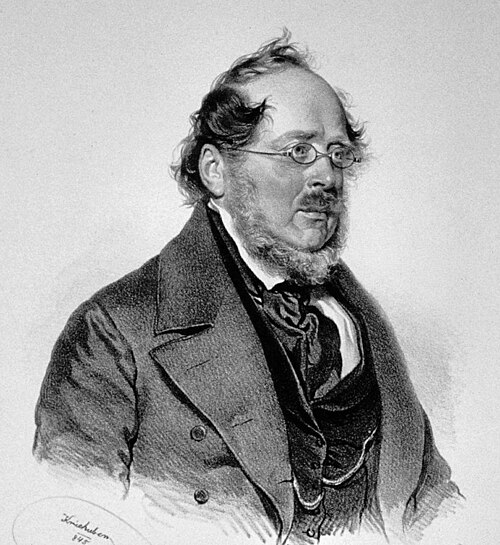
图:Josef Kriehuber · Public domain · 维基共享资源
- 生卒
- 1789 年 8 月 6 日—1846 年 11 月 30 日
- 出生地
- 罗伊特林根
- 去世地
- 库夫施泰因
- 国籍 / 所属
- 美国、符腾堡王国
- 身份
- 作家、政治人物、企业家、经济学家、外交官、商人、经济学家、大学教师
- 职位
- 国会议员
- 子女
- Caroline Hövemeyer
- 原文名
- Daniel Friedrich List
- 宗教
- 路德教会
- 就读
- Friedrich-List-Gymnasium Reutlingen
- 任职机构
- 蒂宾根大学
- 领域
- 经济
- 简述
- 德国经济学家(1789-1846)
弗里德里希·李斯特 (德语:Friedrich List,1789年8月6日—1846年11月30日),德国经济学家。他被视为经济历史学派的先驱,而他的思想亦被视为建立欧洲经济共同体的理论基础。
详细介绍
经济思想
与亚当·斯密的自由主义经济学相反,他认为国家应该在经济生活中起到重要作用。他的观点深受亚历山大·汉密尔顿以及美国学派影响。
他的主要思想包括民族国家主导的工业化和贸易保护主义。他认为国内应该实行彻底的自由贸易,而国际贸易中应该只开放自己占优势的行业,不开放弱小的、在国际竞争中不占优势的行业。保护本国工业,对原材料零关税,给工业品高关税以促进本国工业发展,等待那些工业发展壮大之后再对外开放。他以具体行动力促成德意志关税同盟,废除各邦关税,使德国经济获得统一,并对后世德国的统一产生影响。
影响
目前认为,德国和日本的工业化进程深受他的国家经济学影响。
著作
《政治经济学的国民体系》
正文摘自中文维基百科「弗里德里希·李斯特」(节选,删去了参考文献、表格和图片),按 CC BY-SA 4.0 使用;在维基百科读全文 ›
英文维基百科的更多内容
中文维基百科这一条比较短,下面是英文维基百科同一条目的节选,原文为英文,未翻译。
Daniel Friedrich List (6 August 1789 – 30 November 1846) was a German entrepreneur, diplomat, economist and political theorist who developed the nationalist theory of political economy in both Europe and the United States. He was a forefather of the German historical school of economics and argued for the Zollverein (a pan-German customs union) from a nationalist standpoint. He advocated raising tariffs on imported goods while supporting free trade of domestic goods and stated the cost of a tariff should be seen as an investment in a nation's future productivity. His theories and writing also influenced the American school of economics.
List was a political liberal who collaborated with Karl von Rotteck and Carl Theodor Welcker on the Rotteck-Welckersches Staatslexikon, an encyclopedia of political science that advocated constitutional liberalism and influenced the Vormärz. At the time in Europe, liberal and nationalist ideas were almost inseparably linked, and political liberalism was not yet attached to what was later considered economic liberalism. Emmanuel Todd considers List a forerunner to John Maynard Keynes as a theorist of "moderate or regulated capitalism."
Biography
Early life
Daniel Friedrich List was born in the free imperial city of Reutlingen in the Duchy of Württemberg. His date of birth is uncertain, but his baptism is usually given as August 6, 1789. His father, Johannes (1746–1813), was a prosperous master tanner and a city official, and his mother was Maria Magdalena (née Schäfer). Daniel Friedrich was the second son and youngest child in his family. He was educated at the town's Latin School. As an apprentice at his father's tanning business, List showed little interest in manual labor. He was apprenticed as a bureaucratic clerk at Blaubeuren.……
University professor and early advocacy for German customs union: 1817–1820
At age 23 in 1811, List was promoted to a post at Tübingen.……
Views
Nationalist view of political economy
List's theory of "national economics" differed from the doctrines of "individual economics" and "cosmopolitan economics" by Adam Smith and Jean-Baptiste Say. List argued that Smithian critiques of mercantilism were "partly correct", but argued for the need for temporary tariff protection targeted to protect specific infant industries that were critical to economic growth.
List contrasted the economic behaviour of an individual with that of a nation. An individual promotes only his own personal interests but a state fosters the welfare of all its citizens. An individual may prosper from activities which harm the interests of a nation.……
Personal life
During his time as a professor in Tübingen, List married the widow Karoline Neidhard, daughter of the poet David Christoph Seybold and sister of the writer and editor Ludwig Georg Friedrich Seybold and Major General Johann Karl Christoph von Seybold (1777–1833) in Wertheim on February 19, 1818. List received permission from the ruler and dispensation from the University of Tübingen to marry in Baden.
List had four children:
Emilie (born on December 10, 1818), who served as his secretary from 1833;
Oskar (born on February 23, 1820);
Elise (born July 1, 1822) and
Karoline, known as "Lina" (born January 20, 1829), who married history painter August Hövemeyer on March 5, 1855.
Legacy
List's principal work is entitled Das Nationale System der Politischen Ökonomie (1841) and was translated into English as The National System of Political Economy. This book has been more frequently translated than the works of any other German economist, except Karl Marx.
Before 1914, List and Marx were the two best-known German economists and theorists of development, although Marx, unlike List, devised no policies to promote economic development.
In Ireland he influenced Arthur Griffith of Sinn Féin and these theories were used by the Fianna Fáil government in the 1930s to instigate protectionism with a view to developing Irish industry.
正文摘自英文维基百科(原文为英文,未翻译)「Friedrich List」(节选,删去了参考文献、表格和图片),按 CC BY-SA 4.0 使用;在维基百科读全文 ›
所属政权

同时代、同地区的人物



同时代、同身份的人物(帝王与政治)