史鉴
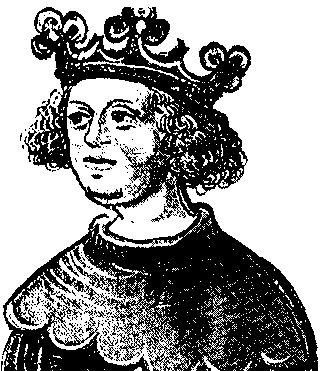
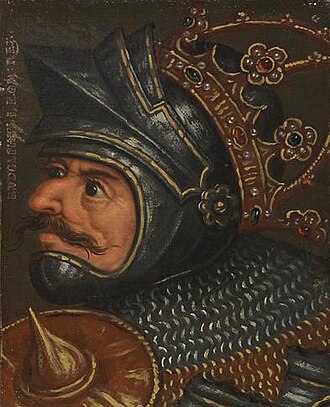
图:佚名 · Public domain · 维基共享资源
详细介绍
生平
康拉德四世是神圣罗马帝国皇帝腓特烈二世之子,母亲为耶路撒冷女王伊莎贝拉二世(或称尤兰达)。他出生于意大利阿普里亚地区巴里省的安德里亚。康拉德四世的母亲在他出生一周左右就由于产褥热去世(卒于1228年5月1日)。
在他的父皇腓特烈二世于1235年最后一次前往德国,并且废除了其叛乱的长子亨利的继承权后,7岁的康拉德代替兄长成为罗马人民的国王人选。1237年2月,还是个孩子的康拉德在维也纳被选为罗马人民的国王,似乎为了避免再一次由儿子向父亲发难的悲剧,皇帝腓特烈二世决定在死后才向他受冠。
当腓特烈二世于1250年去世时,他把西西里和德意志交给康拉德统治。年轻的国王像他父亲一样受到教皇的威胁;教廷的目标是尽一切力量把霍亨斯陶芬家族的势力逐出意大利(如果可能,也赶出德国去)。因此,康拉德四世的统治必然充满了与教皇无休无止的争斗。1251年,康拉德四世第一次入侵意大利,但没能实现清除那里的教皇支持者的目标;实际上,那是不可能的。作为报复,教皇英诺森四世废黜了他的西西里王位,并于1253年把它授予英格兰王子埃德蒙(英格兰国王亨利三世之子)。1254年,英诺森四世将康拉德四世处以绝罚,这几乎等于断送了他的政治生命。就在同年康拉德四世死于热病,而英诺森四世也去世了。他的儿子康拉丁继续了与教廷势力的斗争,直到被彻底击败并死于非命为止。
正文摘自中文维基百科「康拉德四世 (德意志国王)」(删去了参考文献、表格和图片),按 CC BY-SA 4.0 使用
英文维基百科的更多内容
中文维基百科这一条比较短,下面是英文维基百科同一条目的节选,原文为英文,未翻译。
Conrad (25 April 1228 – 21 May 1254), a member of the Hohenstaufen dynasty, was the only son of Emperor Frederick II from his second marriage with Queen Isabella II of Jerusalem. He inherited the title of King of Jerusalem (as Conrad II) upon the death of his mother in childbirth. Appointed Duke of Swabia in 1235, his father had him elected King of Germany (King of the Romans) and crowned King of Italy (as Conrad IV) in 1237. After the emperor was deposed and died in 1250, he ruled as King of Sicily (Conrad I) until his death.
Early years
He was the second child, but only surviving son of Emperor Frederick II and Isabella II (Yolanda), the queen regnant of Jerusalem. Born in Andria, in the South Italian Kingdom of Sicily, his mother died shortly after giving birth to him and he succeeded her as monarch of the Crusader state of Jerusalem. By his father, Conrad was the grandson of the Hohenstaufen emperor Henry VI and great-grandson of Emperor Frederick Barbarossa. He lived in Southern Italy until 1235, when he first visited the Kingdom of Germany. During this period his kingdom of Jerusalem, ruled by his father as regent through proxies, was racked by civil war until Conrad declared his majority and his father's regency lost its validity.
In 1235, Conrad was betrothed to a daughter of Duke Otto II of Bavaria. She died before the marriage could take place, but Conrad later married her sister.
Rise to power
When Emperor Frederick II deposed his eldest son, Conrad's rebellious half-brother King Henry (VII), Conrad succeeded him as duke of Swabia in 1235. However, the emperor was not able to have him elected King of the Romans until the 1237 Imperial Diet in Vienna. The electors were "the archbishops of Mentz [Mainz], of Treves [Trier], and of Cologne, the bishops of Bamberg, of Ratisbon [Regensburg], of Frisingen [Freising], and of Passau, the count palatine of the Rhine, the duke of Bavaria, the king of Bohemia, the landgrave of Thuringia, and the duke of Carinthia". This title, though not acknowledged by Pope Gregory IX, presumed his future as a Holy Roman emperor. Prince-Archbishop Siegfried III of Mainz, in his capacity as German archchancellor, acted as regent for the minor until 1242, when Frederick chose Landgrave Henry Raspe of Thuringia, and King Wenceslaus I of Bohemia to assume this function. Conrad intervened directly in German politics from around 1240. He led the short-lived anti-Mongol crusade of 1241.
However, when Pope Innocent IV excommunicated Frederick in 1245 and declared Conrad deposed, Henry Raspe supported the pope and was in turn elected as a rival king of Germany on 22 May 1246. Henry Raspe defeated Conrad in the battle on the Nidda in August 1246.……
Italian Campaign
When Frederick II died in 1250, he passed Sicily and Germany, as well as the title of King of Jerusalem, to Conrad, but the struggle with the pope continued. After reverses in Germany in 1251, Conrad decided to invade Italy, hoping to regain the rich dominions of his father, and where his half-brother Manfred was acting as regent. In January 1252 he invaded Apulia with a Venetian fleet, successfully managing to restrain Manfred and exercise control of the country. That same year Conrad issued constitutions during the hoftag in Foggia, which were based on the well-known examples from Norman and early Staufer times. After the death of Frederick II, riots began in parts of the kingdom of Sicily and several cities attempted to escape the royal control, forcing Conrad to take military action in order to suppress the revolts. In October 1253 his troops conquered Naples. Steadily, Conrad consolidated his position in the kingdom and the formidable centralized government fashioned by his father continued to function effectively. New historical sources have shown, Conrad tried to reconcile with the pope, but no agreement was reached.
The pope offered Sicily to Edmund Crouchback, son of Henry III of England, in 1253. Conrad was excommunicated on 9 April 1254.……
正文摘自英文维基百科(原文为英文,未翻译)「Conrad IV of Germany」(节选,删去了参考文献、表格和图片),按 CC BY-SA 4.0 使用;在维基百科读全文 ›
亲属


同时代、同地区的人物





同时代、同身份的人物(帝王与政治)