史鉴
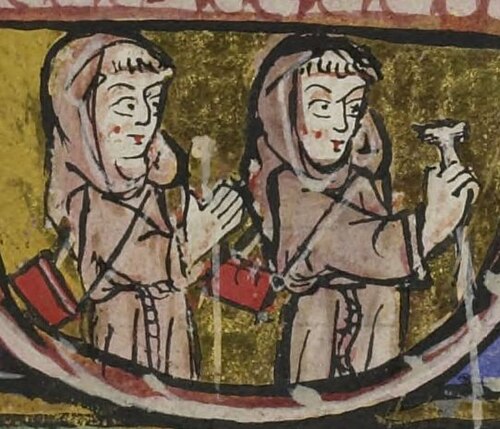
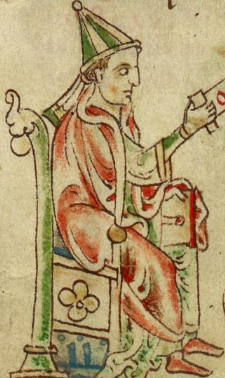
图:佚名 · Public domain · 维基共享资源
- 生卒
- 1220 年—1290 年代 (Wikidata 的生卒只记到十年,非确切年份)
- 出生地
- 吕布鲁克
- 国籍 / 所属
- 法兰西王国
- 身份
- 作家、外交官、传教士、东方学家、神职人员、游记作家、特命全权公使、探险家
- 参与
- 第七次十字军东征
- 代表作
- The Journey of William of Rubruk to the Eastern Parts
- 原文名
- Willem van Rubroeck
- 宗教
- 天主教会
- 简述
- Flemish Franciscan missionary and explorer
鲁不鲁乞(Rubruquis,约1220年-约1293年),全名纪尧姆·德·卢布鲁克(法语:Guillaume de Rubrouck/Rubroeck),法国方济各会教士,1252年曾受法国国王路易九世派遣出使蒙古帝国,抵达其首都哈拉和林并见到蒙古大汗蒙哥。著有《鲁不鲁乞东游记》。他的游记和马可波罗的游记,启发了英国人约翰·曼德维尔创作《约翰·曼德维尔爵士航海及旅行记》,唤起了西方人对东方的向往。
鲁不鲁乞是欧洲第四次正式派往蒙古帝国的使者。在他之前,还有1245年的柏郎嘉宾和阿思凌·隆巴儿底,以及1249年的安德·龙如美。
详细介绍
生平
卢布鲁克生平不详。从其名字看来,可能生于法属佛兰德卡塞勒附近的吕布鲁克。他是法国国王路易九世的朋友,1248年仲夏,鲁不鲁乞与率十字军东征的国王同行,并到达塞浦路斯境内。期间,路易九世风闻蒙古帝国成吉思汗的一位后裔、钦察汗拔都之子撒里答刚刚归化基督教,故而派遣鲁布鲁克前往蒙古传教;1253年5月7日,鲁布鲁克从君士坦丁堡启程,先是造访了钦察汗国,接着前至当时蒙古帝国的首都哈拉和林会见蒙古大汗蒙哥。
正文摘自中文维基百科「鲁不鲁乞」(删去了参考文献、表格和图片),按 CC BY-SA 4.0 使用
英文维基百科的更多内容
中文维基百科这一条比较短,下面是英文维基百科同一条目的节选,原文为英文,未翻译。
William of Rubruck or Rubrouck (fl. 1248–1257) was a Franciscan friar who, with the support of Louis IX of France, undertook a mission to the Great Khan Möngke of the Mongol Empire. On his return, William wrote his Itinerarium, an account addressed to King Louis, detailing his experiences and observations.
William was born likely in the 1210s or 1220s in Rubrouck in the County of Flanders of the Kingdom of France, and died, according to sources, in the 1270s or after 1293. He is known for his travels to various parts of the Middle East and Central Asia in the 13th century, including the Mongol Empire.
He traveled to Mongolia in 1253–1254, thus preceding the journeys of Marco Polo and Odoric of Pordenone. He visited Karakorum, the capital of the empire, and provided some descriptions of it. Upon his return, unable to meet the King of France in person, he wrote him a long letter in Latin recounting his journey through the Mongol Empire.
His account of his travels is one of the masterpieces of medieval travel literature, comparable to those of Marco Polo and Ibn Battuta, as well as an essential historical source. However, it never attained the popularity of Marco Polo's book.
Mission
William was born in Rubrouck, County of Flanders, Kingdom of France. In 1248, he accompanied King Louis IX of France, on the Seventh Crusade. On 7 May 1253, on Louis' orders, he set out on a missionary journey to convert the Tatars to Christianity. He first stopped in Constantinople to confer with Baldwin of Hainaut, who had recently returned from a trip to Karakorum, the capital of the Mongol Empire, on behalf of Baldwin II, Latin Emperor. There, William received letters to some of the Tatar chiefs from the emperor.
William then followed the route of the first journey of the Hungarian Friar Julian, and in Asia that of the Italian Friar Giovanni da Pian del Carpine.……
Travels
After reaching the Crimean town of Sudak, William continued his trek with oxen and carts. Nine days after crossing the Don, he met Sartaq Khan, next ruler of the Kipchak Khanate. The Khan sent William on to his father, Batu Khan, at Sarai near the Volga River. Five weeks later, after the departure from Sudak, he reached the encampment of Batu Khan, Mongol ruler of the Kipchak Khanate and Volga River region. William is said to have taken an aggressive approach with Batu, promising him eternal damnation and everlasting fire should he not convert. Batu was offended by William's preaching and reportedly saw it as a threat.……
Account
On his return, William presented to King Louis IX a very clear and precise report, entitled Itinerarium fratris Willielmi de Rubruquis de ordine fratrum Minorum, Galli, Anno gratiae 1253 ad partes Orientales. William's report is divided into 40 chapters. Chapters 1–10 relate general observations about the Mongols and their customs, while chapters 11–40 give an account of the course and the events of William's voyage. He showed a great facility with language, noting the similarities between those he encountered and those European languages he already knew.
In the report, he described the peculiarities of the Mongol Empire as well as many geographical observations.……
Editions
The Latin text of an incomplete manuscript containing only the first 26 chapters, together with an English translation by Richard Hakluyt, was published in 1599. A critical edition of the complete Latin text prepared by the French historian Francisque Michel and the English antiquarian Thomas Wright was published in 1839. An English translation by William Woodville Rockhill, The Journey of William of Rubruk to the Eastern Parts, was published by the Hakluyt Society in 1900, and an updated translation by Peter Jackson in 1990. Jackson's translation is based on the critical edition by Anastasius Van den Wyngaert that was published in 1929.
正文摘自英文维基百科(原文为英文,未翻译)「William of Rubruck」(节选,删去了参考文献、表格和图片),按 CC BY-SA 4.0 使用;在维基百科读全文 ›
参与的事件
- 第七次十字军东征1248 年—1254 年 · 其他事件 · 非洲
所属政权

同时代、同地区的人物






同时代、同身份的人物(帝王与政治)